Chatbots improve ecommerce customer service by providing instant, consistent support at key moments across the shopping journey. They resolve common questions during browsing, checkout, and post-purchase stages while escalating complex issues to human agents. The methods below explain how this improves service quality without disrupting the customer experience.
Instant Support
Instant support is the primary way chatbots improve ecommerce customer experience. Online shoppers expect answers the moment questions appear. When support is unavailable or slow, uncertainty increases and shoppers leave.
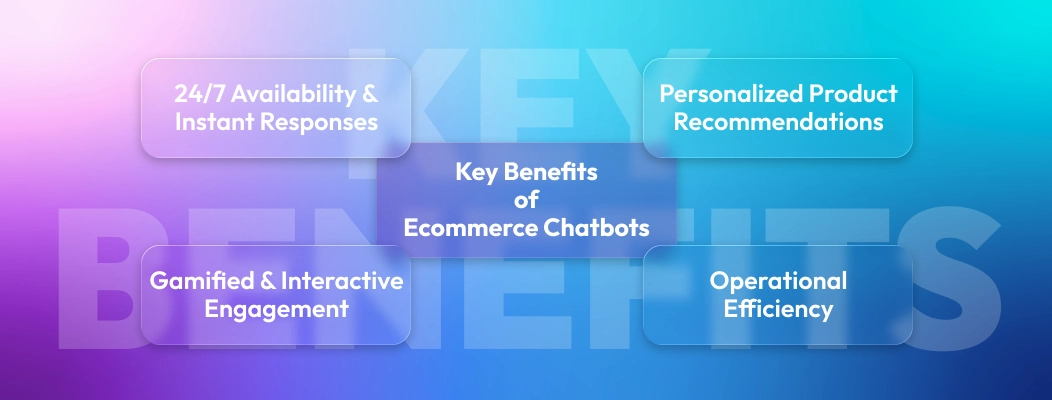
Chatbots provide immediate responses to common questions such as product details, shipping timelines, return policies, stock availability, and order status. This support is especially important outside business hours, when live agents are unavailable. By removing waiting time, chatbots prevent frustration and keep shoppers engaged throughout browsing and checkout.
Instant answers keep shoppers inside the purchase flow by resolving questions before they interrupt browsing or checkout to seek help elsewhere.
Reduced Operational Costs
Reduced operational costs are achieved when chatbots handle high-volume, low-risk customer queries without reducing service quality. These include order tracking, delivery updates, return instructions, payment confirmation questions, and policy explanations.
By handling these requests automatically, chatbots reduce ticket volume and agent workload. Support teams can then focus on complex, emotional, or high-risk issues that require empathy and decision-making. This allows support teams to reserve human attention for issues that require judgment, exceptions, or emotional handling, instead of repeating the same answers at scale.
Lower operational costs do not come from replacing human agents, but from removing repetitive work that slows teams down and creates inconsistency.
Enhanced Conversion Rates & Sales
Chatbots improve conversion rates by supporting shoppers during buying decisions rather than interrupting them. During product discovery and checkout, shoppers often hesitate due to unanswered questions or unclear comparisons.
Chatbots assist by explaining product features, highlighting differences between similar items, answering sizing or compatibility questions, and clarifying pricing or delivery details. When recommendations are based on browsing behavior or cart context, they feel helpful rather than promotional.
This shortens the time between product evaluation and checkout by removing unanswered comparison and compatibility questions that commonly delay purchases.
Chatbots increase conversions by preventing interruption during decision-making. When shoppers leave a product or checkout page to search for answers, many do not return. By resolving comparison, pricing, and policy questions in place, chatbots keep customers inside the purchase flow and shorten the time between evaluation and checkout.
Improved Customer Experience & Retention
Consistent and reliable support improves customer experience and long-term retention. Chatbots deliver the same accurate information across web, mobile, and messaging channels, ensuring customers do not receive conflicting answers.
When customers receive the same accurate answers regardless of device or channel, they spend less time re-explaining issues and are more likely to return to the same store for future purchases. When shoppers know they can get help easily at any stage, they are more likely to return for future purchases.
Multilingual support further improves accessibility for global audiences, making customers feel understood and supported regardless of location.
Seamless Human Hand-off
A seamless human hand-off is critical to protecting customer trust. Chatbots should escalate conversations when issues involve complaints, payment failures, damaged orders, refund disputes, or emotional frustration.
When escalation happens, the full conversation history should transfer to the human agent. This prevents customers from repeating information and reduces frustration caused by restarting conversations.
Clear escalation rules ensure chatbots support customer experience instead of blocking it. Escalating conversations with full context prevents customers from repeating information and signals that the issue is being handled intentionally rather than passed around.
Personalize Interactions
Personalized interactions adjust chatbot responses based on observable customer context, such as current page, cart contents, and prior purchases, rather than assumptions or scripted segments.
Responses should adjust based on customer intent. First-time visitors often need reassurance and explanations. Returning customers usually want speed and efficiency. Matching responses to intent makes conversations feel relevant and respectful.
Effective personalization increases engagement, buying confidence, and satisfaction without feeling intrusive.
Automate Routine Tasks
Routine tasks such as order status checks, shipping updates, return steps, and refund timelines are predictable but important. Chatbots automate these tasks to deliver instant, accurate responses.
Automation improves response speed and availability while reducing support backlog. Customers receive timely information without waiting, which improves post-purchase experience and reduces anxiety.
By automating routine tasks, chatbots free human agents to focus on complex problems that require judgment and empathy.
Integrate Across Channels
Integrating chatbots across channels ensures customers receive consistent support as they move between website, mobile, and messaging platforms. Cross-channel integration prevents fragmented conversations by preserving context as customers move between website, mobile, and messaging platforms.
When chatbots are integrated properly, customers can start a conversation on one channel and continue on another without losing context. This continuity reduces friction and builds confidence in the brand.
Cross-channel integration ensures customer service feels unified rather than fragmented.
Monitor Performance & Feedback
Monitoring performance and feedback ensures chatbots continue to improve customer experience instead of degrading over time. Conversation logs reveal where customers struggle, abandon chats, or request human help.
Monitoring helps identify broken flows, outdated answers, and missing information. A well-maintained knowledge base ensures responses stay accurate as products, policies, and pricing change.
Regular review identifies outdated answers, broken flows, and escalation gaps before they affect real customer conversations.
Measure Key Metrics
Measuring the right metrics ensures chatbots actually improve customer experience. Key indicators include response time, resolution rate, escalation frequency, conversion impact, engagement, and customer satisfaction.
These metrics show whether chatbots are reducing friction, supporting decisions, and maintaining trust. Measurement should focus on experience outcomes, not message volume alone. That’s why performance tracking matters across conversions, escalations, and resolution quality.
Continuous measurement allows teams to refine chatbot behavior and improve results over time.


 ChatGPT
 Perplexity
 Claude


Leave a Comment
Your email address will not be published. Required fields are marked *
By submitting, you agree to receive helpful messages from Chatboq about your request. We do not sell data.