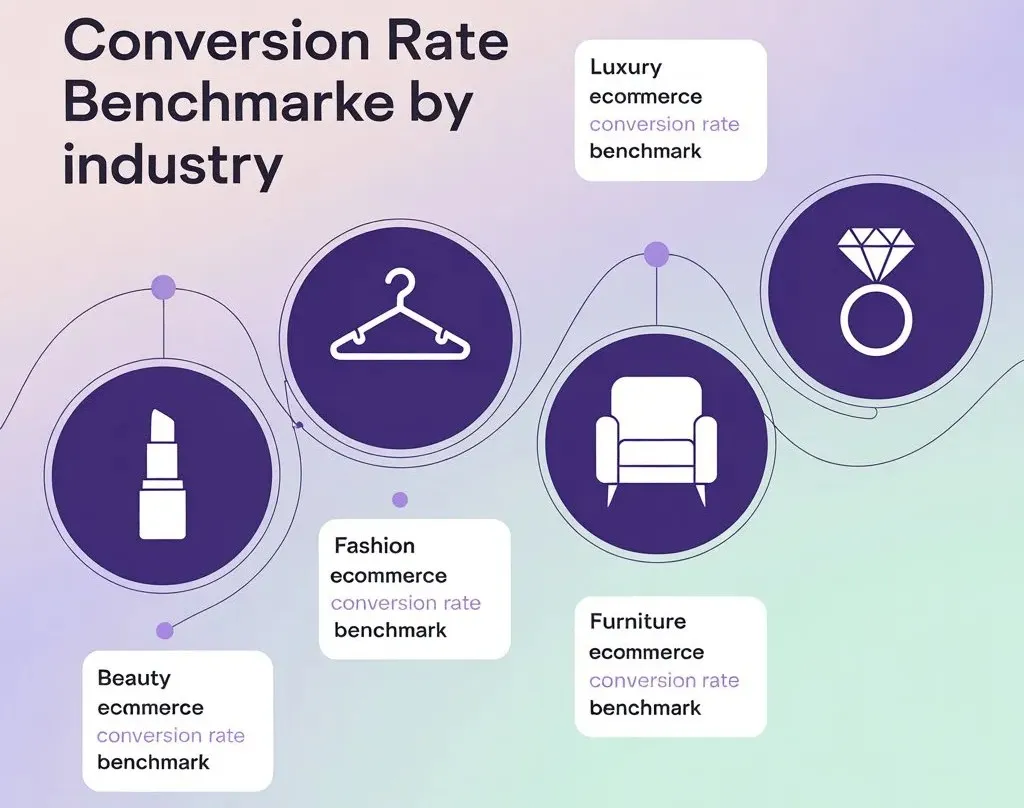
Ecommerce conversion rates vary significantly by industry, ranging from 0.9% (luxury goods) to 6.8% (beauty and personal care), reflecting differences in purchase frequency, price point, and customer decision cycles. Industries with frequent repeat purchases and lower price points consistently outperform high-ticket categories with longer consideration periods. Beauty leads conversion performance due to low-ticket impulse purchases and high repeat customer behavior.
Industry vertical remains the strongest predictor of conversion performance across all other variables. Food and beverage conversion (4.9%) reflects strong subscription and impulse purchase patterns. Electronics and appliances (3.6%) show moderate conversion driven by higher average order values requiring considered purchases. Fashion and apparel (1.9%) experience seasonal variations and style-based uncertainty. Pet care (2.3%) performs moderately due to recurring purchase needs. Home decor and furniture (1.4%) faces long decision cycles and high price points. Luxury and jewelry (0.9-1.5%) converts lowest due to high-value, low-frequency purchase behavior and inherent purchase hesitancy.
These benchmarks reflect broader ecommerce trends where average order value, buyer intent, and customer segmentation significantly influence conversion outcomes. Using industry-specific data rather than global averages enables realistic goal-setting tailored to your business model. What constitutes improvement differs by category, a 0.5% increase for luxury represents substantial progress, while the same increase for beauty signals stagnation.
Beauty Ecommerce Conversion Rate Benchmark
Beauty and personal care achieves 6.8% average conversion rate, the highest among major ecommerce categories. This performance reflects low-ticket repeat purchases, high-frequency transactions, and strong impulse buying behavior. Beauty customers typically visit multiple times annually, enabling higher conversion through loyalty programs and personalization.
Fashion Ecommerce Conversion Rate Benchmark
Fashion and apparel converts at 1.9% average rate, reflecting seasonal demand, style-based uncertainty, and high return rates. Fashion customers research extensively before purchase and often abandon carts due to sizing concerns. Improving conversion requires robust size guides, easy returns policies, and product-specific imagery.
Furniture Ecommerce Conversion Rate Benchmark
Home decor and furniture converts at 1.4% average rate, the second-lowest among major categories. Long decision cycles, high price points ($800-$3,000+), and delivery logistics create significant friction. Furniture purchasing requires room visualization and delivery scheduling, explaining extended consideration periods and lower conversion.
Luxury Ecommerce Conversion Rate Benchmark
Luxury and jewelry converts at 0.9-1.5% average rate, the lowest performing category. High-value purchases ($500-$5,000+), low purchase frequency, and buyer hesitation drive lower conversion. Luxury ecommerce requires premium customer experience, security verification, and concierge services to build confidence.


 ChatGPT
 Perplexity
 Claude





Leave a Comment
Your email address will not be published. Required fields are marked *
By submitting, you agree to receive helpful messages from Chatboq about your request. We do not sell data.