A major misunderstanding is that chatbots only store messages. In reality, many collect device identifiers, browsing activity, contact information, payment data, and behavioral tracking. This makes LLM data training privacy and chatbot data anonymization essential.
Key Statistics
A Surfshark analysis comparing ChatGPT, Google Gemini, Copilot, Meta AI, and 12 other leading apps found:
-
Many AI chatbots collect more personal data than social media apps
-
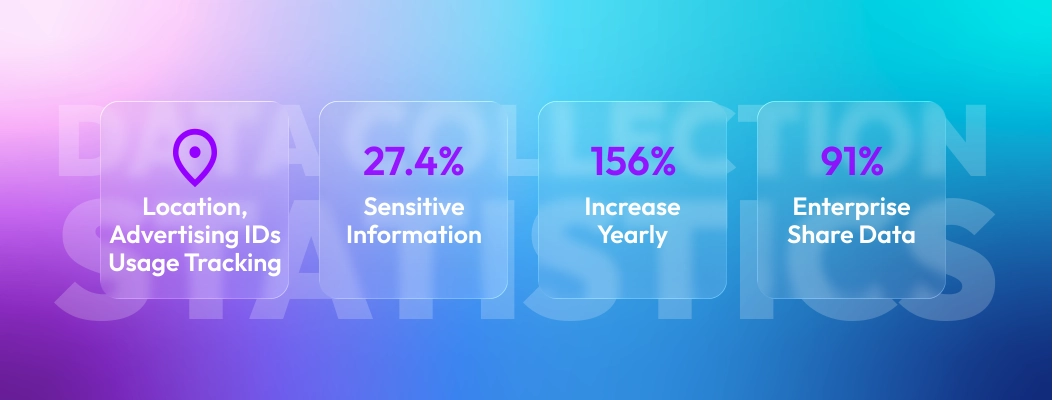
Several collect precise location, advertising IDs, and usage tracking
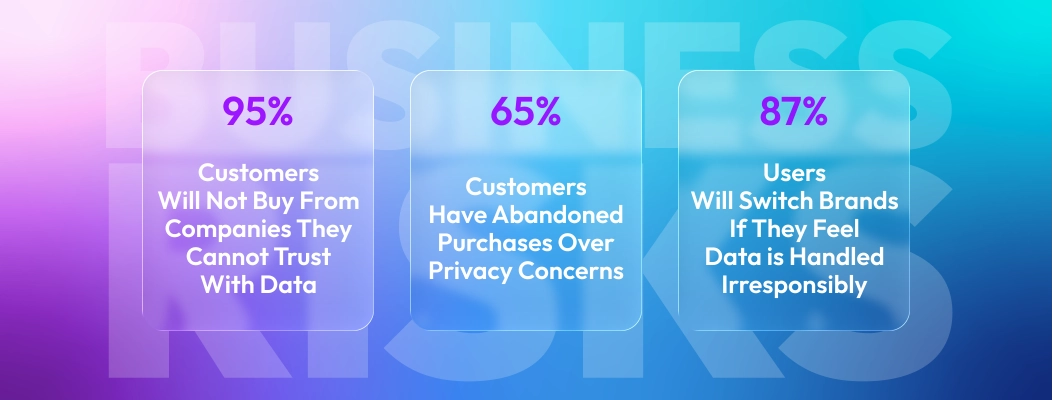
An analysis of AI input data found 27.4% of all content fed into chatbots contained sensitive information, including passwords, addresses, and financial details. That’s a 156% increase year-over-year.
Deloitte reported that 91% of enterprises using AI systems share customer data with third parties, increasing the risk of leaks and loss of control.
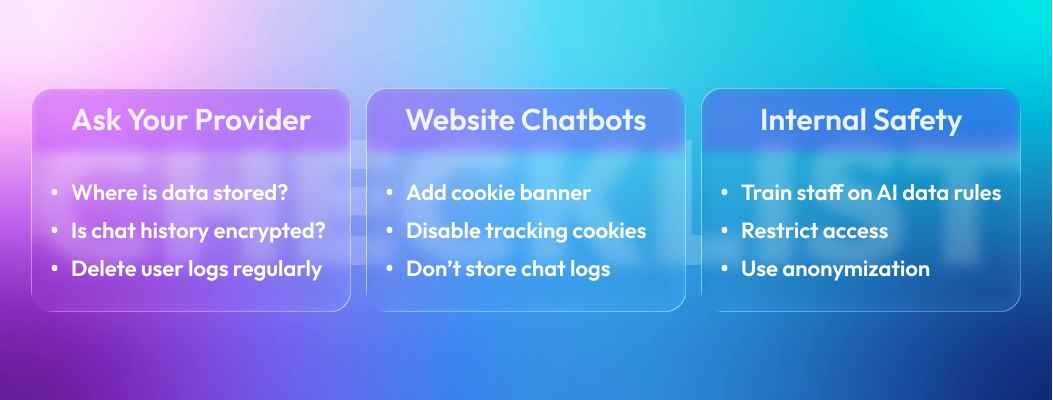
Many businesses assume chatbots delete or mask conversations, but most LLM-powered bots store chat history to improve their model training. This means customer messages can enter the model’s training data if businesses don’t enable privacy configurations, especially when using generative AI tools for automation.
What This Means for Business Owners
If your chatbot collects personal data, you are responsible under GDPR, CCPA, PDPA, and other global privacy laws. Even if a vendor built the chatbot, your business is accountable for data compliance and must adopt Zero-Trust Security and a Secure AI Framework. Recent actions like the third-party AI chatbots ban in certain regions highlight the growing regulatory scrutiny.
Do AI Chatbots Collect Data?
Yes. AI chatbots collect personal data by default, including conversation messages, device identifiers, behavioral patterns, and location data, often without explicit user consent.
Data collection occurs at two stages. First, during real-time interaction: the chatbot captures messages, metadata (email, phone, IP address), and behavioral tracking. Second, post-conversation: all six major frontier AI companies, ChatGPT, Google Gemini, Microsoft Copilot, Meta AI, Claude, and others, store conversations indefinitely and use them to train their models by default, unless users opt out.
A Surfshark analysis of ChatGPT, Gemini, Copilot, Meta AI, and 12 other chatbot applications found that many collect more personal data than social media platforms. Third-party data sharing expands collection further: chatbot providers share user information with external data brokers, analytics firms, and advertisers.
AI Chatbot Data Collection Practices Explained
Chatbots collect data through three distinct mechanisms: first-party capture during user interaction, third-party sharing with external vendors, and model training data fed into LLM improvement loops without explicit consent.
First-party data collection happens when users type messages into a chatbot. The system records the conversation plus metadata: email addresses, phone numbers, IP addresses, device identifiers, timestamps, and behavioral patterns (clicking, scrolling, pausing). Browsing history within the chat session, inferred user preferences, and location data (if the platform collects it) all enter the chatbot's data store.
Third-party data collection occurs when chatbot providers share user information with external data brokers, analytics platforms (Google Analytics, Mixpanel), advertising networks, and AI training companies. Meta's AI chatbots merge chatbot interactions with activity from Instagram, Facebook, and WhatsApp on the same account, building comprehensive user profiles. Microsoft Copilot combines chat data with Office 365, Edge browsing, and Bing search activity. This cross-platform merging creates detailed behavioral dossiers without user awareness.
Model training data collection is the most invasive. All six major frontier AI companies, OpenAI (ChatGPT), Google (Gemini), Microsoft (Copilot), Meta AI, Anthropic (Claude), and others, employ user chat conversations by default to train and improve their language models. These conversations are stored indefinitely in company systems. Some companies de-identify data (removing names and direct identifiers) before training. Others do not. Users must find and enable opt-out settings buried in account menus. When training data is collected without explicit consent, it becomes a compliance liability and reputational risk.

 ChatGPT
 Perplexity
 Claude



Leave a Comment
Your email address will not be published. Required fields are marked *
By submitting, you agree to receive helpful messages from Chatboq about your request. We do not sell data.