North America leads global chatbot market with 30.9% revenue share in 2023, followed by Europe at 28%, Asia Pacific at 22%, and emerging markets (Latin America, Middle East, Africa) at 19%, with Asia Pacific showing fastest growth at 25.4% CAGR through 2030. This geographic distribution reflects investment infrastructure maturity (North America), regulatory frameworks (Europe), mobile first adoption (Asia Pacific), and early mover advantages in developing regions.
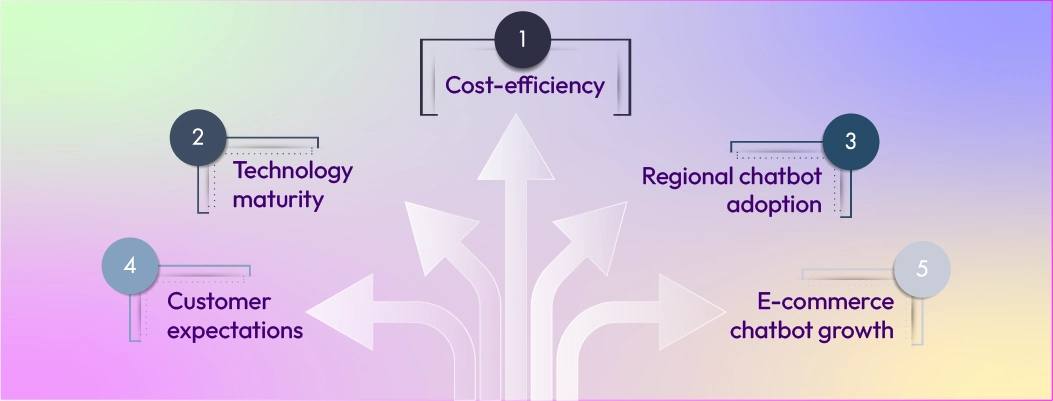
Regional chatbot adoption shows interesting patterns:
North America Chatbot Market (30.9% global share)
North America captured 30.9% of global chatbot market revenue in 2023, representing approximately USD 2.4 billion annually, with 2024 to 2025 estimates at USD 2.8 to 3.1 billion reflecting regional growth rate of 10 to 12% annually (below global average). This slower growth reflects market saturation: 89% of large enterprises already deployed chatbots, limiting new customer acquisition to mid market (71% adoption) and SME (55% adoption) segments.
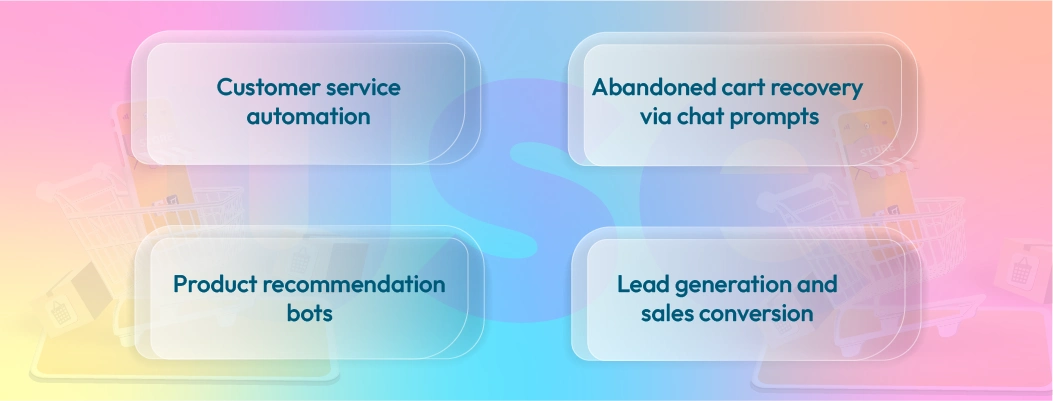
US market specifically accounts for 72% of North America revenue, with Canada 18% and Mexico 10%, establishing US dominance. Key chatbot applications in North America: ecommerce (35% of deployments), customer support (28%), lead generation (22%), internal HR (10%), and other (5%). Cloud deployment reaches 84% in North America, highest globally, reflecting enterprise preference for SaaS models.
North American chatbot buyers prioritize security and compliance above cost, with 67% of procurement decisions weighting data governance heavily, driving on premise and hybrid adoption (16%) despite lower adoption than global average.
Asia Pacific Chatbot Market (22% global share, 25.4% CAGR)
Asia Pacific represents 22% of global chatbot market in 2023, approximately USD 1.7 billion, but shows fastest growth trajectory at 25.4% CAGR through 2030, indicating the region will capture 28 to 30% of market by 2030. This growth reflects three drivers: mobile first adoption (87% of interactions occur on mobile devices, highest globally), messaging app integration (WeChat, WhatsApp, Line, Viber account for 68% of interactions versus 54% globally), and labor cost advantages (offshore chatbot development and support creates price competition benefiting regional vendors).
India specifically represents 31% of Asia Pacific market (USD 527 million in 2023), with Indonesia 18%, China 22%, and other countries 29%, establishing India as regional hub despite smaller absolute market than China. APAC adoption profile differs from West: SME adoption (58%) nearly equals enterprise adoption (64%), reflecting that smaller businesses adopt chatbots through low cost cloud platforms unavailable in early adoption phase elsewhere.
Regulation environment lighter than Western regions, enabling faster experimentation with generative AI (62% of APAC deployments use LLMs versus 48% globally in 2024).
Europe Chatbot Market (28% global share)
Europe accounts for 28% of global chatbot market revenue in 2023, approximately USD 2.17 billion annually, with growth rate of 18% CAGR (slightly below global average) constrained by GDPR compliance requirements increasing implementation costs. Germany, UK, and France combined represent 58% of European market revenue, with Germany 22%, UK 20%, France 16%, and other countries 42%.
European chatbot deployments prioritize data privacy over feature velocity: 73% of European chatbots operate on premise or hybrid infrastructure (versus 22% globally), reflecting GDPR requirements and data residency mandates.
Cloud adoption in Europe reaches only 27% (versus 78.4% globally), indicating that privacy regulation creates deployment friction absent in US and APAC markets. Enterprise adoption in Europe reaches 83% (slightly below North America's 89%), but SME adoption lags at 48% (below North America's 55%), suggesting that compliance costs disproportionately burden smaller businesses.
Key European regulations shaping chatbot deployments: GDPR Article 22 (automated decision making restrictions), ePrivacy Directive (cookie and tracking consent), and Digital Services Act (transparency requirements for algorithmic recommendations).
Emerging Markets (19% global share, High Growth Potential)
Emerging markets (Latin America, Middle East, Africa combined) represent 19% of global market in 2023, approximately USD 1.47 billion, with growth rate of 28.6% CAGR through 2030 (highest globally), indicating these regions will reach 22 to 24% of market by 2030.
Latin America leads emerging segment with 42% of revenue (USD 618 million), Middle East 28% (USD 412 million), Africa 30% (USD 440 million). Key drivers: increasing internet penetration (76% in Latin America, 71% in Middle East, 48% in Africa), rising labor costs making chatbots economically attractive for customer support, and mobile payment adoption enabling ecommerce through chat platforms.
Chatbot deployment patterns differ from developed markets: 81% of emerging market deployments target customer support (versus 28% in North America), 12% target ecommerce (versus 35% in North America), reflecting that customer support cost reduction provides urgency absent in higher wage markets.
Cloud adoption in emerging markets reaches 89% (highest globally, versus 78.4% average), reflecting lack of IT infrastructure capital for on premise deployments. Regulatory environment lighter than Western markets but evolving: India data localization requirements, Brazil LGPD (data protection law), and CCPA equivalent regulations emerging across regions.
Overall: Emerging regional markets (Latin America, the Middle East, and Africa) show strong adoption, contributing to overall growth in the chatbots market.


 ChatGPT
 Perplexity
 Claude






Leave a Comment
Your email address will not be published. Required fields are marked *
By submitting, you agree to receive helpful messages from Chatboq about your request. We do not sell data.