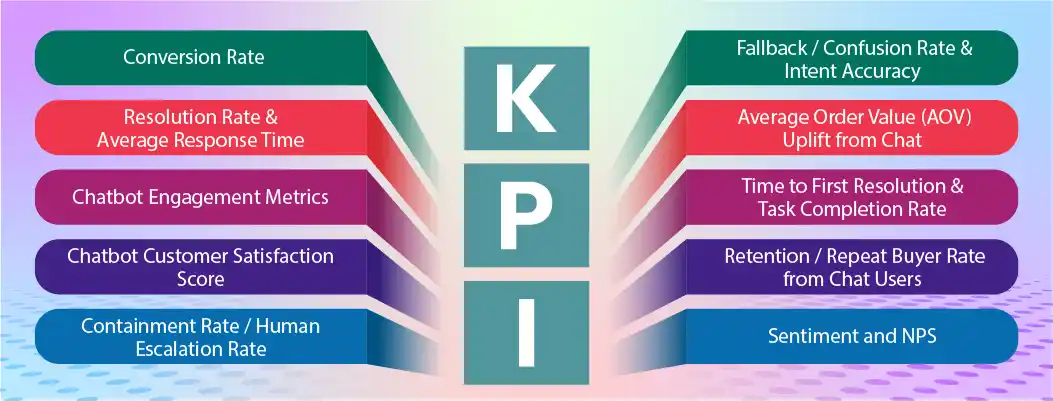
Tracking e-commerce chatbot metrics goes beyond counting conversations. These KPIs help teams measure customer value, service quality, and sales conversion. Each one below includes what it means, how to calculate it, and why it matters..
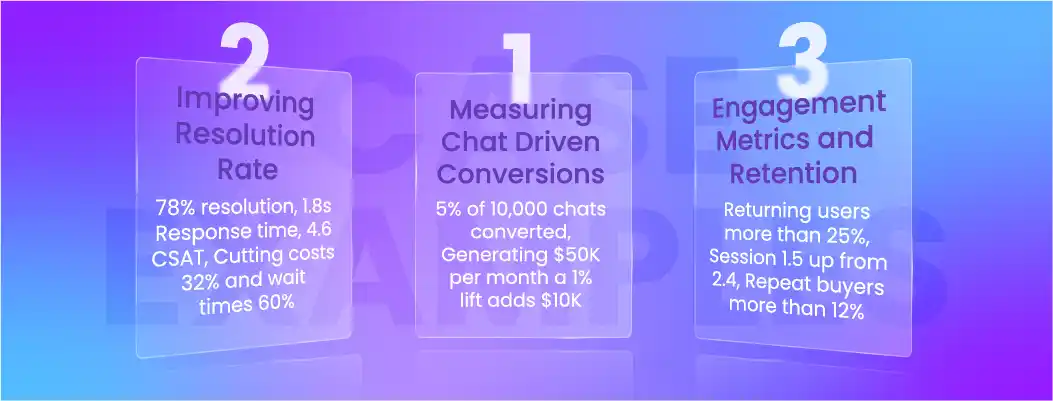
1. Conversion Rate (chat-driven purchases/conversions)
Definition:
The percentage of chat interactions that lead to a sale or key conversion event.Formula:
Conversion Rate=Chat−driven PurchasesTotal Chat Sessions×100Conversion\ Rate = \frac{Chat-driven\ Purchases}{Total\ Chat\ Sessions} \times 100Conversion Rate=Total Chat SessionsChat−driven Purchases×100
Why it matters:
E-commerce chatbot measures conversion rate in the most direct way to evaluate true lead conversion metrics and how conversations turn into revenue.
2. Resolution Rate and Average Response Time
Definition:
Resolution rate shows how many issues are solved fully by the bot. Response time reflects reply speed.
Formulas:
Why it matters:
3. Chatbot Engagement Metrics
Includes:
Session starts, active users, and messages per conversation.
Why it matters:
-
Engagement shows how much users trust and interact with your chatbot.
-
High engagement: Indicates valuable, relevant responses.
-
Falling engagement: May mean poor UX or unclear dialogue design.
Segment engagement by traffic source, device type, or returning vs. new users to find patterns.
-
Engagement shows how users interact across touchpoints, providing structured query analytics that improve chatbot optimization and performance clarity.
4. Chatbot Customer Satisfaction Score (CSAT)
Definition:
A post-chat rating that measures how satisfied users are with their chatbot experience.
Formula:
CSAT= Positive RatingsTotal Ratings×100CSAT = \frac{Positive\ Ratings}{Total\ Ratings} \times 100CSAT=Total RatingsPositive Ratings×100
Sample question:
“How satisfied were you with your chat experience?” (1-5 scale)
Why it matters:
CSAT highlights service quality and user sentiment as an early signal for customer loyalty.
5. Containment Rate / Human Escalation Rate
Definition:
Containment Rate = % of chats solved by the bot without human help.
Formula:
Containment Rate=Bot−Handled ConversationsTotal Conversations×100Containment\ Rate = \frac{Bot-Handled\ Conversations}{Total\ Conversations} \times 100Containment Rate=Total ConversationsBot−Handled Conversations×100
Impact:
A high containment rate indicates strong automation performance and scalable workflow efficiency across ecommerce operations. A rising escalation rate suggests training or intent accuracy issues.
6. Fallback / Confusion Rate and Intent Accuracy
Definition:
Fallback rate measures how often the chatbot doesn’t understand a query.
Formula:
Fallback Rate=Unrecognized MessagesTotal Messages×100Fallback\ Rate = \frac{Unrecognized\ Messages}{Total\ Messages} \times 100Fallback Rate=Total MessagesUnrecognized Messages×100
Why it matters:
Frequent fallback events mean poor NLP training. Improving intent accuracy raises customer satisfaction and reduces frustration.
7. Average Order Value (AOV) Uplift from Chat
Definition:
Measures how chat influences the amount customers spend.
Formula:
AOV Uplift=(AOVChat Users−AOVNon−Chat Users)AOV\ Uplift = (AOV_{Chat\ Users} - AOV_{Non-Chat\ Users})AOV Uplift=(AOVChat Users−AOVNon−Chat Users)
Why it matters:
8. Time to First Resolution (TTFR) and Task Completion Rate
TTFR:
Measures how quickly the bot resolves the first issue.
Task Completion Rate:
The share of users who complete intended actions (checkout, booking, or registration).
Why it matters:
Both metrics reflect smooth customer experiences that encourage repeat business.
9. Retention / Repeat Buyer Rate from Chat Users
Definition:
Percentage of returning buyers who previously interacted with the chatbot.
Formula:
Repeat Rate=Repeat Customers from ChatTotal Chat Customers×100Repeat\ Rate = \frac{Repeat\ Customers\ from\ Chat}{Total\ Chat\ Customers} \times 100Repeat Rate=Total Chat CustomersRepeat Customers from Chat×100
Why it matters:
Shows long-term customer value driven by chatbot support and personalization.
10. Sentiment and NPS
Definition:
Sentiment measures tone in messages (positive, neutral, negative). NPS (Net Promoter Score) measures loyalty.
Formula:
NPS=%Promoters−%DetractorsNPS = \%Promoters - \%DetractorsNPS=%Promoters−%Detractors
Why it matters:
Together, these reveal emotional connection and long-term trust between customers and the brand.


 ChatGPT
 Perplexity
 Claude





Leave a Comment
Your email address will not be published. Required fields are marked *
By submitting, you agree to receive helpful messages from Chatboq about your request. We do not sell data.