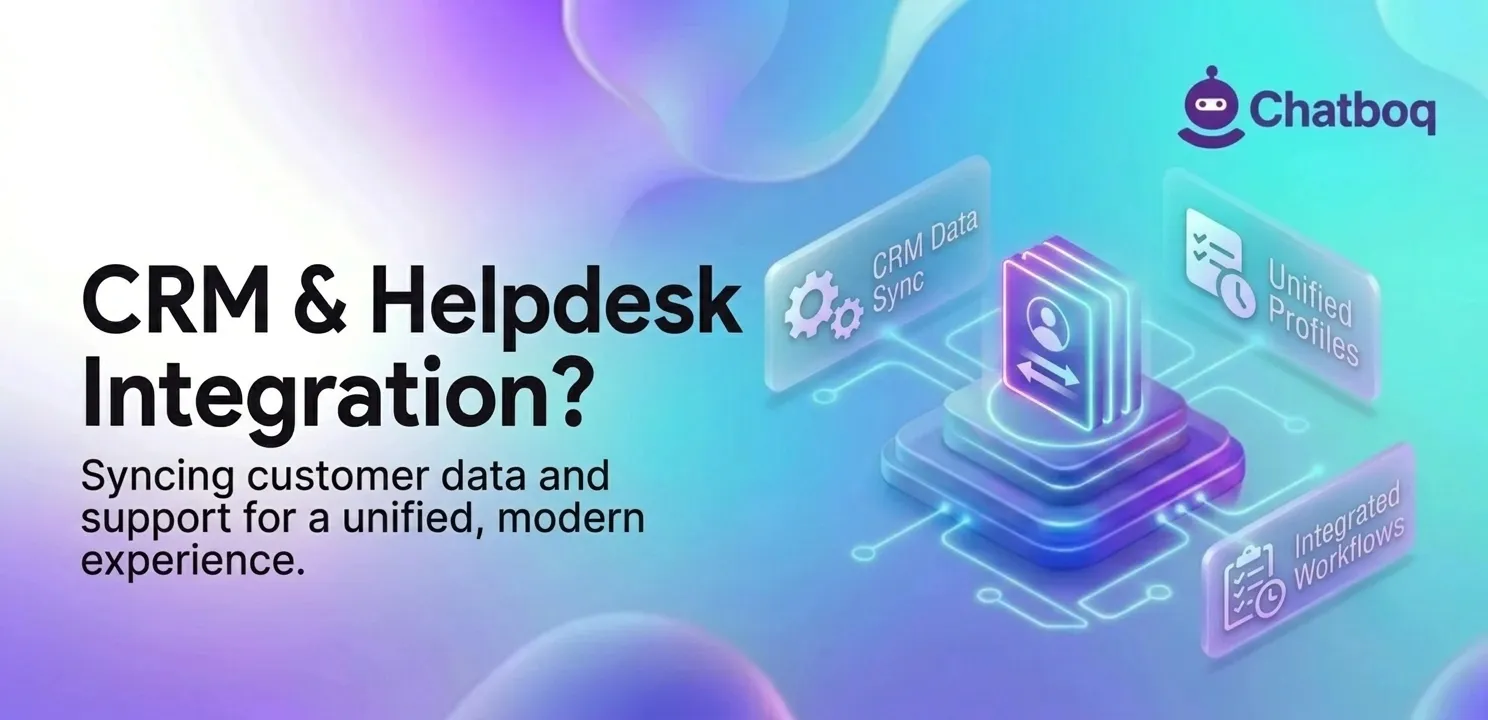
Four integration architecture types exist for connecting CRM and helpdesk systems: native unified platforms, API-based integration, marketplace plug-in integration, and custom data sync architecture. Each model differs in integration depth, flexibility, implementation cost, and maintenance overhead.
|
Integration Model
|
Setup Speed
|
Depth
|
Flexibility
|
Cost
|
|
Native unified platform
|
Fast
|
Deep
|
Low
|
Medium-High
|
|
API-based integration
|
Medium
|
High
|
High
|
Medium
|
|
Marketplace plug-in
|
Very fast
|
Shallow
|
Low
|
Low
|
|
Custom data sync
|
Slow
|
Very deep
|
Very high
|
High
|
Native Unified Platforms (All-in-One Systems)
Native unified platforms provide CRM and help desk functionality within a single product. HubSpot's CRM and Service Hub, Freshsales and Freshdesk within the Freshworks ecosystem, and Zoho CRM with Zoho Desk share a common customer data model without requiring external integration. Data flows between modules automatically without API configuration.
API-Based Integration (Best for Flexibility)
API-based integration connects separate CRM and helpdesk systems through their public APIs. Salesforce and Zendesk, for example, connect through bidirectional API sync that maps customer records, ticket events, and data fields between the two platforms. This model preserves the best-of-breed capability of each system while enabling data sharing.
iPaaS tools like MuleSoft, Workato, and Zapier manage API connections between CRM and helpdesk platforms without custom development for standard integration use cases.
Marketplace Plug-in Integration (Fast Setup, Limited Depth)
Helpdesk platforms like Zendesk and Freshdesk offer marketplace apps that provide one-click CRM connections for HubSpot, Salesforce, and Pipedrive. These plug-ins surface basic CRM data inside the helpdesk interface without full bidirectional sync. Setup takes hours rather than days. Data depth is limited to what the plug-in maps by default.
Custom Data Sync Architecture (Enterprise Use)
Enterprise organizations with complex data models and compliance requirements build custom integration layers using event-driven architecture, webhooks, and dedicated data pipeline infrastructure. Custom sync architecture enables precise control over what data syncs, in which direction, under which conditions, and with what transformation logic.
This model requires engineering resources to build and maintain. It is appropriate when the standard integration models cannot meet data fidelity, latency, or compliance requirements.

 ChatGPT
 Perplexity
 Claude


Leave a Comment
Your email address will not be published. Required fields are marked *
By submitting, you agree to receive helpful messages from Chatboq about your request. We do not sell data.