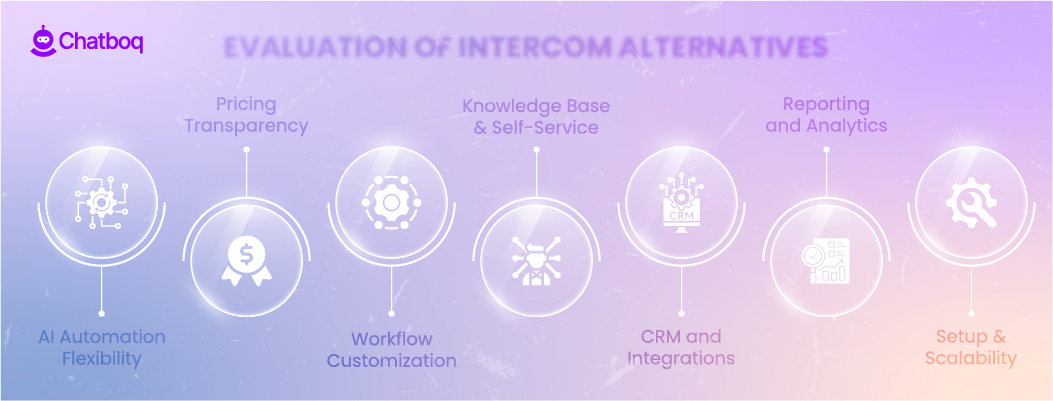
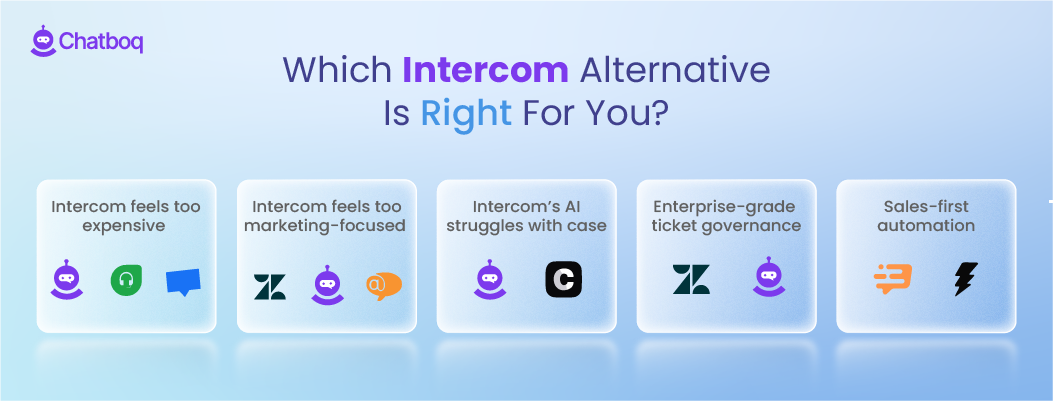
Below are the leading Intercom alternatives based on pricing structure, AI automation level, workflow flexibility, and ecommerce readiness. Each platform is evaluated against the same criteria to highlight key differences, operational tradeoffs, and suitability by team size and use case.
1. Chatboq - Intercom Alternative For All-in-One AI Chatbot & Live Chat Platform
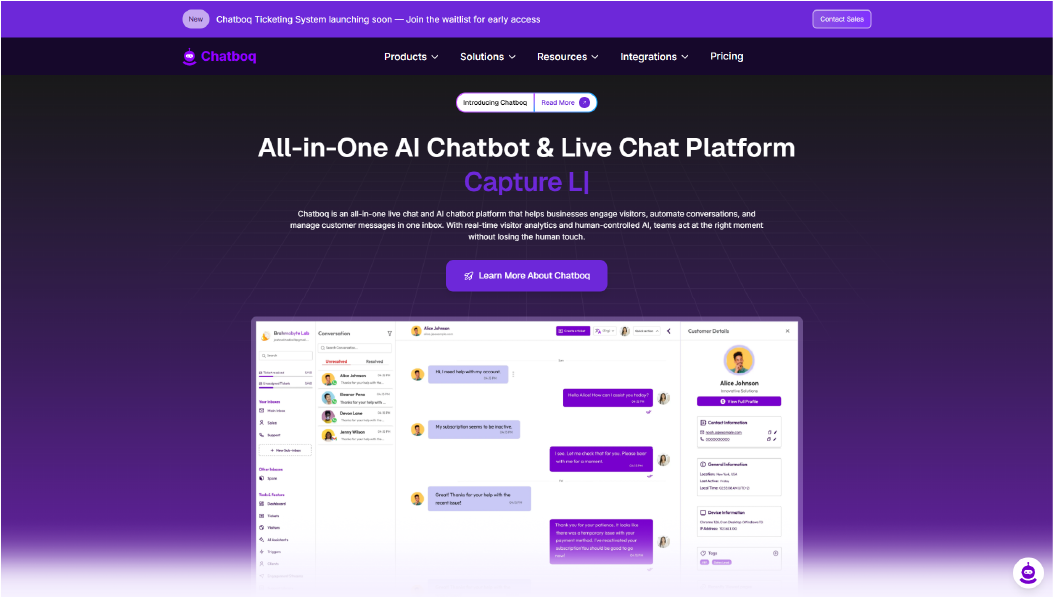
Chatboq is an all-in-one AI chatbot and live chat platform that keeps customer conversations organized and easy to manage.
Why It’s a Strong Intercom Alternative
Chatboq addresses common switching triggers from Intercom, including pricing escalation, limits in complex automation, and restricted workflow control. While Intercom performs well for general live chat and AI-based responses, Chatboq focuses on structured case handling, ticket lifecycle control, and operational stability.
For teams managing refunds, billing cases, and high-volume order workflows, Chatboq enforces SLA thresholds, structured ticket priorities, and organization-level permission controls.
Core Strengths
-
AI agent trained on knowledge base, documents, inbox history, and structured replies
-
Easy setup live chat Widget and website messaging
-
Ticket management with priority control and resolution alerts
-
Omnichannel support including email, chat, social, and voice
-
Shared inbox with agent assignment, role permissions, and workspace separation
-
Predictable tiered pricing without aggressive add-on stacking
-
Messaging integrations including WhatsApp, Messenger, Slack, Telegram, and Zoho CRM
Why Chatboq is better than Intercom
Intercom prioritizes conversational engagement and product messaging over structured help desk governance. Chatboq is structured around operational case management and SLA enforcement.
Intercom’s AI performs well for general queries but may require structured phrasing when handling edge cases like billing disputes or refund exceptions. Chatboq allows knowledge-based training with structured automation rules.
Intercom pricing often scales with contacts. Chatboq emphasizes predictable subscription tiers.
Limitations
-
Particularly strong in ecommerce environments
-
Smaller ecosystem compared to long-established enterprise platforms
-
Most teams can launch quickly, while highly customized enterprise workflows may require additional configuration.
Best For
-
Ecommerce brands handling refunds and order-based workflows
-
Teams needing SLA enforcement and structured ticket management
-
Organizations seeking predictable pricing over contact-based scaling
Pricing Snapshot
Tiered subscription model with billing transparency, invoice tracking, and structured plan upgrades.
2. Zendesk - Structured Help Desk Alternative to Intercom
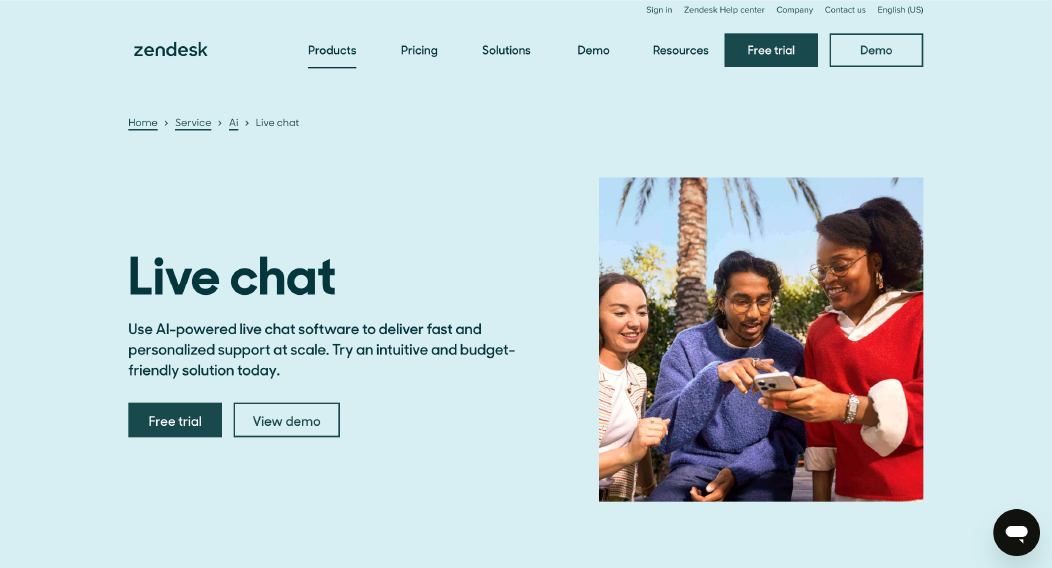
Zendesk is a customer support platform built around structured ticketing, SLA management, and large-scale support operations.
Why It’s a Strong Intercom Alternative
Teams typically move to Zendesk when conversational support is no longer enough and structured ticket lifecycle control becomes necessary. While Intercom focuses on live chat and AI-led engagement, Zendesk emphasizes structured case management, queue control, and SLA enforcement.
For teams handling high ticket volume, complex escalations, or multi-department workflows, Zendesk provides a deeper operational structure than Intercom’s shared inbox model.
Core Strengths
-
Agent-based pricing tied to team size rather than contact volume
-
Strong reporting and analytics for performance tracking
-
Broad integrations marketplace and CRM compatibility
-
Omnichannel support including email, chat, social, and voice
Why Zendesk is better than Intercom
Intercom centers on conversational support and AI-driven chat experiences. Zendesk is built around structured help desk workflows and queue-based ticket management.
Intercom pricing scales by contact volume, which increases cost as your audience grows. Zendesk’s seat-based pricing ties cost to agent count instead of contact growth, improving monthly predictability.
Zendesk provides deeper SLA enforcement and reporting control compared to Intercom’s lighter workflow structure.
Limitations
-
Setup complexity can be higher than Intercom
-
Interface may feel heavier for small teams
-
Advanced customization may require administrative oversight
Best For
Pricing Snapshot
Primarily seat-based pricing with tiered plans depending on feature access and reporting depth.
Check out the best Zendesk alternatives available on the market today.
3. Tidio - SMB-Focused Chatbot Alternative to Intercom
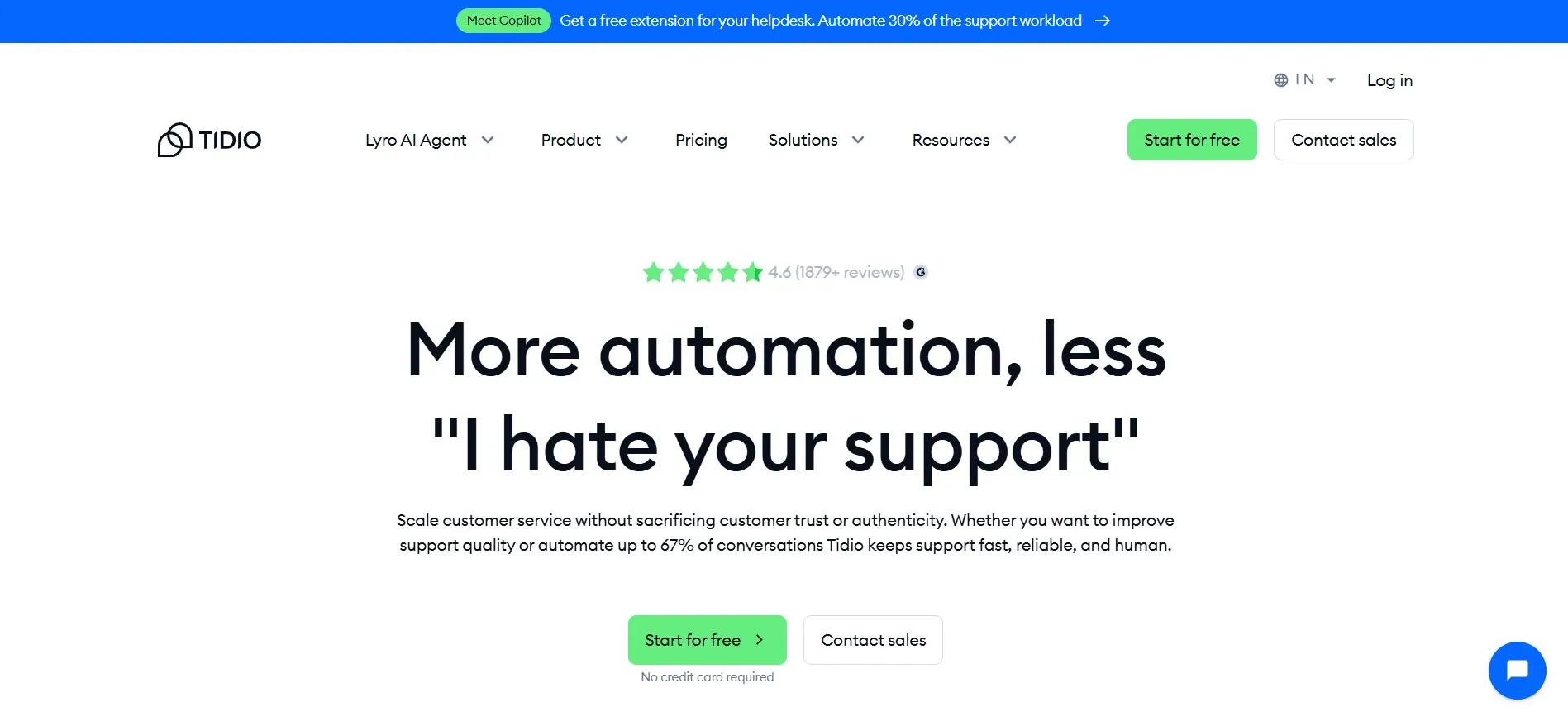
Tidio is an Intercom alternative for startups that want basic automation without contact-based pricing.
Why It’s a Strong Intercom Alternative
Startups shift to Tidio when Intercom’s contact-based pricing begins to exceed early-stage budgets. While Intercom offers advanced conversational support, its cost structure and add-ons can scale quickly. Tidio provides a simpler automation layer with more affordable starting plans.
For teams focused on basic live chat, chatbot automation, and website engagement, Tidio can replace Intercom without enterprise-level complexity.
Core Strengths
-
AI chatbot for handling common queries and basic automation workflows
-
Lower entry pricing compared to Intercom
-
Easy setup for live chat and website messaging
-
Email and messaging integrations for omnichannel support
-
Simple interface suitable for small teams
Why Tidio is better than Intercom
Intercom supports advanced conversational workflows and deeper integrations. Tidio focuses on lightweight automation and faster setup.
Intercom’s AI agent supports broader use cases, but Tidio provides a simpler chatbot model without the higher contact-based pricing impact.
Tidio does not offer the same enterprise reporting depth as Intercom.
Limitations
-
Limited advanced workflow customization
-
Reporting and analytics less detailed
-
Not designed for large enterprise SLA enforcement
Best For
Pricing Snapshot
Freemium entry tier with paid plans scaling by feature access and automation usage.
Read More : Explore the best alternatives of the Tidio available in the market.
4. Freshdesk - Scalable Help Desk Alternative to Intercom
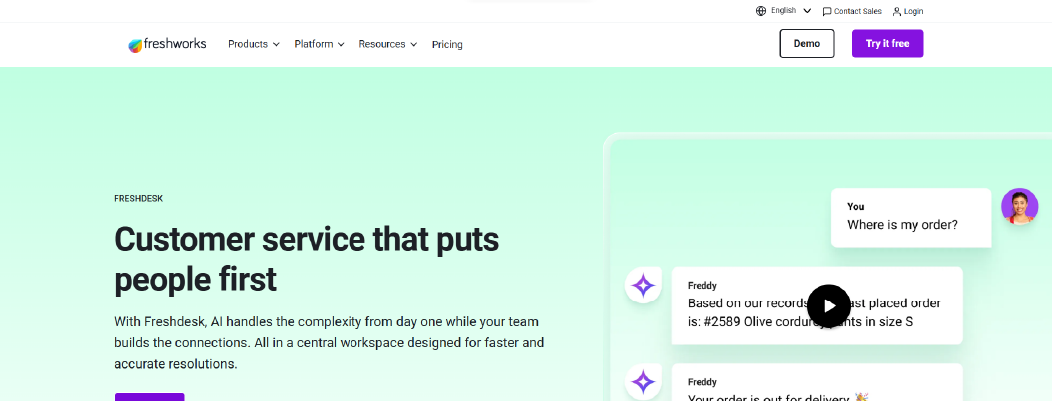
Freshdesk is a customer support platform built for structured ticket management, automation rules, and scalable support operations.
Why It’s a Strong Intercom Alternative
Freshdesk becomes relevant when teams require SLA enforcement and seat-based pricing stability. Intercom performs well for conversational support, but Freshdesk provides deeper help desk structure, SLA tracking, and queue management.
For teams handling complex support workflows, Freshdesk offers more structured case management than Intercom’s messenger-first approach.
Core Strengths
-
Robust ticketing system with SLA policies and priority rules
-
Seat-based pricing that supports predictable scaling
-
Automation rules for ticket routing and workflow management
-
Knowledge base tools for self-service support
-
Reporting and analytics for team performance tracking
Why Freshdesk is better than Intercom
Intercom centers on live chat and AI-driven conversations. Freshdesk focuses on structured ticket queues and operational workflow control.
Freshdesk provides deeper SLA enforcement and rule-based automation compared to Intercom’s lighter workflow design.
Freshdesk is less focused on conversational marketing features.
Limitations
-
Interface may require onboarding for new agents
-
AI chatbot capability may not match dedicated conversational platforms
-
Advanced Chat widget customization may require higher-tier plans
Best For
Pricing Snapshot
Seat-based tiered pricing with feature upgrades tied to plan levels.
Discover the best Freshdesk Alternatives available in the market
5. Intuit - Finance-Integrated Support Alternative to Intercom
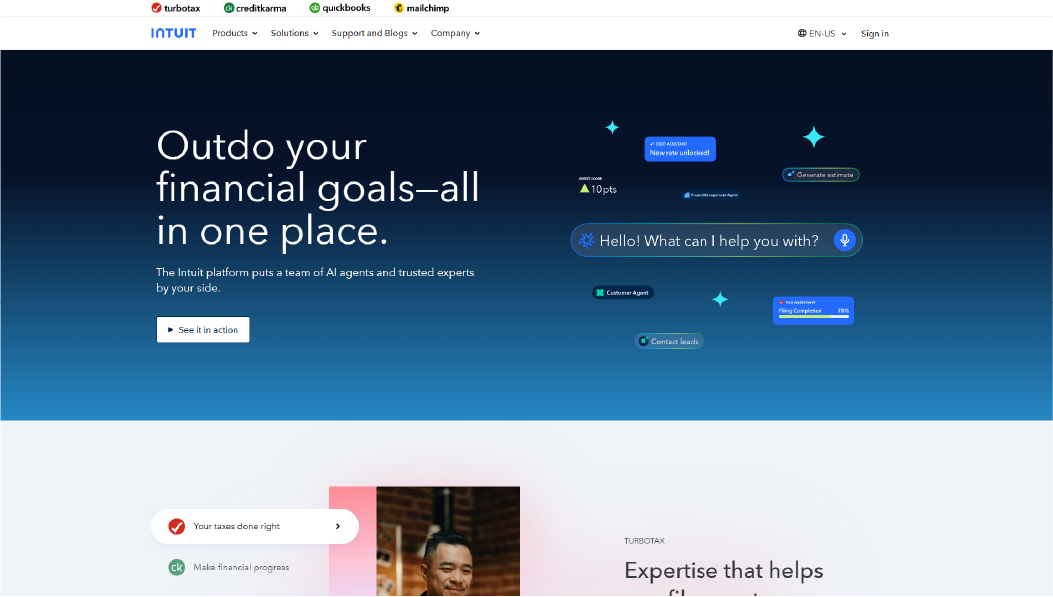
Intuit offers customer support tools integrated into its financial and accounting ecosystem, designed for businesses that manage billing, payments, and financial workflows within the same platform.
Why It’s a Strong Intercom Alternative
Intuit becomes relevant when support conversations are closely tied to billing, subscriptions, and financial records. Intercom handles conversational engagement well, but financial case management may require deeper system-level integration.
For teams managing billing disputes, payment updates, or finance-driven inquiries, Intuit’s ecosystem integration can reduce context switching compared to Intercom’s standalone messaging model.
Core Strengths
-
Native integration with accounting and financial systems
-
Structured case handling for payment-related workflows
-
Reporting aligned with financial operations
-
Predictable tier-based pricing within the Intuit ecosystem
Why Intuit is better than Intercom
Intercom focuses on conversational messaging and marketing engagement. Intuit centers on finance-integrated support workflows.
Intercom requires external integrations for deep accounting context. Intuit operates within its own financial environment.
Intuit is less focused on conversational marketing automation.
Limitations
-
Not built primarily as a conversational AI platform
-
Limited ecommerce-native integrations outside financial tools
-
May not suit teams needing advanced live chat automation
Best For
-
Finance-driven businesses
-
Teams managing billing disputes and payment workflows
-
Organizations already operating within the Intuit ecosystem
Pricing Snapshot
Tier-based pricing integrated with Intuit product plans.
6. Crisp - Affordable Omnichannel Alternative to Intercom
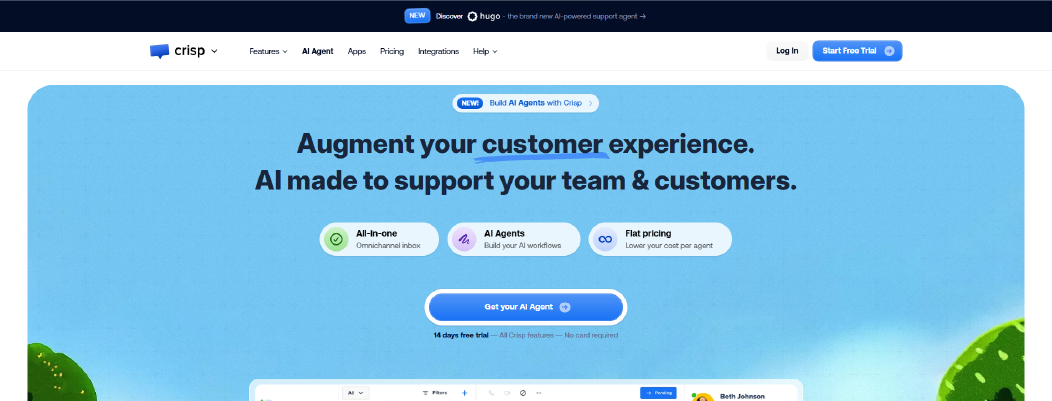
Crisp is a customer messaging and live chat platform built for small and mid-sized teams that need omnichannel support with lower pricing complexity.
Why It’s a Strong Intercom Alternative
Crisp becomes a practical option when Intercom’s pricing and add-ons exceed what small teams can sustain. Intercom supports advanced conversational support, but its contact-based pricing and add-ons can increase cost over time.
Crisp provides a simpler omnichannel inbox with more affordable entry plans, making it a practical Intercom alternative for budget-conscious teams.
Core Strengths
-
Omnichannel inbox supporting chat, email, and messaging platforms
-
Transparent tier-based pricing with lower cost entry
-
Built-in chatbot for basic automation
-
Shared inbox with conversation routing
-
Basic reporting and customer data tracking
Why Crisp is better than Intercom
Intercom offers deeper AI automation and marketing-driven workflows. Crisp focuses on affordable live chat and messaging consolidation.
Intercom’s AI agent provides broader automation capabilities. Crisp offers lighter automation suitable for small teams.
Crisp places less emphasis on advanced analytics and enterprise workflow structure.
Limitations
-
Limited advanced AI automation
-
Reporting depth not suited for enterprise SLA enforcement
-
Fewer enterprise-level integrations
Best For
-
Small and mid-sized businesses
-
Teams seeking affordable Intercom alternatives
-
Companies prioritizing omnichannel messaging over advanced automation
Pricing Snapshot
Tier-based pricing with lower starting cost compared to many Intercom plans.
7. Chatbase - AI Chatbot-Focused Alternative to Intercom
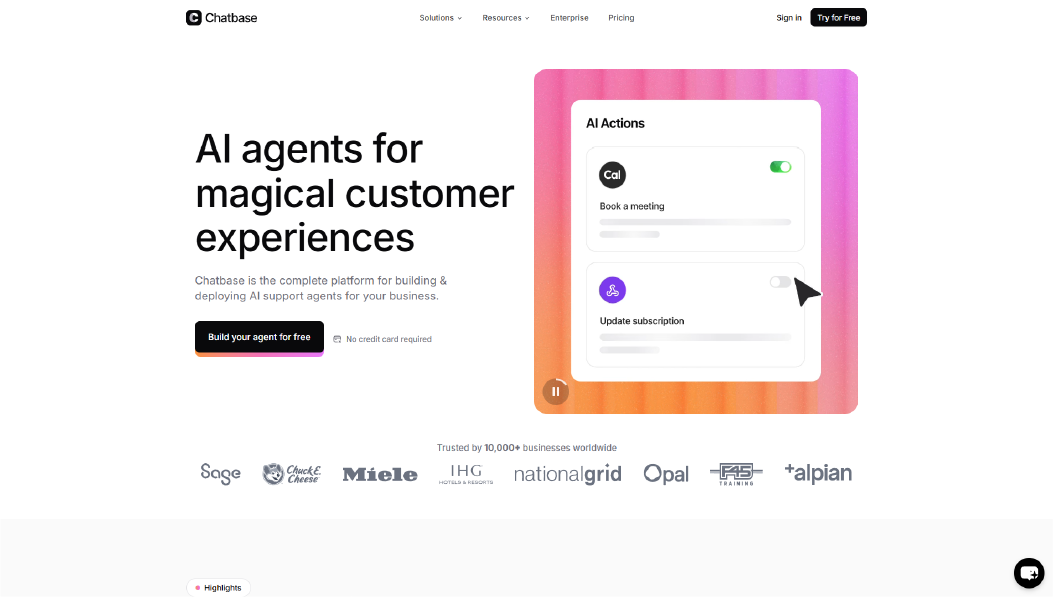
Chatbase is an AI chatbot platform designed for businesses that want to deploy AI agents trained on custom knowledge sources.
Why It’s a Strong Intercom Alternative
If you want an Intercom alternative with better AI training control, Chatbase is often shortlisted. Intercom’s Fin performs well for general queries, but review patterns show limits in complex cases and phrasing sensitivity.
Chatbase focuses on AI-first deployment, allowing businesses to train bots on documents, FAQs, and structured data. For teams prioritizing AI automation over conversational marketing tools, this makes it a relevant Intercom competitor.
Core Strengths
-
AI chatbot trained on custom documents and knowledge sources
-
Flexible deployment across websites and messaging channels
-
Usage-based pricing aligned with AI consumption
-
Fast setup for AI-driven support use cases
Why Chatbase is better than Intercom
Intercom combines conversational support, live chat, and marketing tools in one platform. Chatbase centers specifically on AI chatbot performance.
Intercom provides a broader customer support platform with shared inbox and ticketing features. Chatbase emphasizes AI training depth rather than full help desk workflows.
Chatbase may offer more direct control over AI knowledge ingestion compared to Intercom’s structured AI environment.
Limitations
-
Limited native ticketing system
-
Not designed as a full help desk replacement
-
Requires external tools for advanced SLA management
Best For
-
Businesses focused on AI chatbot deployment
-
Teams needing custom AI training control
-
Organizations prioritizing automated responses over full case management
Pricing Snapshot
Usage-based pricing tied to AI interactions and consumption volume.
8. LiveChat - Website-Focused Live Chat Alternative to Intercom
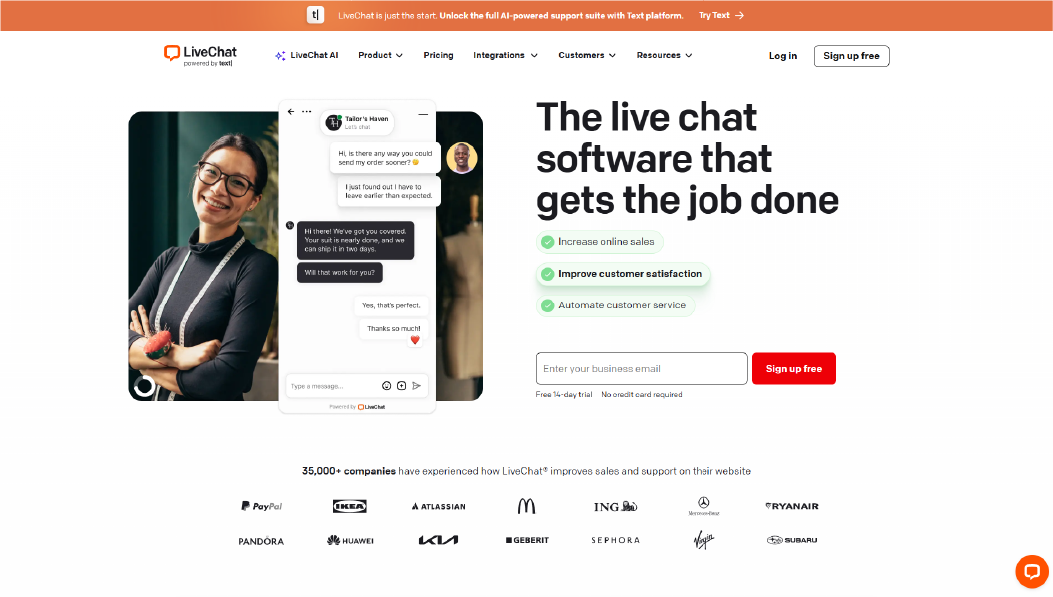
LiveChat is a live chat software platform designed to optimize real-time website conversations and agent responsiveness.
Why It’s a Strong Intercom Alternative
LiveChat is often evaluated when teams want stronger real-time chat performance without the broader marketing layer that Intercom includes. Intercom combines live chat, AI agents, and onboarding tools. LiveChat focuses specifically on live support efficiency.
For teams that prioritize fast chat routing, agent response time, and website engagement over conversational marketing workflows, LiveChat can serve as a focused Intercom competitor.
Core Strengths
-
Real-time live chat optimized for website support
-
Seat-based pricing for predictable scaling
-
Built-in ticketing conversion from chat to case
-
Reporting focused on response time and chat performance
Why LiveChat is better than Intercom
Intercom combines support chat, onboarding flows, and campaign messaging within a single conversational layer. LiveChat centers on structured live chat operations.
Intercom offers broader AI automation capabilities. LiveChat prioritizes agent-driven conversations and performance tracking.
LiveChat does not emphasize marketing automation features as heavily as Intercom.
Limitations
-
Limited advanced AI automation compared to Intercom
-
Fewer built-in marketing campaign tools
-
May require integrations for deeper workflow automation
Best For
-
Support teams focused on website live chat
-
Businesses prioritizing response time tracking
-
Teams seeking seat-based pricing stability
Pricing Snapshot
Primarily seat-based pricing with tiered plans based on feature depth.
Read more: Discover the best Livechat Alternative and choose the right one for your business.
9. LiveAgent - Multichannel Ticketing Alternative to Intercom
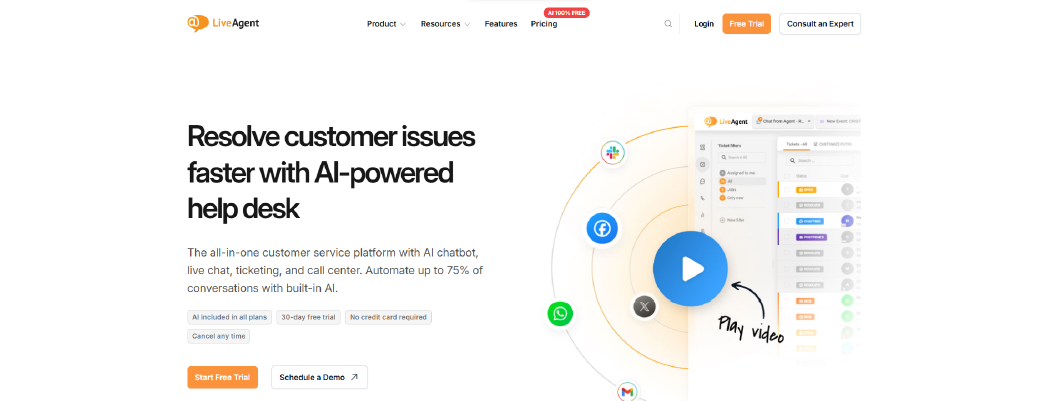
LiveAgent is a help desk and live chat platform built for structured multichannel ticket management.
Why It’s a Strong Intercom Alternative
LiveAgent is often evaluated when teams need deeper ticket lifecycle control than Intercom’s messenger-focused workflow. Intercom supports conversational support well, but LiveAgent emphasizes structured ticket queues, SLA rules, and multichannel case handling.
For teams managing email, chat, calls, and social tickets within one help desk system, LiveAgent provides stronger operational control when you need queue-based ticketing across email, chat, and voice instead of chat-first conversations.
Core Strengths
-
Unified ticketing system across email, chat, voice, and social
-
Tier-based pricing with lower entry compared to Intercom
-
Automation rules for ticket routing and assignment
-
Reporting tools for support performance tracking
Why LiveAgent is better than Intercom
Intercom prioritizes conversational AI and marketing workflows. LiveAgent centers on structured help desk operations.
Intercom’s AI agent handles automated chat flows. LiveAgent focuses more on ticket-based case management and multichannel routing.
LiveAgent offers stronger native voice support compared to Intercom’s chat-driven emphasis.
Limitations
-
AI automation not as advanced as Intercom’s Fin
-
Interface may feel traditional compared to modern chat platforms
-
Advanced customization may require higher-tier plans
Best For
-
Teams handling multichannel ticket volume
-
Support centers requiring voice integration
-
Organizations prioritizing structured help desk workflows
Pricing Snapshot
Tier-based pricing with feature access tied to plan level.
Check out the top LiveAgent alternatives and select one that best suits your business.
10. Tawk.to - Budget-Friendly Alternative to Intercom
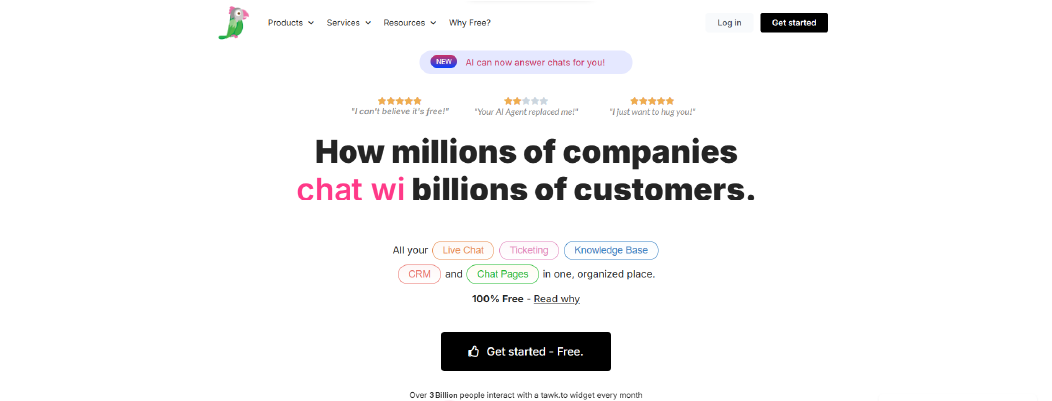
Tawk.to is a live chat software platform designed for businesses that need basic customer support functionality at minimal cost.
Why It’s a Strong Intercom Alternative
Tawk.to is commonly evaluated when Intercom pricing becomes difficult to sustain, especially for startups and small businesses. Intercom offers advanced AI and conversational support, but its contact-based pricing and feature upgrades can increase costs over time.
Tawk.to provides a low-cost entry point for teams that need simple live chat without enterprise automation layers.
Core Strengths
-
Free core live chat functionality
-
Basic ticketing and conversation management
-
Multichannel messaging support
-
Simple setup with low operational overhead
-
Paid add-ons available without complex pricing tiers
Where It Differs from Intercom
Intercom combines AI agents, marketing automation, and structured workflows. Tawk.to focuses on real-time live chat with limited automation.
Intercom provides advanced AI chatbot capability. Tawk.to prioritizes affordability over automation depth.
Tawk.to does not offer the same reporting or workflow customization level as Intercom.
Limitations
Best For
Pricing Snapshot
Free core plan with optional paid features and service add-ons.
11. Dashly - Funnel-Based Engagement Alternative to Intercom
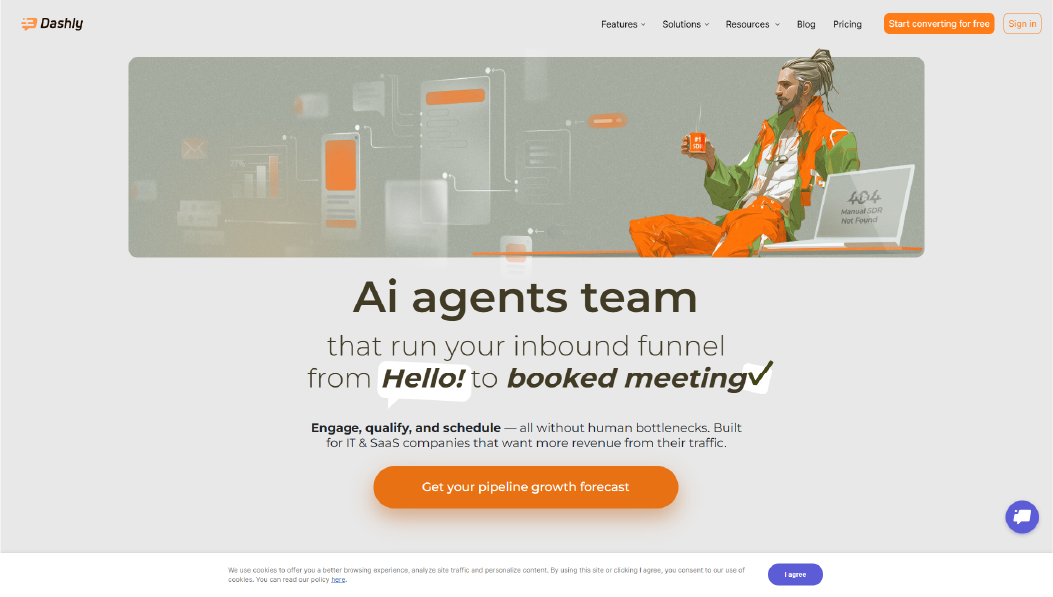
Dashly is a conversational marketing and support platform built around user journey tracking and behavior-based engagement.
Why It’s a Strong Intercom Alternative
Dashly is often evaluated when teams want behavior-driven messaging without the higher pricing complexity associated with Intercom. Intercom combines conversational support with marketing automation, but review patterns show concerns around cost scaling and workflow rigidity.
Dashly focuses on funnel tracking, visitor segmentation, and trigger-based campaigns. For teams prioritizing conversion flows and structured engagement triggers, it provides an alternative approach to Intercom’s messaging model.
Core Strengths
-
Behavior-based campaign triggers with segmentation
-
Built-in live chat and chatbot automation
-
Tier-based pricing structure
-
Integration support for CRM and marketing tools
Why Dashly is better than Intercom
Intercom blends support and product messaging with AI agents. Dashly places stronger emphasis on funnel analytics and campaign automation.
Intercom’s AI agent supports conversational workflows across support and onboarding. Dashly focuses more on conversion-driven triggers rather than structured help desk management.
Dashly may offer more granular behavioral targeting compared to Intercom’s broader messaging approach.
Limitations
-
Less structured SLA management than traditional help desk platforms
-
AI automation depth may not match dedicated AI-first tools
-
Reporting centered more on funnels than support performance metrics
Best For
Pricing Snapshot
Tier-based pricing with plan upgrades tied to feature and usage expansion.
12. Drift - B2B Conversational Sales Alternative to Intercom
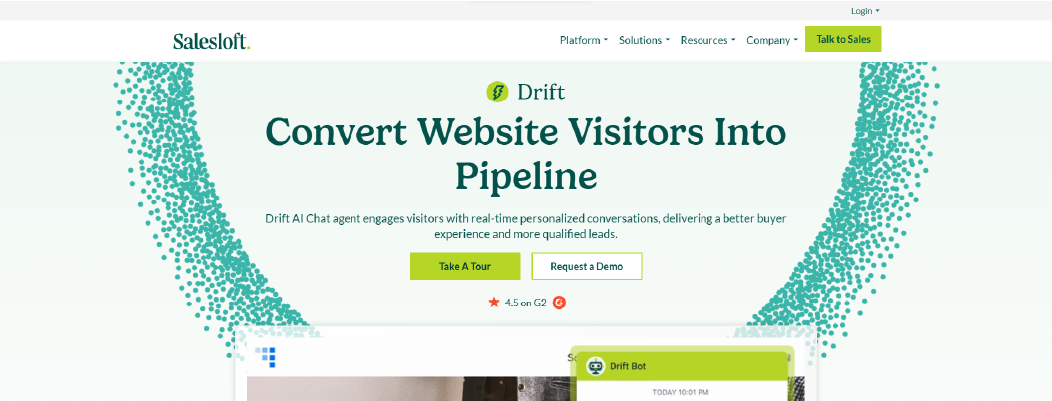
Drift is a conversational marketing and sales platform built for B2B lead qualification and pipeline acceleration.
Why It’s a Strong Intercom Alternative
Drift is often evaluated when teams use Intercom for sales conversations but require deeper lead qualification workflows. Intercom supports conversational engagement well, but Drift focuses more directly on B2B revenue operations.
For companies prioritizing sales pipeline acceleration over support ticketing, Drift provides structured bot qualification flows and meeting booking automation.
Core Strengths
-
Conversational AI designed for B2B lead qualification
-
Automated meeting scheduling and routing
-
Account-based targeting capabilities
-
CRM integrations aligned with sales workflows
-
Tier-based pricing for sales teams
Why Drift is better than Intercom
Intercom combines customer support, onboarding, and messaging in one platform. Drift centers on conversational sales rather than structured help desk operations.
Intercom’s AI agent handles support queries across workflows. Drift focuses more on qualifying leads and routing prospects to sales teams.
Drift is less focused on SLA-based ticket management.
Limitations
-
Not built as a full help desk replacement
-
Limited structured ticket lifecycle management
-
Pricing may scale for larger sales teams
Best For
Pricing Snapshot
Tier-based pricing aligned with sales team size and feature depth.

 ChatGPT
 Perplexity
 Claude



Leave a Comment
Your email address will not be published. Required fields are marked *
By submitting, you agree to receive helpful messages from Chatboq about your request. We do not sell data.