
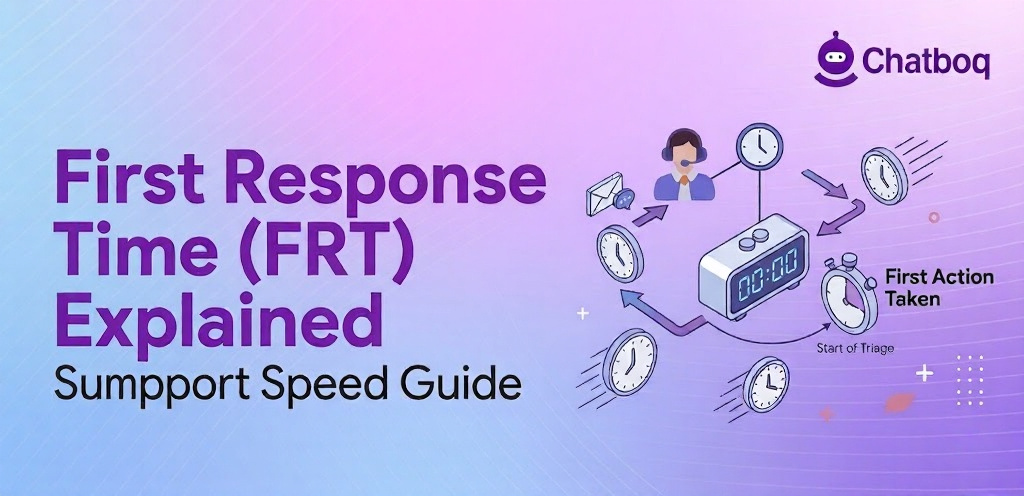
First response time (FRT) measures how quickly businesses acknowledge customer inquiries across support channels like live chat, email, ticketing systems, messaging apps, and chatbot conversations. It plays a central role in customer support operations because response speed directly shapes customer expectations, support experience quality, and perceived reliability before an issue is even resolved.
FRT performance depends on support workflows, ticket routing, agent availability, workflow automation, SLA policies, and help desk infrastructure working together in real time. Live chat systems, chatbot automation, canned responses, and support analytics dashboards all influence how quickly teams respond across SaaS, ecommerce, and omnichannel support environments.
Support teams track first response time alongside metrics like CSAT, resolution time, average handle time, deflection rate, and customer effort score to understand operational efficiency and customer experience quality together. AI-powered routing, chatbot automation, workflow optimization, staffing strategies, and support analytics help reduce delays, manage ticket volume, and improve response consistency across different channels and priority levels.
As customer expectations shift toward real-time communication, businesses increasingly rely on conversational AI, chatbot automation, and SLA monitoring to maintain fast response times at scale. At the same time, poor routing, understaffing, low-quality replies, missing automation, and lack of real-time monitoring remain common reasons support teams struggle to improve FRT consistently.
 ChatGPT
 Perplexity
 Claude




Leave a Comment
Your email address will not be published. Required fields are marked *
By submitting, you agree to receive helpful messages from Chatboq about your request. We do not sell data.