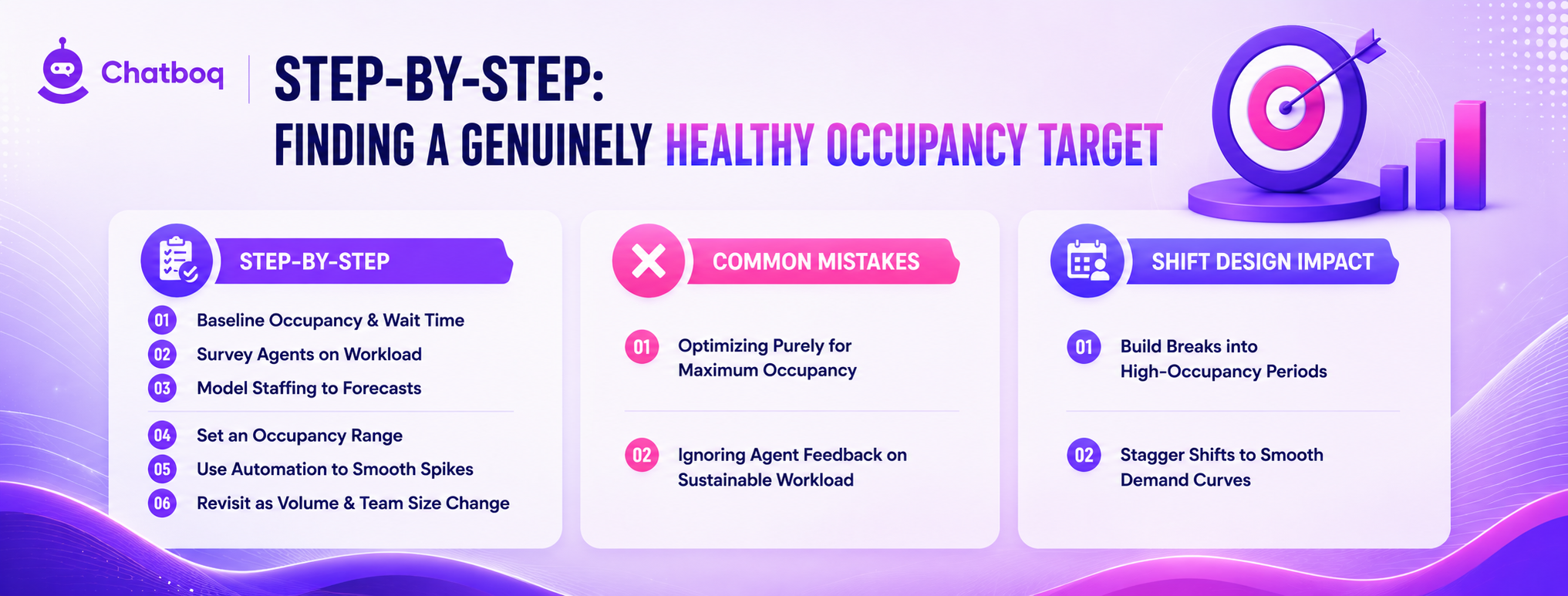
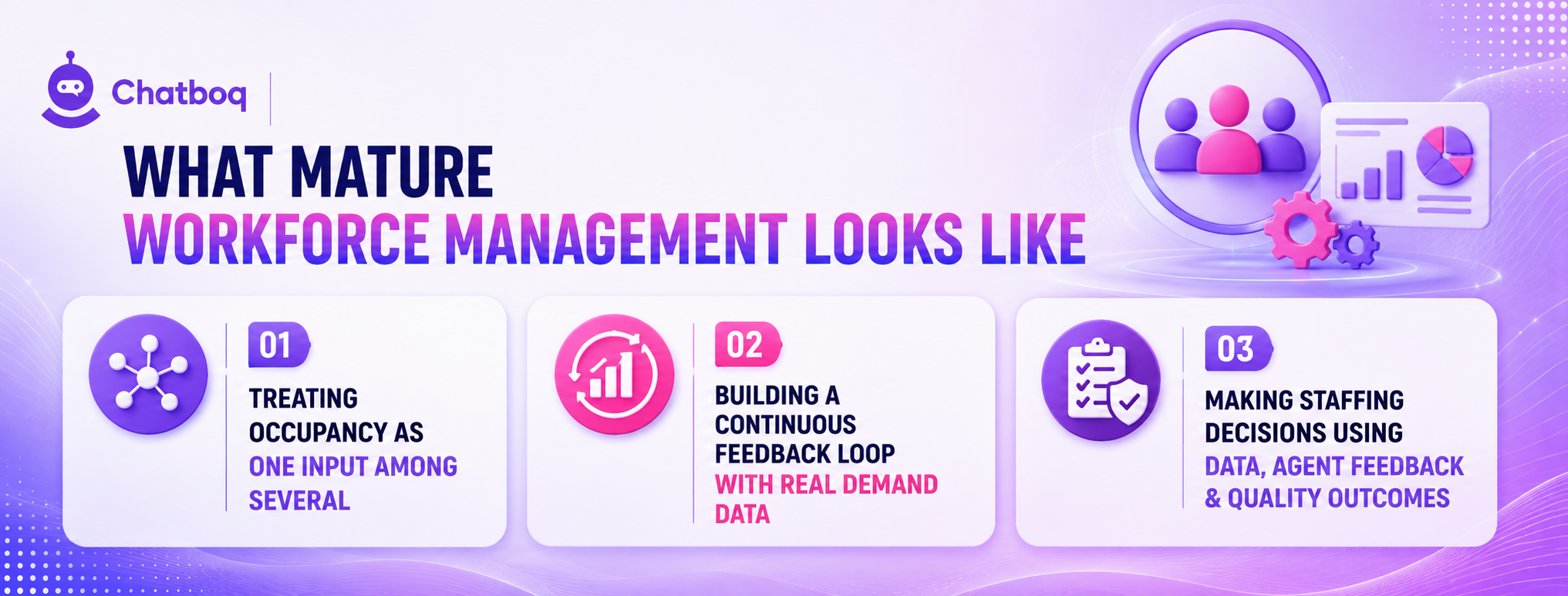
Finding a genuinely healthy target involves baselining current occupancy and wait time together, directly surveying agents about workload sustainability, modeling staffing against realistic demand forecasts, setting an occupancy range rather than a single fixed number, using automation to smooth demand spikes, and revisiting the target as volume and team size evolve.
Step 1: Baseline your current occupancy and wait time together
Establishing a clear baseline for both occupancy and customer wait time together reveals the genuine current tradeoff the team is operating under before attempting to deliberately shift it.
Step 2: Survey agents about workload sustainability
Directly asking agents whether their current workload feels genuinely sustainable surfaces valuable, qualitative signal that pure occupancy numbers alone can't fully capture.
Step 3: Model staffing against realistic demand forecasts
Modeling staffing levels against genuinely realistic, data-informed demand forecasts, rather than a flat, unchanging assumption, supports a more accurate and sustainable occupancy target.
Step 4: Set an occupancy range, not a single fixed number
Setting a reasonable target range, rather than a single rigid number, gives the team appropriate flexibility to absorb genuine, natural variation in daily demand without constantly missing an overly precise target.
Step 5: Use automation to smooth demand spikes
Leaning on chatbot automation to absorb a share of volume during genuine demand spikes helps keep human agent occupancy within a healthy range even during predictably busier periods.
Step 6: Revisit the target as volume and team size change
Periodically revisiting the occupancy target as overall volume and team size genuinely evolve keeps the standard relevant rather than anchored to an outdated assumption about the business's current scale.

 ChatGPT
 Perplexity
 Claude





Leave a Comment
Your email address will not be published. Required fields are marked *
By submitting, you agree to receive helpful messages from Chatboq about your request. We do not sell data.