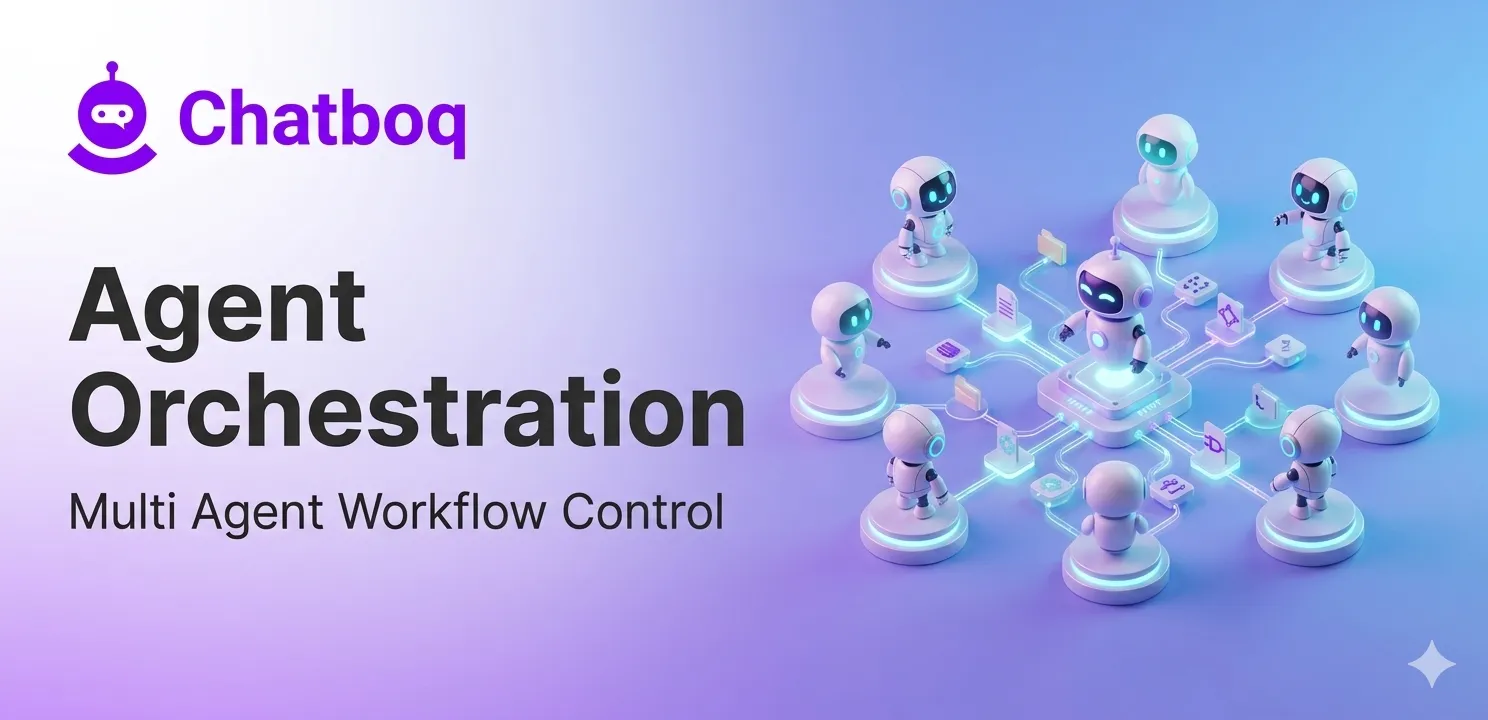
Core orchestration components include the orchestration controller making routing decisions, an agent registry identifying capabilities, a task routing engine directing work, state management tracking progress, and monitoring layers ensuring visibility.
Orchestration controller
The controller is the decision-making core. It receives requests, evaluates options, and decides action.
Controllers use logic: rules, machine learning, or combinations. Rule-based controllers are predictable. ML-based controllers are adaptive.
Controllers and agent monitoring systems track orchestration state, workload distribution, and execution health across multi-agent systems. They know which agents are busy, which are idle, which are failing.
Agent registry and capability mapping
The registry is a database of all available agents. It stores agent names, capabilities, endpoints, and metadata.
Capability mapping documents what each agent can do. Capability tags enable routing decisions. Search agents tagged "search." Summarization agents tagged "summary."
The registry is dynamic. New agents register themselves. Agents report capability changes. Offline agents get marked unavailable.
Task routing engine
The routing engine uses the registry and controller logic to assign tasks. It implements routing algorithms.
Algorithms might be simple: "Route all customer queries to customer service agents." Or complex: "Route to agent with lowest average handle time who can perform tasks."
The router handles failures. If the primary choice is unavailable, it routes to backup. It prevents task loss.
State management system
State tracking records which tasks are in progress, which are queued, which are complete. It provides visibility into system status.
State management and context propagation systems track workflow state, execution history, and task context across orchestration layers. Information flows from completed tasks to next tasks. Context persists through execution.
State enables recovery. If a system crashes, state reconstruction resumes work from where it stopped. No work is lost.
Monitoring and logging layer
Monitoring and AI governance systems track orchestration health, execution workflows, routing behavior, and agent reliability continuously. It alerts to failures, bottlenecks, and performance issues.
Logging records every action. Which task went to which agent. How long did it take? What was the outcome?
Logs enable debugging. When something goes wrong, logs show exactly what happened. They enable root cause analysis.

 ChatGPT
 Perplexity
 Claude


Leave a Comment
Your email address will not be published. Required fields are marked *
By submitting, you agree to receive helpful messages from Chatboq about your request. We do not sell data.