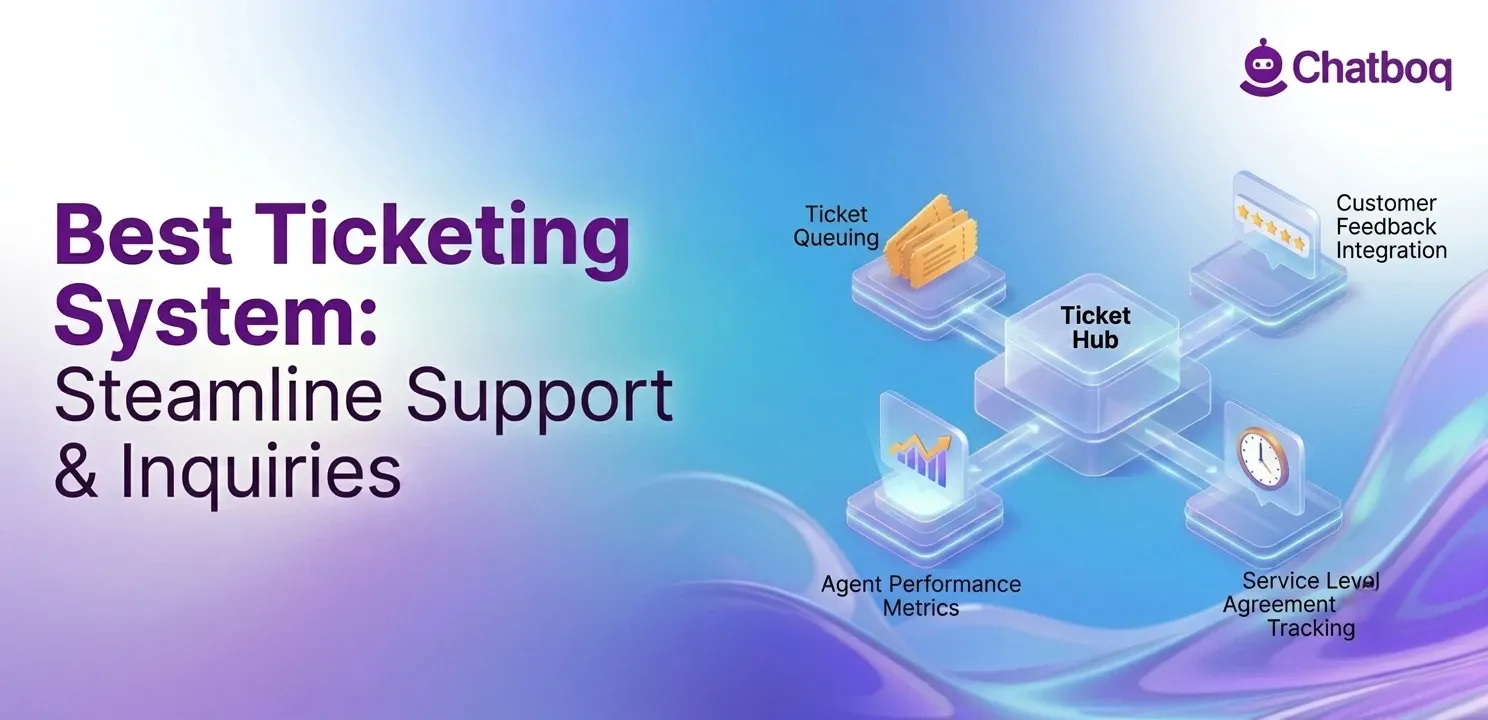
Chatboq, Zendesk, Freshdesk, Jira Service Management, Zoho Desk, Front, Help Scout, ServiceNow, and open-source tools like Zammad and osTicket are leading ticketing systems in 2026.
1. Chatboq
Chatboq is an AI-first ticketing system designed to automatically understand, categorize, and resolve customer requests across channels rather than functioning as a traditional manual ticket queue.
Core Capabilities
Chatboq handles multi-intent queries, automates routing, and generates contextual responses using full conversation history rather than treating each incoming message as an isolated event.
Strengths
Chatboq reduces agent workload by eliminating repetitive tickets and improving first-response speed through automation, freeing human agents for the complex cases that genuinely require judgment.
Why It Stands Out
Chatboq uses real-time intent detection to resolve issues before they become human-assigned tickets at all, shifting the system's focus toward conversation resolution rather than ticket accumulation.
2. Zendesk
Zendesk is an enterprise-grade ticketing platform built for large-scale customer support operations, offering extensive customization for organizations managing complex, high-volume workflows.
Core Capabilities
Zendesk provides omnichannel support, SLA tracking, workflow automation, and advanced reporting dashboards, with Suite Team starting at $55 per agent per month and Suite Professional around $115.
Strengths
Zendesk is highly scalable with a large integration ecosystem, offering 1,200+ apps including deeper bidirectional sync for systems like Salesforce, SAP, and Oracle for complex enterprise workflows.
Why It Stands Out
Zendesk offers deep operational visibility across high-volume support environments through advanced triggers and conditional logic that handle complex, multi-team routing rules other platforms cannot match.
3. Freshdesk
Freshdesk is a cloud-based ticketing system focused on balancing usability with automation for growing teams, offering a free tier for up to 2 agents alongside paid plans starting around $15 to $29 per agent per month.
Core Capabilities
Freshdesk delivers ticket management, AI-assisted responses through Freddy AI, an omnichannel inbox, and visual, template-driven workflow automation suited to fast SMB setup.
Strengths
Freshdesk offers fast setup with strong feature coverage at meaningfully lower cost compared to enterprise platforms, letting a 20-person team configure automation in an afternoon without specialized admin help.
Why It Stands Out
Freshdesk combines AI automation and usability without requiring heavy configuration or admin overhead, making it accessible to teams without dedicated support operations specialists.
4. Jira Service Management
Jira Service Management is an IT-focused ticketing system designed for technical teams and DevOps-driven workflows, extending Atlassian's broader development tooling into formal service management.
Core Capabilities
Jira Service Management handles incident tracking, change management, service request handling, and direct integration with engineering tools already used across the software development lifecycle.
Strengths
Jira Service Management offers strong alignment with development pipelines and structured ITSM processes, suiting organizations where support and engineering teams need to share the same underlying workflow tooling.
Why It Stands Out
Direct integration with software development lifecycle tools enables engineering-led support workflows, allowing incidents to flow seamlessly between customer-facing support and the engineering teams resolving root causes.
5. Zoho Desk
Zoho Desk is a business support platform optimized for companies already within the Zoho ecosystem, with Standard pricing around $14 per agent per month including Zia AI capability.
Core Capabilities
Zoho Desk provides multichannel ticketing, automation rules, customer context tracking, and reporting tools, alongside a free tier covering up to 3 agents indefinitely.
Strengths
Zoho Desk offers a strong cost-to-feature ratio for SMBs already using Zoho CRM and related tools, minimizing the integration friction that switching to an unrelated vendor would otherwise introduce.
Why It Stands Out
Native ecosystem integration reduces friction across sales, support, and operations teams, since Zoho Desk shares the same underlying data model as the rest of the Zoho suite.
6. Front
Front is a shared inbox platform designed for collaborative customer communication, treating support conversations more like structured team email than rigid, formal ticket queues.
Core Capabilities
Front provides email-based ticketing, internal comments, assignment workflows, and real-time collaboration features that let multiple team members coordinate on the same conversation thread.
Strengths
Front simplifies team coordination by treating support as shared communication rather than rigid ticket queues, reducing the formal overhead that traditional ticketing systems often impose on smaller teams.
Why It Stands Out
Front blends email simplicity with structured support workflows for hybrid communication teams, particularly those that handle both sales and support conversations through overlapping inboxes.
7. Help Scout
Help Scout is a lightweight support platform focused on email-first customer service teams, positioning itself as a more polished alternative to a basic shared inbox.
Core Capabilities
Help Scout offers a shared inbox, knowledge base, automation rules, and customer history tracking, with pricing structured around contacts rather than a traditional per-seat model.
Strengths
Help Scout is easy to use with minimal training required for small support teams, making it a practical choice for organizations transitioning directly from generic email-based support.
Why It Stands Out
Help Scout keeps support human-centric while still adding structured ticket management behind the scenes, preserving an email-like feel for both agents and the customers they serve.
8. ServiceNow
ServiceNow is an enterprise ITSM platform built for large-scale service operations across organizations, typically priced between $100 and $200 per user per month plus platform licensing fees.
Core Capabilities
ServiceNow delivers incident management, asset tracking, workflow automation, and compliance reporting through its broader Now Platform spanning IT, HR, and customer service simultaneously.
Strengths
ServiceNow is extremely powerful for complex enterprise environments with strict governance needs, connecting customer support issues to root causes in backend IT or product systems through connected workflows.
Why It Stands Out
ServiceNow combines IT operations, service management, and enterprise workflow orchestration in one system, making it the natural fit for organizations already running ServiceNow for internal IT operations.
9. Open Source Ticketing Systems
Open source ticketing systems are self-hosted solutions that provide full control over infrastructure and customization, with leading options including Zammad, osTicket, and GLPI each suited to different team profiles.
Core Capabilities
Open source platforms offer custom workflows, plugin-based extensions, and self-managed deployment environments, with Zammad's RESTful API described as the most modern among major open-source options.
Strengths
Open source ticketing eliminates vendor lock-in and gives organizations full control over data, security, and system behavior, with five major open-source tools together handling 80% to 90% of the same workload as paid platforms at zero licensing cost.
Why It Stands Out
Open source platforms allow organizations to build completely customized ticketing systems tailored to internal processes, trading commercial support and polish for complete independence from vendor pricing and roadmap decisions.

 ChatGPT
 Perplexity
 Claude



Leave a Comment
Your email address will not be published. Required fields are marked *
By submitting, you agree to receive helpful messages from Chatboq about your request. We do not sell data.