
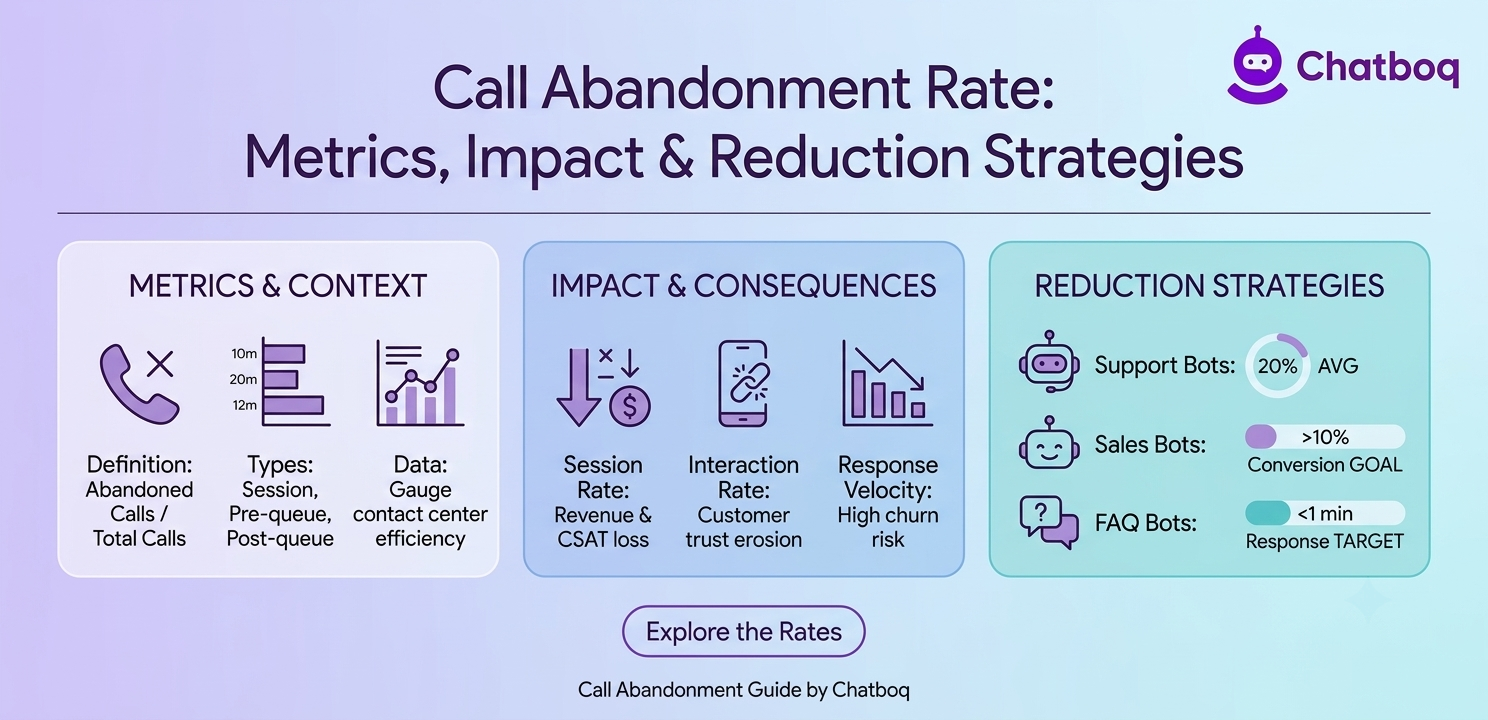
Call abandonment rate measures how often customers leave a support queue before receiving help through a live agent or support system. It reflects the relationship between customer patience, queue experience, support responsiveness, and operational efficiency across inbound call environments. When abandonment rises, it usually signals problems in the support experience before customers even reach an agent.
Call abandonment is influenced by queue management, IVR flows, workforce scheduling, routing logic, peak call demand, and customer wait time expectations across contact center operations. Call center platforms, callback systems, queue analytics, AI-powered routing tools, and workforce management software all affect how efficiently inbound calls move through support queues.
Businesses track abandonment rate alongside response time, service level agreements, customer satisfaction, churn risk, and contact center analytics to understand how queue performance affects customer experience and operational outcomes. Analytics dashboards and real-time queue tracking help teams identify bottlenecks, reduce queue drop-offs, and improve support coverage during high-volume periods.
As customers expect faster support, businesses increasingly rely on omnichannel support, AI chatbots, intelligent routing, and self-service systems to reduce abandoned calls without excessive staffing costs. At the same time, poor routing logic, long hold times, weak IVR experiences, reactive scheduling, and lack of alternative support channels remain some of the biggest contributors to high abandonment rates.
 ChatGPT
 Perplexity
 Claude


Leave a Comment
Your email address will not be published. Required fields are marked *
By submitting, you agree to receive helpful messages from Chatboq about your request. We do not sell data.