
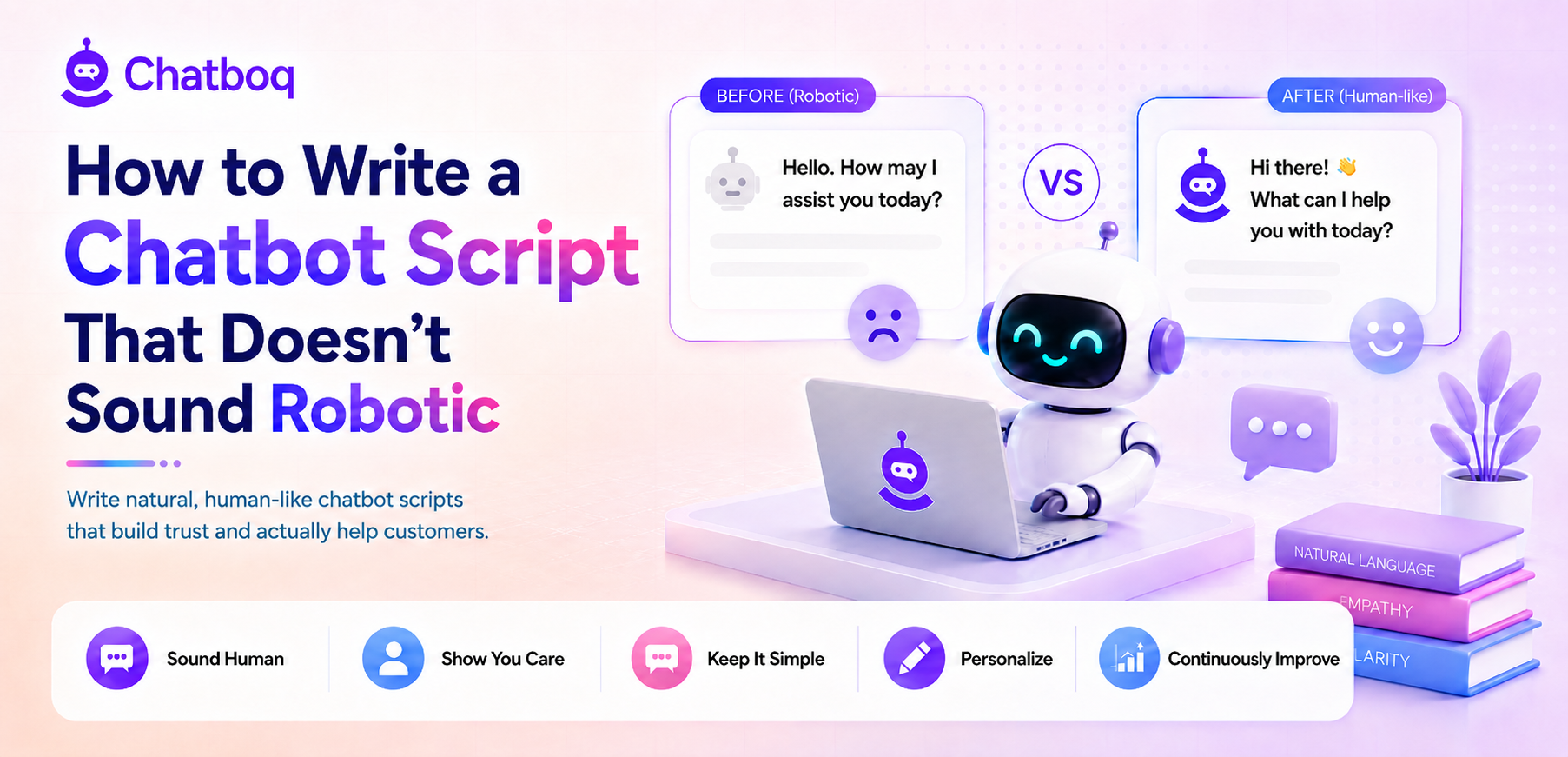
Chatbot scripts sound robotic for three main reasons: they're written in overly formal, textbook language nobody actually speaks, they never acknowledge what the customer just said before jumping to an answer, and they rely on rigid, one-size-fits-all phrasing that repeats identically no matter how the conversation is actually going.
Overly formal, textbook language
Scripts drafted by teams worried about sounding unprofessional often overcorrect into stiff, formal phrasing, "We regret to inform you" instead of "Sorry about that," that no real person would say out loud in a normal conversation, and customers notice the mismatch between how a chat window looks and how the actual words read.
No acknowledgment of what the customer actually said
A script that jumps straight from a customer's message to an answer, without any acknowledgment in between, reads like a lookup table rather than a conversation, since real conversations almost always include some brief signal that the other person was actually heard before a response is given.
Rigid, one-size-fits-all phrasing
Reusing the exact same sentence structure for every response, regardless of context, is efficient to write but reads as mechanical the moment a customer notices the pattern, especially across a longer conversation involving several back-and-forth exchanges.
 ChatGPT
 Perplexity
 Claude





Leave a Comment
Your email address will not be published. Required fields are marked *
By submitting, you agree to receive helpful messages from Chatboq about your request. We do not sell data.