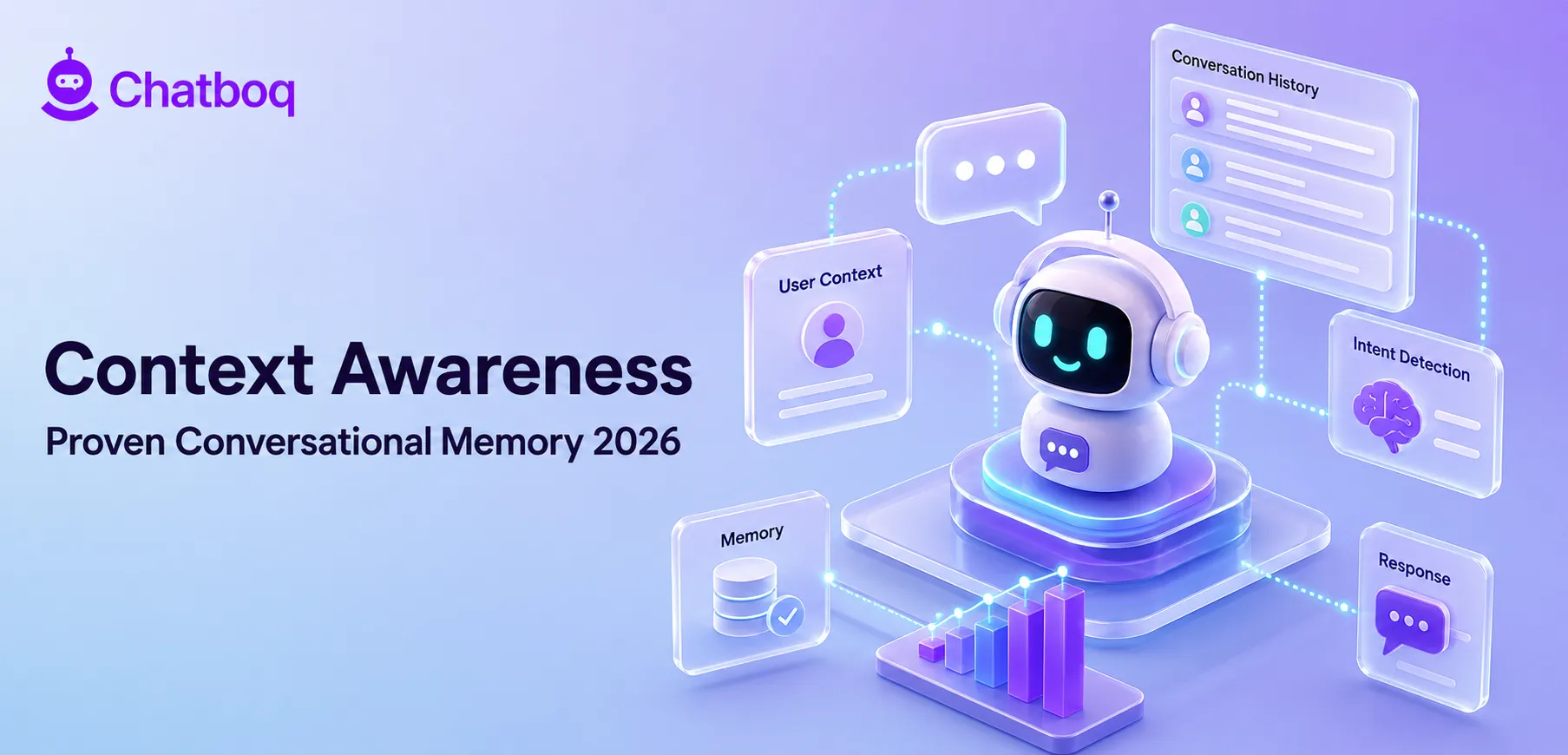
Context-aware systems operate through sophisticated input processing and context extraction, memory storage and retrieval, context-based response generation, and continuous learning and adaptation mechanisms.
Input processing and intelligent context extraction
Conversational AI receives user messages continuously throughout daily operations successfully. The first processing step extracts meaning from incoming messages automatically and accurately. Natural Language Processing models identify key information and entities correctly. Intent classification determines what the customer actually wants to accomplish. Detected information becomes context that guides subsequent processing steps forward. Quality extraction determines overall system quality and response appropriateness significantly. More accurate context processing improves response relevance, intent detection, and conversation continuity.
Vector embeddings convert conversational meaning into numerical representations that AI systems can process efficiently. Transformer architecture then analyzes relationships between words, phrases, and previous messages to maintain conversational context across interactions. Vector embeddings enable semantic search across large knowledge bases by identifying meaning-based similarities between messages, documents, and user queries. Mathematical representation enables sophisticated processing that improves response quality. Transformer-based architectures process long conversational dependencies more accurately than rule-based or keyword-matching systems. Modern architectures handle complex context processing at scale effectively.
Memory storage and retrieval systems for context
Dialogue state tracking maintains conversation state across multiple turns completely. Systems remember what happened in previous conversation exchanges accurately. Retrieval-Augmented Generation (RAG) combines external knowledge retrieval with Large Language Models to improve response accuracy, contextual relevance, and factual consistency. AI conversational memory systems store relevant user information, preferences, and conversation history for fast retrieval during future interactions. Quick retrieval enables rapid response generation maintaining conversational flow smoothly.
Memory quality directly determines context awareness quality and system performance. Well-designed memory systems enable sophisticated context-aware interactions consistently. Knowledge base integration allows conversational AI systems to retrieve product information, support documentation, and previous interactions during response generation. Semantic search finds relevant information quickly from massive databases. Vector databases enable similarity-based retrieval of relevant information successfully. Fast retrieval enables real-time response generation maintaining conversation naturalness. Retrieval speed determines whether systems feel responsive or sluggish. Low-latency retrieval systems help AI assistants maintain natural conversational flow during live interactions. Database architecture, vector indexing, and retrieval optimization directly affect latency, scalability, and real-time conversational performance.
Context-based response generation leveraging information
AI models generate responses based on all gathered context information. Models consider previous messages when generating new responses appropriately. Models consider user preferences and detect intent when responding fully. Models consider emotional tone and urgency when selecting responses. Considering context produces better responses than ignoring context completely. Response generation quality depends directly on context information quality. Better context produces dramatically better responses overall consistently. Transformer models process sequential conversational data efficiently, allowing Large Language Models to maintain context awareness across multi-turn interactions. Large Language Models maintain extended context windows for longer conversations.
Context retention in LLMs enables sophisticated understanding and response generation. Extended context windows enable understanding longer conversation histories effectively. Model architecture directly determines context awareness capabilities and performance. Modern Large Language Models support larger AI context windows, enabling better long-form conversation continuity and memory retention. Modern Large Language Models process conversational dependencies more effectively, allowing stronger contextual understanding across long interactions.
Continuous learning and adaptation from interactions
AI systems improve measurably from conversation feedback and user interactions. Successful interactions reinforce good response patterns in models over time. Failed interactions prompt investigation and model improvement efforts continuously. Continuous learning pipelines improve conversational AI performance by refining intent classification, response selection, and contextual understanding over time. Learning happens naturally from accumulating interaction data over time. Feedback loops guide AI improvement toward better context awareness. Iterative learning compounds into significant performance improvements over months.
Feedback systems guide AI improvement toward better context understanding. User reactions to responses inform which changes help most. Iterative refinement helps conversational AI systems adapt to new interaction patterns and change user behavior over time. Continuous adaptation enables better context awareness capabilities over time. Continuously trained models adapt more effectively to evolving customer behavior and changing conversational patterns. Learning-enabled systems gain competitive advantages through continuous improvement mechanisms. Businesses that want to build context aware chatbot systems often combine memory systems, NLP models, intent detection, and vector databases to improve conversational continuity.

 ChatGPT
 Perplexity
 Claude


Leave a Comment
Your email address will not be published. Required fields are marked *
By submitting, you agree to receive helpful messages from Chatboq about your request. We do not sell data.