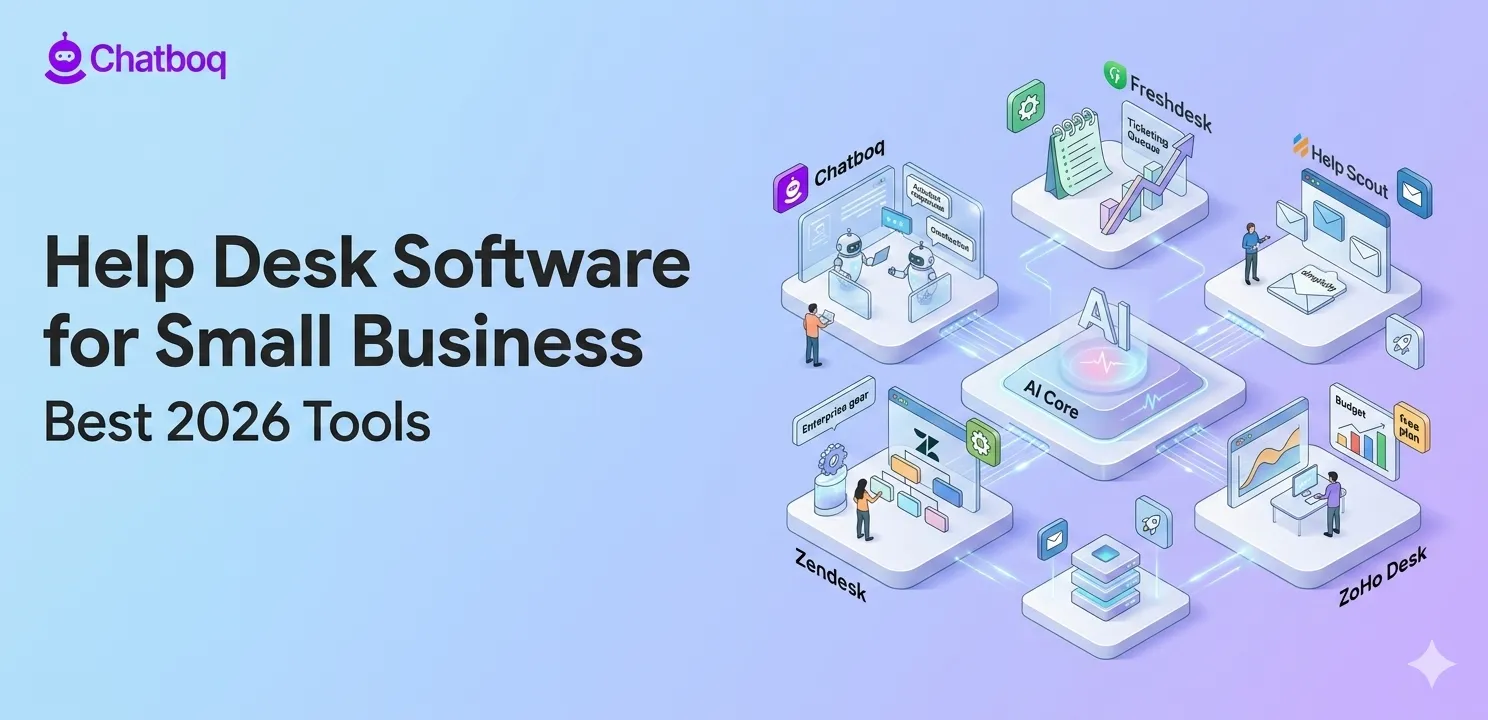
The best help desk software for small businesses depends on whether the team needs shared inbox simplicity, structured ticketing with SLAs, or AI-driven automation. Lightweight tools like Hiver and Help Scout suit small teams, while Freshdesk and Zendesk support scalable workflows. AI-first platforms like Chatboq reduce manual workload through automated routing and responses.
Chatboq - AI-Powered Help Desk for Small Business (Next-Gen Option)
Chatboq is an AI-powered customer support and help desk platform that combines ticketing, live chat, and automation into a unified system. It uses intent-based AI to automatically classify incoming customer queries, route them to the right workflow, or resolve repetitive issues without manual intervention. For small businesses, this reduces the need for manual ticket triage and allows lean support teams to handle higher ticket volumes efficiently without scaling headcount proportionally.
Why it stands out
Chatboq stands out because it replaces traditional manual ticket handling with AI-driven workflow automation. Instead of agents sorting, tagging, and prioritizing every request, the system automatically understands intent and routes tickets accordingly, significantly reducing operational workload for small support teams.
Best for small business support teams (1-10 agents)
Chatboq is best for startups and small businesses with limited support staff but increasing customer queries. It is particularly effective in environments where a large portion of tickets are repetitive, such as FAQs, order tracking, billing questions, and account-related requests that can be automated.
Core strengths in SMB operations
-
AI-based intent detection for automatic ticket classification
-
Automates a significant share of repetitive support requests
-
Smart prioritization based on SLA urgency and customer context
-
Unified workspace combining chat, chatbot, and ticketing
-
Reduces manual triage and first-response workload significantly
-
Fast setup with minimal configuration required
Limitations
Chatboq still has developing enterprise-grade capabilities. Advanced SLA structures, deep compliance logging, and highly granular role-based access controls are less mature compared to established platforms like Zendesk.
Help Scout - Best Simple Customer Support Platform
Help Scout is an email-first customer support platform designed to feel like a shared inbox rather than traditional ticketing software. It centralizes customer conversations into a clean, human-centric workspace where teams can respond collaboratively while maintaining a personal, email-like experience for customers. For small businesses, it replaces fragmented inbox management with a lightweight but structured support system.
Why it stands out
Help Scout stands out because it prioritizes simplicity and customer experience over complex workflows. Unlike traditional help desk tools that focus on ticketing structures, it keeps interactions email-native while still adding collaboration features like assignments, internal notes, and visibility across the team.
Best for small, customer-focused teams (1-8 agents)
Help Scout is best for small businesses that want organized support without adopting heavy ticketing systems. It works particularly well for teams that value personalized customer communication and do not require complex routing, SLA hierarchies, or advanced automation workflows.
Core strengths in SMB operations
-
Clean, email-like interface with minimal learning curve
-
Shared inbox for team collaboration on customer emails
-
Internal notes and conversation visibility across agents
-
Built-in knowledge base (Docs) for self-service support
-
Fast onboarding and easy adoption for non-technical teams
-
Strong focus on personalized customer communication
Limitations
Help Scout has limited automation depth compared to structured help desk systems like Freshdesk or Zendesk. It is less suitable for teams that require complex workflows, advanced routing rules, or heavy SLA-driven support operations.
Freshdesk - Best Scalable SMB Help Desk
Freshdesk is a full-featured help desk platform built to help small and mid-sized businesses manage customer support across email, chat, phone, and social channels. It converts incoming customer inquiries into structured tickets with automation, SLAs, and reporting, making it suitable for teams that need both simplicity at entry level and scalability as support operations grow.
Why it stands out
Freshdesk stands out because it balances accessibility with scalability. It offers a genuinely usable free plan for early-stage teams while still providing advanced automation, omnichannel support, and SLA management as businesses grow. This makes it one of the few platforms that can support a small team from startup stage to mid-market scale without migration.
Best for growing small businesses (2-50 agents)
Freshdesk is best for small businesses that expect steady growth in support volume and team size. It is especially useful for teams that need structured ticketing, automation workflows, and multi-channel support without immediately moving to enterprise-heavy systems like Zendesk.
Core strengths in SMB operations
-
Omnichannel support across email, chat, phone, and social media
-
Strong ticketing system with ownership, status, and prioritization
-
Automation workflows for routing, tagging, and response handling
-
SLA tracking for response and resolution time management
-
Generous free plan for early-stage deployment
-
Scales smoothly from small teams to larger support organizations
Limitations
Freshdesk can become complex as automation rules and workflows increase, especially for teams without dedicated support operations experience. Advanced configuration may require time to set up properly, and some features are locked behind higher pricing tiers.
Zendesk - Best Advanced Support Platform
Zendesk is a mature customer support and help desk platform built for structured, high-volume support operations. It centralizes customer conversations from multiple channels into a unified ticketing system with advanced routing, SLA controls, automation, and deep reporting. While it serves enterprise teams, it is often adopted by growing small businesses that need strict process control and scalability.
Why it stands out
Zendesk stands out because of its depth of workflow control and ecosystem maturity. It provides highly configurable ticket routing, advanced automation logic, and one of the largest integration marketplaces in the support software space, making it suitable for teams that require strict operational structure and customization.
Best for structured, scaling support teams (10-100+ agents)
Zendesk is best for small businesses that are scaling into mid-market operations and need formal support processes. It fits teams that require multi-department routing, strict SLA enforcement, and detailed performance analytics across large support volumes.
Core strengths in SMB operations
-
Highly advanced ticket routing and workflow customization
-
Strong SLA management with escalation rules
-
Extensive integration marketplace (CRM, ecommerce, internal tools)
-
Deep analytics and reporting for support performance tracking
-
Supports complex multi-team and multi-product support structures
-
Scales reliably for high-volume customer support environments
Limitations
Zendesk can be expensive and operationally heavy for small teams. Setup and configuration complexity is significantly higher than lightweight tools, and many small businesses underutilize its advanced features while still paying premium pricing per agent.
Hiver - Best Gmail-Based Help Desk
Hiver is a help desk platform that operates directly inside Gmail, turning the inbox into a shared support system with ticket assignment, tracking, and collaboration features. It allows teams to manage customer support without leaving their email interface, making it especially suitable for businesses already built around Google Workspace.
Why it stands out
Hiver stands out because it removes the need for a separate help desk interface by embedding support workflows directly into Gmail. This dramatically reduces adoption friction, since agents continue working in a familiar environment while gaining structured ticket management capabilities like assignment, SLAs, and collision detection.
Best for Gmail-first small businesses (2-15 agents)
Hiver is best for teams that rely heavily on Google Workspace and want structured support operations without introducing a new platform. It is especially effective for small businesses where email is the primary support channel and simplicity of adoption is more important than advanced workflow complexity.
Core strengths in SMB operations
-
Fully integrated into Gmail interface (no new platform required)
-
Shared inbox with assignment and ownership tracking
-
SLA monitoring and basic performance reporting
-
Collision detection to prevent duplicate responses
-
Easy adoption due to zero workflow disruption
-
Works naturally with Google Workspace ecosystem
Limitations
Hiver is limited to Gmail and cannot be used with non-Google email providers. It also has less advanced automation and reporting depth compared to full help desk platforms like Freshdesk or Zendesk, making it less suitable for complex or high-volume support environments.
Zoho Desk - Best Budget Help Desk Software
Zoho Desk is a cost-effective help desk platform designed for small and mid-sized businesses that need structured ticketing, automation, and SLA management at a lower price point. It converts customer inquiries into organized tickets and provides workflow controls, reporting, and integrations within the broader Zoho ecosystem.
Why it stands out
Zoho Desk stands out because it delivers enterprise-style help desk functionality at a significantly lower cost than most competitors. It combines ticketing, automation, and SLA tracking with tight integration across Zoho’s business suite, making it especially valuable for cost-sensitive teams already using Zoho tools.
Best for budget-conscious SMBs (3-30 agents)
Zoho Desk is best for small businesses that want full help desk functionality without premium pricing. It works well for teams that need structured support workflows, SLA tracking, and automation but want to keep operational costs low while still maintaining scalability.
Core strengths in SMB operations
-
Affordable pricing with strong feature coverage
-
Structured ticketing with SLAs and workflow automation
-
Good reporting and operational visibility tools
-
Native integration with Zoho CRM and Zoho ecosystem
-
Supports omnichannel customer support (email, chat, social)
-
Scales beyond entry-level SMB requirements
Limitations
Zoho Desk has a steeper learning curve compared to simpler tools like Help Scout or Hiver. Its interface can feel more complex for first-time help desk users, and its integrations outside the Zoho ecosystem are less extensive than platforms like Zendesk.
Front - Best Collaboration-Focused Help Desk
Front is a collaborative customer communication platform that blends shared inbox functionality with workflow automation and team collaboration features. It is designed to help teams manage customer conversations across email and other channels while enabling real-time internal collaboration before responding to customers.
Why it stands out
Front stands out because it is built around collaboration rather than traditional ticketing. Instead of treating support requests as isolated tickets, it allows teams to work together inside shared conversations using internal comments, assignments, and real-time discussion, making it especially effective for multi-person response workflows.
Best for collaboration-heavy support teams (5-50 agents)
Front is best for small businesses where customer support requires coordination between multiple team members before responding. It is particularly useful for teams handling complex inquiries that require input from sales, operations, or product teams before a final response is sent.
Core strengths in SMB operations
-
Strong internal collaboration within customer conversations
-
Shared inbox with assignments and conversation ownership
-
Real-time internal comments and @mentions
-
Integrates with CRM, ecommerce, and productivity tools
-
Good visibility across team-wide customer communication
-
Suitable for cross-functional support workflows
Limitations
Front is more expensive than most SMB help desk tools and may be overkill for simple support workflows. It also lacks some deep ticketing-style structure and advanced SLA enforcement found in dedicated help desk platforms like Zendesk or Freshdesk.
Missive - Best Lightweight Inbox Collaboration Tool
Missive is a lightweight shared inbox and team communication tool that combines email, internal chat, and basic collaboration features into a single workspace. It is designed for small teams that want to manage customer emails together without the complexity of full-scale help desk systems.
Why it stands out
Missive stands out because it focuses on speed and simplicity. It blends email and internal team chat in the same interface, allowing teams to discuss and respond to customer messages without switching tools. This makes it especially useful for small, fast-moving teams that prioritize efficiency over complex workflows.
Best for small agile teams (2-8 agents)
Missive is best for very small support teams that need shared inbox functionality without adopting structured ticketing systems. It works well for teams that handle relatively low to moderate support volume and want a lightweight, flexible communication layer.
Core strengths in SMB operations
-
Combines email and internal chat in one interface
-
Simple shared inbox with assignment capabilities
-
Fast setup with minimal configuration required
-
Strong mobile-friendly and lightweight experience
-
Good for real-time team coordination
-
Low learning curve for small teams
Limitations
Missive lacks advanced help desk features such as SLA tracking, deep automation workflows, and detailed reporting. It is not suitable for scaling support operations or teams that require structured ticket lifecycle management.
Re:amaze - Best Ecommerce Support Tool
Re:amaze is a customer support and help desk platform built specifically for ecommerce businesses. It combines messaging, live chat, email support, and social channels into a unified inbox while integrating deeply with ecommerce platforms like Shopify to surface order and customer data directly inside support conversations.
Why it stands out
Re:amaze stands out because it is purpose-built for ecommerce support workflows rather than generic ticketing. It brings order history, shipping details, and customer purchase context directly into the support interface, allowing agents to resolve issues faster without switching between multiple systems.
Best for ecommerce and DTC brands (1-30 agents)
Re:amaze is best for online stores and direct-to-consumer brands where most support tickets are related to orders, shipping, returns, and refunds. It is especially effective for Shopify-heavy businesses that need tight integration between customer support and store operations.
Core strengths in SMB operations
-
Deep Shopify and ecommerce platform integration
-
Unified inbox for email, chat, social, and SMS
-
Order and customer data visible inside conversations
-
Automated workflows for order updates and notifications
-
Built-in tools for FAQs and self-service support
-
Strong fit for high-volume ecommerce support
Limitations
Re:amaze is less suitable for SaaS or service-based businesses that need advanced ticketing workflows or complex SLA structures. Its strengths are heavily concentrated in ecommerce use cases, which limits flexibility for non-retail support environments.

 ChatGPT
 Perplexity
 Claude



Leave a Comment
Your email address will not be published. Required fields are marked *
By submitting, you agree to receive helpful messages from Chatboq about your request. We do not sell data.