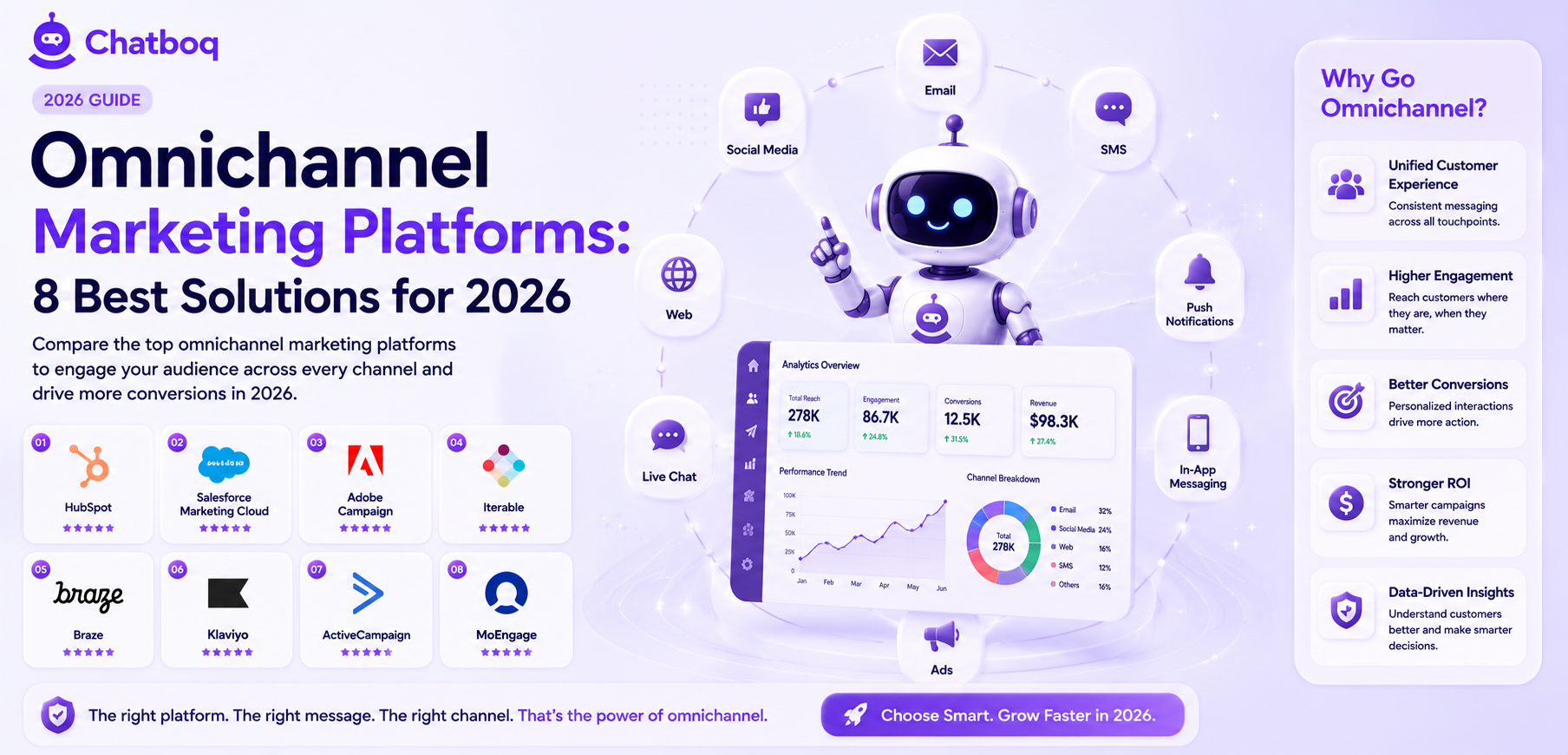
The best omnichannel marketing platforms include Chatboq, Klaviyo, Braze, HubSpot, Salesforce Marketing Cloud, Omnisend, ActiveCampaign, and MoEngage, each designed for different business sizes, channels, and customer engagement needs.
1. Chatboq
Chatboq is an AI-native conversational platform built around qualifying and structuring customer conversations through chat-first engagement, positioned as a complementary entry-layer tool rather than a full-spectrum omnichannel marketing suite.
Who Should Choose Chatboq
Teams wanting AI-driven conversational engagement integrated tightly with downstream CRM and support workflows should evaluate Chatboq specifically for that conversational layer.
Who Should NOT Choose Chatboq
Teams needing deep email/SMS lifecycle marketing automation, advanced segmentation, or enterprise-grade journey orchestration across 8+ channels should look toward the broader platforms covered later in this comparison instead.
Industries Where It Performs Best
Chatboq performs best for SaaS and ecommerce businesses prioritizing AI-driven first-contact conversation over broad multi-channel campaign breadth.
Supported Communication Channels
Chatboq centers on live chat and AI conversational messaging, with structured ticket handoff to downstream support and CRM systems.
Customer Journey Automation Capabilities
Journey logic in Chatboq is concentrated at the conversational entry point, qualifying and routing rather than orchestrating long-horizon, multi-touch lifecycle campaigns.
AI Capabilities
Chatboq applies real-time intent detection and conversational AI to qualify and resolve incoming queries before human or downstream system involvement.
Customer Data Architecture
Chatboq's data architecture is built around conversation context rather than the deep behavioral profile store that dedicated marketing platforms like Braze or Klaviyo maintain.
Integration Ecosystem
Chatboq is designed to feed structured, pre-qualified data into downstream CRM and marketing systems rather than functioning as the system of record itself.
Implementation Difficulty
Implementation is low, reflecting Chatboq's positioning as a fast-deploying conversational layer rather than a heavy, multi-month platform rollout.
Typical Deployment Timeline
Typical deployment runs days to a few weeks given the platform's narrower, conversation-focused scope.
Pricing Model
Chatboq uses custom, volume-based pricing rather than a published flat-rate tier structure.
Limitations
Chatboq is not designed to replace full lifecycle marketing automation, advanced segmentation, or the broad channel coverage that dedicated platforms in the remainder of this comparison provide.
2. Klaviyo
Klaviyo is the default omnichannel platform for ecommerce, built around a genuine profile store with deep, native Shopify-class integrations and built-in revenue attribution.
Who Should Choose Klaviyo
Ecommerce brands wanting deep personalization, rich email and SMS automation, and direct revenue attribution per flow should choose Klaviyo as the category default.
Who Should NOT Choose Klaviyo
B2B SaaS teams get little practical value from Klaviyo's ecommerce-specific architecture, and one detailed comparison explicitly flags it as overkill and overpriced for non-ecommerce use cases.
Industries Where It Performs Best
Klaviyo performs best in direct-to-consumer ecommerce and retail, where its pre-built revenue workflows (cart recovery, browse abandonment, post-purchase) map directly to existing operational needs.
Supported Communication Channels
Klaviyo natively covers email, SMS, and mobile push, with omnichannel automation available even on its free plan, a notable differentiator versus HubSpot's far more restricted free tier.
Customer Journey Automation Capabilities
Klaviyo's flow builder supports rich, behavior-triggered automation, though its omnichannel sync for desktop web push trails Omnisend's more fully integrated approach in that specific channel.
AI Capabilities
Klaviyo applies AI-powered automation and predictive analytics, including customer lifetime value prediction, layered onto its segmentation engine.
Customer Data Architecture
Klaviyo maintains a real, modern profile store (cited among the platforms with genuine profile architecture rather than a flattened list database) and bills based on total active profiles rather than only contacts emailed in a given period.
Integration Ecosystem
Klaviyo integrates deeply with Shopify and similar ecommerce platforms natively, with CRM connections to Salesforce and Zoho available but less deep than HubSpot's native CRM integration.
Implementation Difficulty
Implementation is low to moderate; most ecommerce teams can launch core flows within days given Klaviyo's pre-built template library.
Typical Deployment Timeline
Typical deployment runs days to 2 weeks for core ecommerce use cases.
Pricing Model
Klaviyo bills by total active profiles: $45/month at 1,000 profiles, $150/month at 10,000 profiles, and $720/month at 50,000 profiles for email-only, with SMS pricing combined at higher rates; a free plan covers up to 250 contacts with 500 email sends monthly.
Limitations
Since early 2025, Klaviyo bills on all active profiles rather than only contacts actually emailed, which has increased costs specifically for brands carrying large, unengaged contact lists.
3. Braze
Braze is a mobile-first, real-time customer engagement platform built for organizations that need deep journey orchestration and first-party data unification across email, SMS, push, in-app, WhatsApp, and web.
Who Should Choose Braze
Choose Braze when real-time journey orchestration and first-party data unification are core requirements and the team has the technical resources to fully exploit a highly configurable platform.
Who Should NOT Choose Braze
Teams without dedicated technical or marketing operations resources will likely underutilize Braze's configurability, since the platform's value is heavily implementation-dependent.
Industries Where It Performs Best
Braze performs best in fintech (cited as a compliance and mobile leader specifically), media, and publishing, where mobile app engagement and real-time behavioral response matter most.
Supported Communication Channels
Braze natively supports email, SMS, push, in-app messaging, WhatsApp, LINE, and web messaging, among the broadest native channel sets in this comparison.
Customer Journey Automation Capabilities
Braze is repeatedly grouped among the platforms winning on native omnichannel breadth (alongside Iterable and MoEngage) rather than depth within a single channel.
AI Capabilities
Braze's AI capabilities include message-level personalization and autonomous journey optimization, cited among the 2026 baseline expectations for enterprise-tier platforms.
Customer Data Architecture
Braze maintains a genuine, large-scale profile store supporting millions of attributes and event streams, placing it among the platforms with real identity-graph architecture rather than a flattened list.
Integration Ecosystem
Braze connects to major CDPs, data warehouses (Snowflake, BigQuery, Databricks), and CRM systems, though teams should verify real integrations with their specific tech stack before committing given the platform's configuration-heavy nature.
Implementation Difficulty
Implementation is high; Braze's depth and configurability mean meaningful value typically requires weeks to months of setup with dedicated technical involvement.
Typical Deployment Timeline
Typical deployment runs several weeks to a few months depending on data integration complexity.
Pricing Model
Braze pricing is enterprise-tier and quote-based, generally positioned toward the $60,000 to $250,000-plus annual range for the company-stage profile (Series A to growth) most likely to need its full feature set.
Limitations
Braze's primary weak flank is accessibility: smaller teams without dedicated marketing ops or engineering support frequently cannot extract full value relative to its cost and configuration overhead.
4. HubSpot Marketing Hub
HubSpot Marketing Hub is a CRM-native marketing platform that ties campaign activity directly to the same customer record used by sales and service, positioned as a Business Operating System rather than a marketing-only tool.
Who Should Choose HubSpot Marketing Hub
Choose HubSpot when marketing and sales need to operate from the same CRM and campaign ROI must be visible directly inside the revenue pipeline without separate integration work.
Who Should NOT Choose HubSpot Marketing Hub
Cost-sensitive ecommerce brands should avoid HubSpot for marketing automation specifically; one direct comparison names Klaviyo the clear winner over HubSpot for ecommerce email and omnichannel automation.
Industries Where It Performs Best
HubSpot performs best for B2B and mid-market companies where centralized campaign planning, sales alignment, and pipeline-visible ROI matter more than deep ecommerce-specific channel depth.
Supported Communication Channels
HubSpot covers email, social, ads, and live chat natively, but omnichannel automation (combining channels in unified workflows) is restricted to the Marketing Hub Professional tier and above.
Customer Journey Automation Capabilities
HubSpot's workflow editor supports custom triggers, conditions, and actions, though its free tier limits automation to a single basic follow-up email after a form submission.
AI Capabilities
HubSpot offers AI-assisted content and workflow suggestions integrated into its broader CRM platform, generally less specialized than the AI decisioning engines built natively into channel-native platforms like MoEngage or Braze.
Customer Data Architecture
HubSpot's core strength is its CRM-grade contact record, deeper for relationship and pipeline data than Klaviyo's profile store, though HubSpot charges per "marketing contact" actively emailed or automated rather than total CRM database size.
Integration Ecosystem
HubSpot's integration depth is strongest within its own CRM and sales tooling; its native ecommerce integrations are comparatively shallower than Klaviyo's or Omnisend's purpose-built commerce connectors.
Implementation Difficulty
Implementation is moderate to high at the Professional and Enterprise tiers, which carry mandatory onboarding fees and meaningfully more configuration than HubSpot's Starter tier.
Typical Deployment Timeline
Typical deployment runs 2 to 4 weeks for full setup at the mid-market tier.
Pricing Model
HubSpot's Starter plan runs $20/month for 1,000 marketing contacts with limited automation; Professional runs $890/month for 2,000 contacts with full omnichannel automation, plus a mandatory $3,000 onboarding fee, with additional contacts costing $100/month per 5,000; Enterprise runs $3,600/month.
Limitations
HubSpot's Professional-tier pricing combined with its mandatory onboarding fee is repeatedly cited as a deterrent for small to mid-sized companies, with one direct comparison calling the elevated prices and hidden costs simply not justified for that segment.
5. Salesforce Marketing Cloud
Salesforce Marketing Cloud Engagement is the enterprise marketing automation suite built for organizations already running their business on Salesforce CRM, offering deep two-way CRM data sync at scale.
Who Should Choose Salesforce Marketing Cloud
Choose Salesforce Marketing Cloud when the broader organization already runs on Salesforce and needs deep, governed data sync between CRM, analytics warehouse, and marketing campaigns at true enterprise scale.
Who Should NOT Choose Salesforce Marketing Cloud
Smaller teams without dedicated marketing operations resources should avoid Salesforce Marketing Cloud; one comparison notes its UX is fragmented across separate "Studios" and total cost of ownership is heavily consultant-dependent.
Industries Where It Performs Best
Salesforce Marketing Cloud performs best in large B2B and B2C enterprises across financial services, retail, and any sector already standardized on Salesforce as the system of record.
Supported Communication Channels
Salesforce Marketing Cloud natively supports email, SMS, mobile push, WhatsApp, and social ads; teams needing web push, on-site messaging, or RCS typically require additional third-party integration, a notable native gap versus MoEngage.
Customer Journey Automation Capabilities
Journey Builder supports complex, multi-step, branching campaigns with wait conditions, and the newer Data Cloud profile layer is cited as stronger than Marketing Cloud's legacy Email Studio reputation would suggest.
AI Capabilities
Einstein AI provides predictive lead scoring, Send Time Optimization (analyzing up to 90 days of historical engagement data), and content recommendations, with Einstein's Generative AI covering email and SMS specifically.
Customer Data Architecture
Salesforce's Data Cloud profile layer increasingly competes directly with dedicated CDPs, syncing tightly with the broader Salesforce CRM data model.
Integration Ecosystem
Salesforce Marketing Cloud's defining strength is Salesforce ecosystem gravity: native, governed integration with Sales Cloud, Service Cloud, and the rest of the Salesforce platform that no non-Salesforce competitor can match as natively.
Implementation Difficulty
Implementation is high, with enterprise platforms in this tier typically requiring 3 to 6 months of configuration and data migration, and budgets that should anticipate dedicated ops resources rather than a lean marketing team alone.
Typical Deployment Timeline
Typical deployment runs 3 to 6 months for a full enterprise rollout.
Pricing Model
Pricing is enterprise custom and negotiated, with one 2026 industry benchmark placing realistic year-one enterprise-tier budgets (Salesforce Marketing Cloud, similarly scoped platforms) in the $250,000 to $2,000,000-plus range including implementation, premium support, and sandbox environments.
Limitations
Implementation cost and a fragmented UX across separate Studios are the most consistently cited weaknesses, with list pricing reportedly covering fewer than 30% of total cost at enterprise scale once implementation partner fees and premium support are factored in.
6. Omnisend
Omnisend is an ecommerce-focused omnichannel platform built specifically for online stores wanting multi-channel marketing running fast without weeks of configuration, serving over 100,000 customers since 2014.
Who Should Choose Omnisend
Choose Omnisend as a beginner-friendly, affordable option for solo founders and small to mid-sized ecommerce brands wanting multichannel capability without Klaviyo's complexity or cost growth at scale.
Who Should NOT Choose Omnisend
Fast-scaling, data-driven teams needing advanced segmentation and predictive analytics depth should evaluate Klaviyo instead, where Omnisend offers more value at lower tiers but Klaviyo unlocks deeper capability as lists grow.
Industries Where It Performs Best
Omnisend performs best for small and midsize online retail stores, rated 4.7 stars on the Shopify App Store specifically for its ecommerce-native workflow templates.
Supported Communication Channels
Omnisend combines email, SMS, and push notifications natively in unified workflows, with web push notifications cited at a strong 36x return on ad spend in cart-recovery use cases specifically.
Customer Journey Automation Capabilities
Omnisend ships pre-built ecommerce workflows, cart recovery, browse abandonment, and post-purchase sequences, ready to deploy across email, SMS, and push without building from scratch.
AI Capabilities
Omnisend's AI capabilities are comparatively lighter than Klaviyo's predictive analytics suite, with its differentiation centered more on workflow templates and gamified engagement (such as its "Wheel of Fortune" pop-up) than deep AI decisioning.
Customer Data Architecture
Omnisend's segmentation operates on shopping behavior, purchase history, and customer lifecycle data, integrated tightly with Shopify and WooCommerce.
Integration Ecosystem
Omnisend's defining integration strength is direct Shopify and WooCommerce sync for product, order, and customer data, with two-way SMS specifically requiring a Gorgias helpdesk integration to handle customer replies.
Implementation Difficulty
Implementation is low; Omnisend is specifically positioned around getting multichannel marketing running fast without extended configuration time.
Typical Deployment Timeline
Typical deployment runs days for core ecommerce workflows.
Pricing Model
Omnisend's value proposition centers on accessible entry-tier pricing relative to Klaviyo, though exact current tier pricing should be confirmed directly given how frequently ecommerce tool pricing changes.
Limitations
Omnisend's two-way SMS limitation, only one reply per ticket allowed before a new ticket is created in the connected Gorgias helpdesk, is a real operational constraint for high-volume SMS conversation use cases.
7. ActiveCampaign
ActiveCampaign combines email marketing, a built-in CRM, and omnichannel automation (SMS, WhatsApp, site messaging) into one platform serving over 150,000 to 180,000 businesses, known for automation depth that goes beyond basic send-only tools.
Who Should Choose ActiveCampaign
Choose ActiveCampaign when sophisticated, behavior-based automation with conditional logic is needed without committing to HubSpot's enterprise pricing tier.
Who Should NOT Choose ActiveCampaign
Teams wanting the absolute simplest, fastest setup with minimal learning curve may find ActiveCampaign's interface takes longer to learn than more basic competitors, even though the flexibility pays off for complex, multi-step campaigns.
Industries Where It Performs Best
ActiveCampaign performs best for small to mid-sized businesses (50 to 1,000 employees) in technology, professional services, education, ecommerce, and digital services.
Supported Communication Channels
ActiveCampaign orchestrates email, SMS, WhatsApp, and site messaging from a single workflow, with an integration library connecting to 1,000-plus tools spanning ecommerce, SaaS, B2B, and service businesses.
Customer Journey Automation Capabilities
ActiveCampaign's visual automation canvas supports split paths, goals, and conditional if/then logic with delays and multiple branches, cited as deeper than most competitors at its specific price point.
AI Capabilities
ActiveCampaign's AI-suggested segments create smart audiences from behavior automatically, and its Business Goals agent maps plain-language objectives to proven strategies while tracking real-time progress.
Customer Data Architecture
ActiveCampaign's built-in CRM aligns marketing and sales directly, with automated lead scoring and deal creation reducing the need for a separate CRM purchase for most teams, though the CRM itself is a paid add-on starting at $50/month on Plus, Professional, and Enterprise plans.
Integration Ecosystem
ActiveCampaign's 1,000-plus tool integration library provides broader lifecycle orchestration breadth than Constant Contact, GetResponse, or Brevo, with channel depth comparable to Omnisend but more automation flexibility.
Implementation Difficulty
Implementation is low to moderate; the platform's feature depth can look overwhelming initially, but pre-built recipes, templates, and free migration assistance help teams navigate that complexity.
Typical Deployment Timeline
Typical deployment runs 1 to 3 weeks for core automation setup.
Pricing Model
ActiveCampaign starts at $29/month (Starter, up to 500 contacts), Plus at $49/month, Pro at $149/month, with custom Enterprise pricing, billed annually with contact-based scaling; a direct comparison found ActiveCampaign's pricing "much more reasonable" than HubSpot's equivalent $890/month Professional tier.
Limitations
The CRM functionality requiring a separate paid add-on (from $50/month) means teams wanting both marketing automation and CRM in one bundled price should factor that additional cost into total comparison against all-in-one competitors like HubSpot.
8. MoEngage
MoEngage is an AI-native, mobile-first customer engagement platform trusted by 1,350-plus global brands including McAfee, Flipkart, Domino's, and Nestle, unifying messaging, segmentation, and journey automation into one system.
Who Should Choose MoEngage
Choose MoEngage for fast, data-driven omnichannel engagement when mobile app behavior drives campaign triggers and the team needs broad native channel coverage without heavy engineering dependency.
Who Should NOT Choose MoEngage
Teams needing deep predictive personalization or the most mature North American deliverability tooling should evaluate Insider or Braze instead, since MoEngage's deliverability tooling is still maturing in North America specifically and its partner ecosystem is thinner than Braze's or Iterable's.
Industries Where It Performs Best
MoEngage performs best for mid-market and regional enterprises, with particularly strong presence in APAC and emerging markets, and consumer brands where mobile app engagement is a primary channel.
Supported Communication Channels
MoEngage natively supports SMS, RCS, email, mobile and web push, WhatsApp, in-app and on-site messages, plus direct Google Ads and Facebook Audience sync, a broader native channel list than Salesforce Marketing Cloud in several specific categories (web push, on-site messaging, RCS).
Customer Journey Automation Capabilities
MoEngage's AI Campaign Decisioning agent defines campaign objectives and operational constraints (like budget) to deliver hyper-personalized experiences without manual rule-writing for each scenario, built on a visual canvas for marketers without deep technical expertise.
AI Capabilities
MoEngage's Sherpa AI and 2026 agent suite (including Merlin AI Copywriter and Merlin AI Designer, which generate campaign copy and images directly inside the workflow) are described as credible, verified production capabilities rather than marketing claims alone.
Customer Data Architecture
MoEngage operates as a unified customer engagement platform where data ingestion, segmentation, and AI all run inside the same system, avoiding the second-tool, engineering-request dependency that fragmented architectures require.
Integration Ecosystem
MoEngage's most cited total cost of ownership advantage is concrete: independent comparisons place its TCO 25-35% lower than Salesforce Marketing Cloud, with 30% faster average time to market.
Implementation Difficulty
Implementation is low to moderate, with MoEngage specifically positioned around faster go-lives and less engineering dependency than legacy enterprise platforms.
Typical Deployment Timeline
Typical deployment runs 2 to 6 weeks depending on channel scope and data integration complexity.
Pricing Model
MoEngage is free for up to 10,000 Monthly Tracked Users (MTUs), with Growth and Enterprise tiers above that threshold; one source cites enterprise custom pricing typically starting at $1,000-plus monthly with annual contracts.
Limitations
MoEngage's web and app personalization depth is less mature than Insider's, its reporting has noted limitations in multi-touch attribution and advanced funnel tracking, and it relies on third-party delivery partners for email/SMS rather than a proprietary ESP, which affects deliverability control.

 ChatGPT
 Perplexity
 Claude






Leave a Comment
Your email address will not be published. Required fields are marked *
By submitting, you agree to receive helpful messages from Chatboq about your request. We do not sell data.