

You cannot audit paths you cannot see, and most flows are considerably more complex than the diagram anyone drew when they were designed.
Every branch, not the happy path
The intended path through a flow is well understood and rarely where dead ends live, since it is the one everyone tested.
Mapping every conditional branch, including the ones that seem unlikely, is where the audit actually produces findings.
Including error paths
What happens when validation fails, an integration times out or a lookup returns nothing are all paths through the flow and are frequently undesigned.
These are the most common location for dead ends because nobody walks them during normal testing.
Counting the endings
A flow has a finite number of points at which the conversation can end, and listing them is the practical basis for the audit.
Most flows have considerably more endings than their designers expect, which is itself a useful finding.
Auditing after every significant change
A flow audited at launch and edited repeatedly since is no longer the flow that was audited, and dead ends enter through exactly those edits.
Repeating the audit after any substantial change is considerably cheaper than discovering the problem through a customer complaint.
 ChatGPT
 Perplexity
 Claude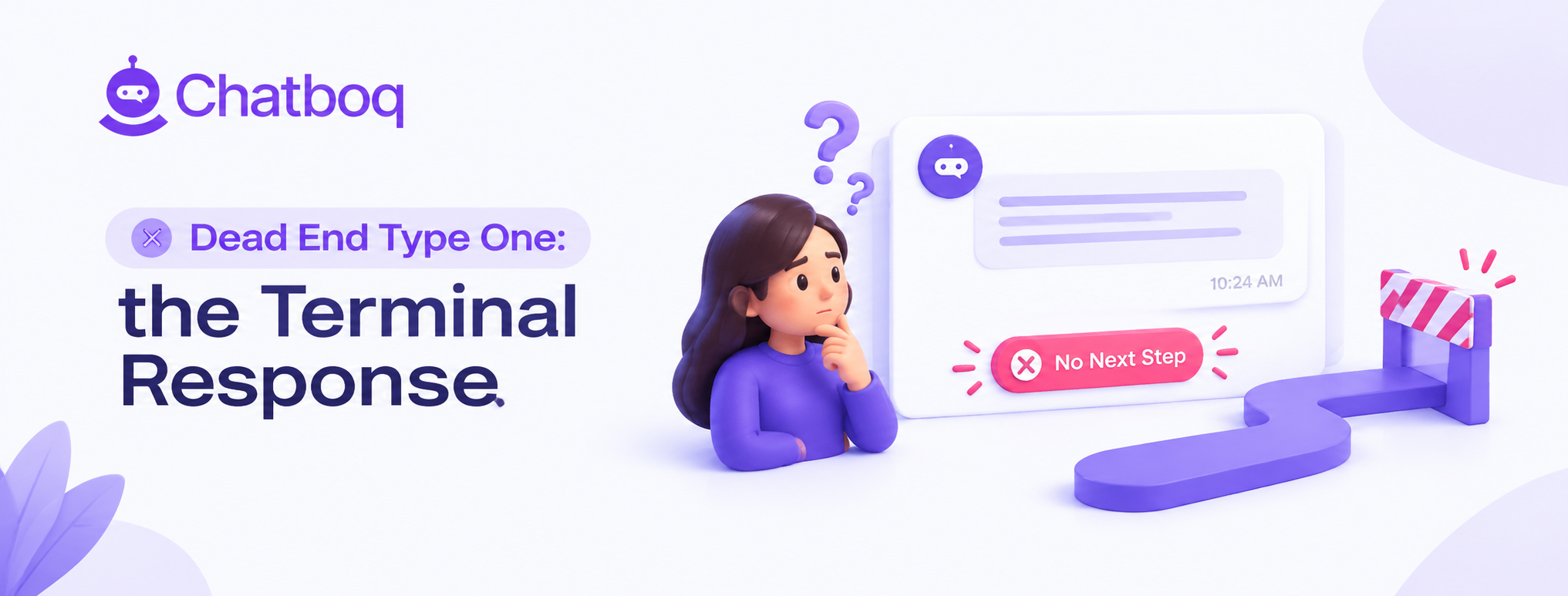




Leave a Comment
Your email address will not be published. Required fields are marked *
By submitting, you agree to receive helpful messages from Chatboq about your request. We do not sell data.