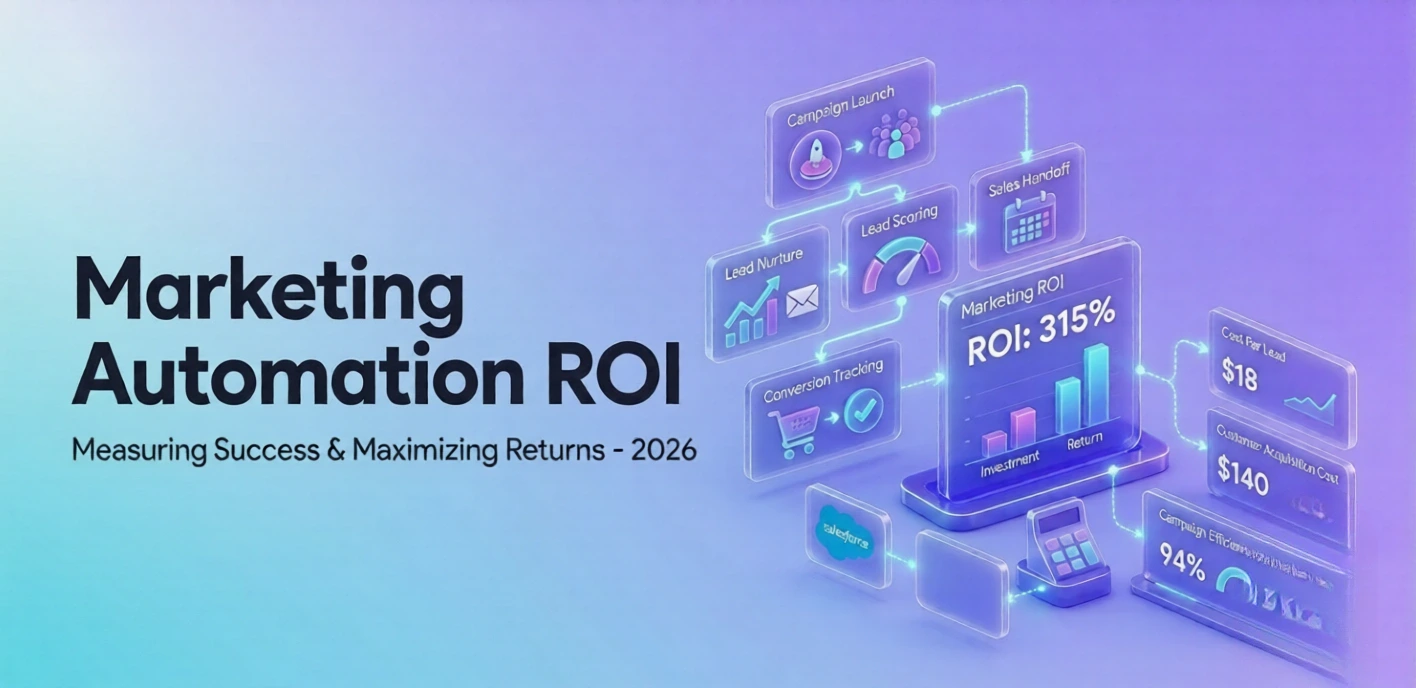
Marketing automation performance requires tracking metrics across 3 funnel layers: engagement metrics that measure content effectiveness, conversion metrics that measure funnel progression, and revenue metrics that measure business impact. Tracking only one layer produces an incomplete picture that misattributes performance.
What Are the Most Important Marketing Automation KPIs?
The 6 most important marketing automation KPIs in priority order are: conversion rate (percentage of leads that convert to customers, the primary funnel output metric), customer acquisition cost (total marketing spend divided by new customers acquired, the primary efficiency metric), click-through rate (percentage of recipients who click a link in an automation email, the primary engagement metric), email open rate (percentage of delivered emails opened, the engagement baseline metric), revenue per email (total campaign revenue divided by emails sent, the direct revenue impact metric), and customer lifetime value (total revenue per customer over the full relationship, the long-term ROI metric).
How Do You Track Conversion Rates in Automation Workflows?
Conversion rate tracking in automation workflows requires defining a conversion event for each workflow stage: email subscriber to MQL (marketing qualified lead), MQL to SQL (sales qualified lead), SQL to opportunity, and opportunity to closed customer. Each conversion event requires a corresponding CRM stage update or goal completion in Google Analytics.
Workflow-level conversion rates reveal where the automation funnel is losing prospects. A workflow with a 35% email open rate, 8% CTR, and 0.5% lead-to-customer conversion rate has a conversion efficiency problem at the bottom of the funnel, not an engagement problem at the top. Stage-specific conversion tracking enables targeted optimization rather than unfocused campaign-level changes.
What Metrics Show Email Marketing Automation Success?
Email marketing automation success is confirmed by 3 metric combinations. High open rate (above 25%) combined with low click-through rate (below 1.5%) indicates messaging relevance problems: recipients open the email but the content does not motivate action. High CTR (above 3%) combined with low conversion rate indicates landing page or offer problems: recipients engage with the email but do not complete the conversion action. High conversion rate combined with high unsubscribe rate indicates audience targeting problems: the offer converts but reaches too many irrelevant contacts, producing list degradation.
How Do Engagement Metrics Impact Marketing Automation ROI?
Engagement metrics are leading indicators of marketing automation ROI because they show how campaign content is performing before revenue impact becomes measurable. A declining open rate in a lead nurture sequence signals that the audience is losing interest in the content, which will produce declining conversion rates and reduced revenue attribution 2 to 4 weeks later as the affected cohort progresses through the funnel.
Monitoring engagement decay (the rate at which open rates and CTRs decline across subsequent emails in a sequence) identifies nurture sequence fatigue before it compounds into measurable revenue loss. Sequences showing more than 15% engagement decay per email require content or timing optimization before the decay reaches the conversion stage of the funnel.

 ChatGPT
 Perplexity
 Claude


Leave a Comment
Your email address will not be published. Required fields are marked *
By submitting, you agree to receive helpful messages from Chatboq about your request. We do not sell data.