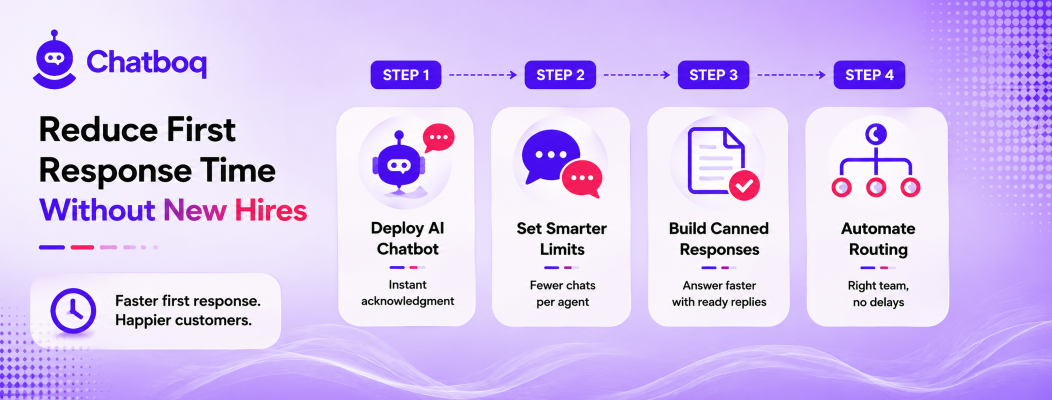
Six changes consistently reduce first response time without adding headcount: deploying a chatbot for instant acknowledgment, setting smarter concurrent chat limits, building out a canned response library, automating routing and triage, using proactive chat to shift volume earlier in the journey, and monitoring the queue in real time to reassign dynamically.
Step 1: Deploy an AI chatbot for instant acknowledgment
A chatbot that immediately acknowledges a message, even for requests it ultimately hands off to a human, satisfies the customer's need for an instant first response while the actual detailed answer is still being prepared.
Step 2: Set smarter concurrent chat limits
Reducing how many simultaneous conversations an agent is expected to juggle, based on actual observed response quality at different concurrency levels, often improves first response time more than it costs in raw throughput.
Step 3: Build out a canned response library
A well-organized library covering the handful of questions that make up most support volume lets agents respond in seconds rather than the minute or more it takes to type a full answer from scratch.
Step 4: Automate routing and triage
Automatically routing a conversation to the right team or skill group, and flagging its likely complexity, based on the customer's initial message removes the delay of a conversation sitting in a generic queue waiting for manual triage.
Step 5: Use proactive chat to shift volume earlier
Proactively starting a conversation at a moment of likely hesitation, rather than waiting for a customer to initiate contact, can resolve some questions before they ever become a queued, reactive support request at all.
Step 6: Monitor real-time queue and reassign dynamically
A live view of queue depth and individual agent load lets a team lead or supervisor manually rebalance conversations during unexpected spikes, catching the kind of temporary imbalance that automated routing alone sometimes misses.

 ChatGPT
 Perplexity
 Claude




Leave a Comment
Your email address will not be published. Required fields are marked *
By submitting, you agree to receive helpful messages from Chatboq about your request. We do not sell data.