
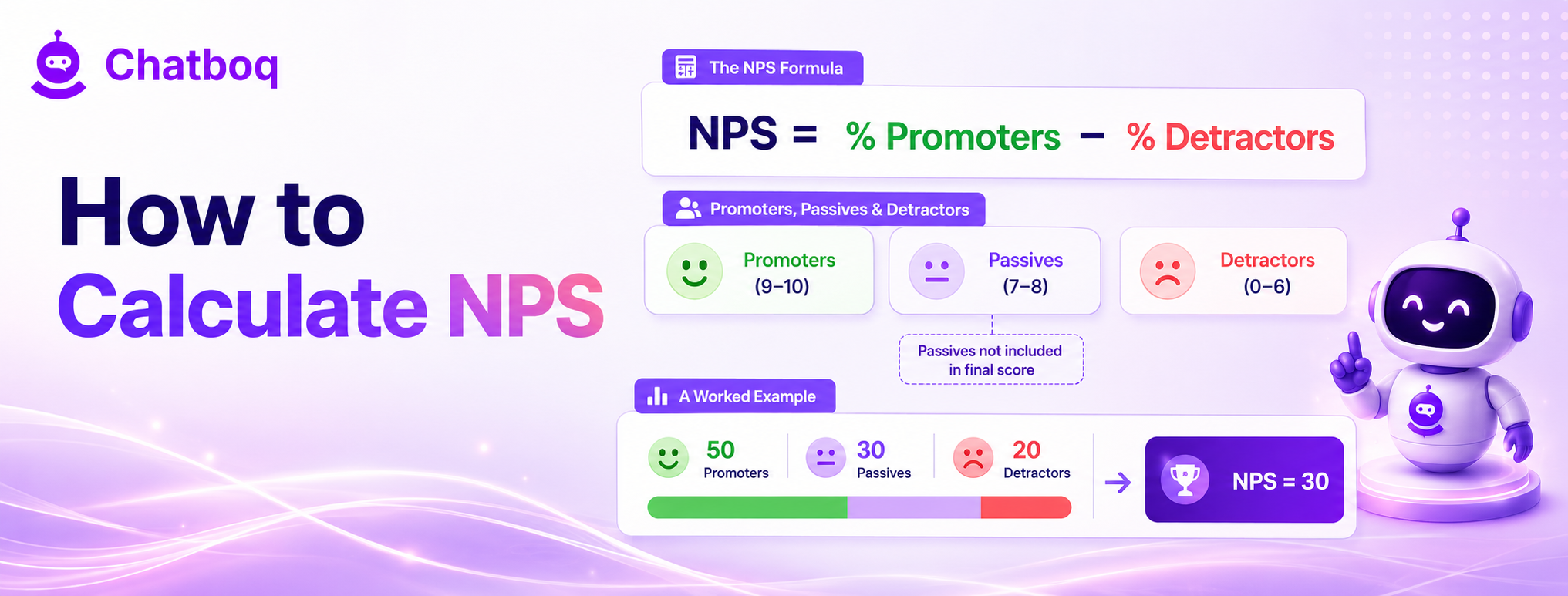
NPS is calculated by subtracting the percentage of detractors from the percentage of promoters, ignoring passives entirely, which produces a score ranging from -100 to 100, unlike a percentage-based metric that stays within a 0 to 100 range.
The NPS formula
NPS = % Promoters − % Detractors, where promoters are respondents who scored 9 or 10, passives scored 7 or 8, and detractors scored 0 through 6. Passives are counted toward the total number of respondents when calculating the percentages, but they don't appear anywhere in the final subtraction, which is a detail that trips up a lot of people building their first NPS calculation.
Promoters, passives, and detractors explained
Promoters are enthusiastic, loyal customers likely to refer others, repurchase, and stick around through a price increase or a rough patch. Passives are satisfied but unenthusiastic, the customers most vulnerable to a competitor's marketing the moment a better offer appears. Detractors are unhappy customers at real risk of churning, and importantly, capable of actively damaging the brand through negative word of mouth well beyond their own individual relationship with the business.
A worked example
Out of 100 responses, 50 promoters, 30 passives, and 20 detractors gives an NPS of 50% − 20%, or 30, a straightforward score to track over time even though the underlying number ranges far beyond a typical percentage scale. If that same business improved its onboarding and, six months later, saw 60 promoters and 15 detractors out of the same 100 responses, the new NPS of 45 would clearly show the improvement even without reading a single comment.
 ChatGPT
 Perplexity
 Claude









Leave a Comment
Your email address will not be published. Required fields are marked *
By submitting, you agree to receive helpful messages from Chatboq about your request. We do not sell data.