
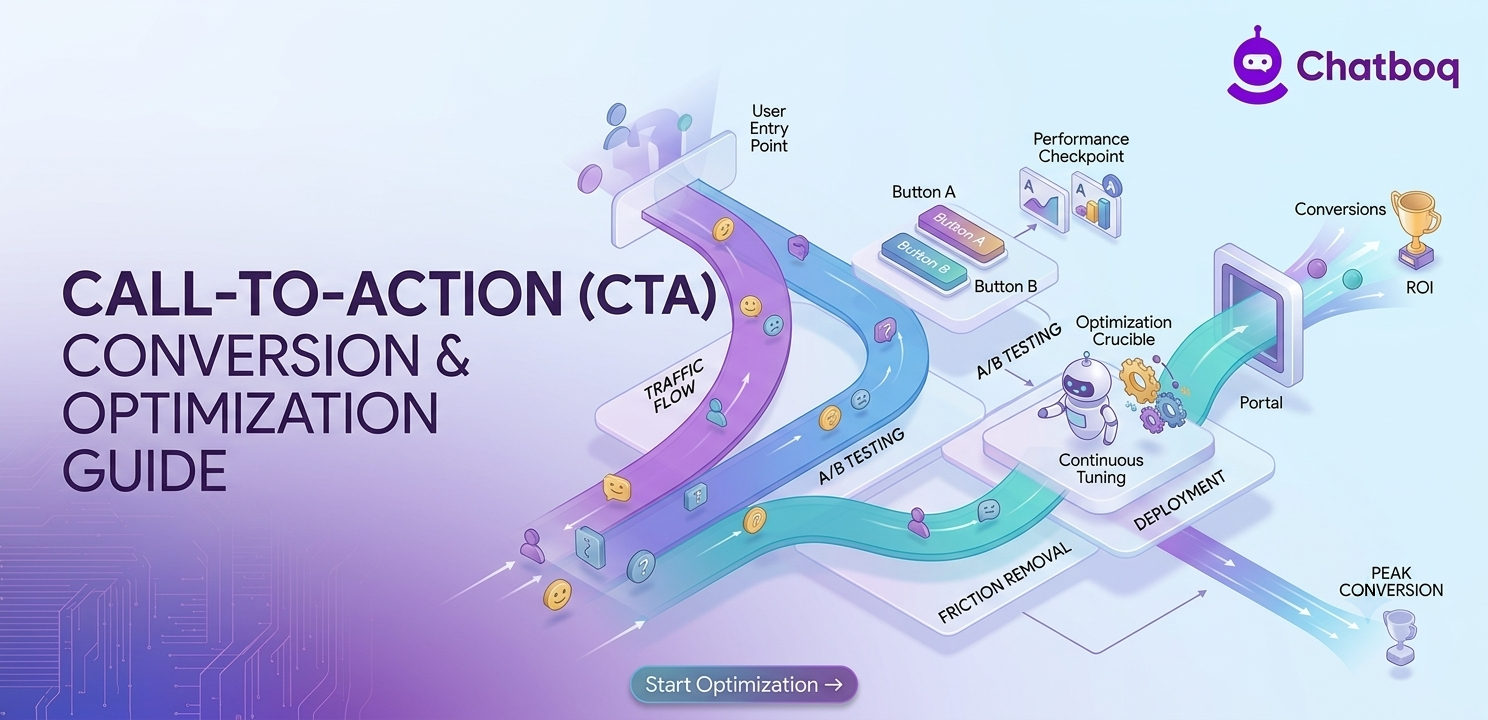
A call-to-action (CTA) guides users toward a specific next step inside a website, email, landing page, chatbot flow, or marketing campaign. Businesses use CTAs to move users through conversion paths, reduce decision friction, increase engagement, and turn attention into measurable actions like clicks, sign-ups, purchases, demo requests, or conversation responses.
CTA performance depends on strong copy, visual hierarchy, behavioral targeting, placement strategy, and alignment with user intent. Landing page CTAs, ecommerce purchase buttons, SaaS sign-up prompts, email marketing CTAs, conversational chatbot prompts, and micro-interaction CTAs all serve different functions depending on where the user is in the decision process.
Businesses measure CTA performance through click-through rate, conversion rate, engagement metrics, funnel analytics, and conversion tracking. Businesses use A/B testing, personalization systems, analytics platforms, behavioral segmentation, and AI-driven optimization workflows to improve CTA visibility, messaging clarity, timing, and conversion outcomes across websites, marketing campaigns, and conversational interfaces.
As digital experiences become more personalized, businesses increasingly use AI-generated CTAs, conversational CTAs, and real-time personalization systems to improve conversion performance. At the same time, weak messaging, poor placement, choice overload, unclear value propositions, and lack of testing continue to reduce CTA effectiveness across websites, email campaigns, ecommerce funnels, and chatbot interactions.
 ChatGPT
 Perplexity
 Claude



Leave a Comment
Your email address will not be published. Required fields are marked *
By submitting, you agree to receive helpful messages from Chatboq about your request. We do not sell data.