
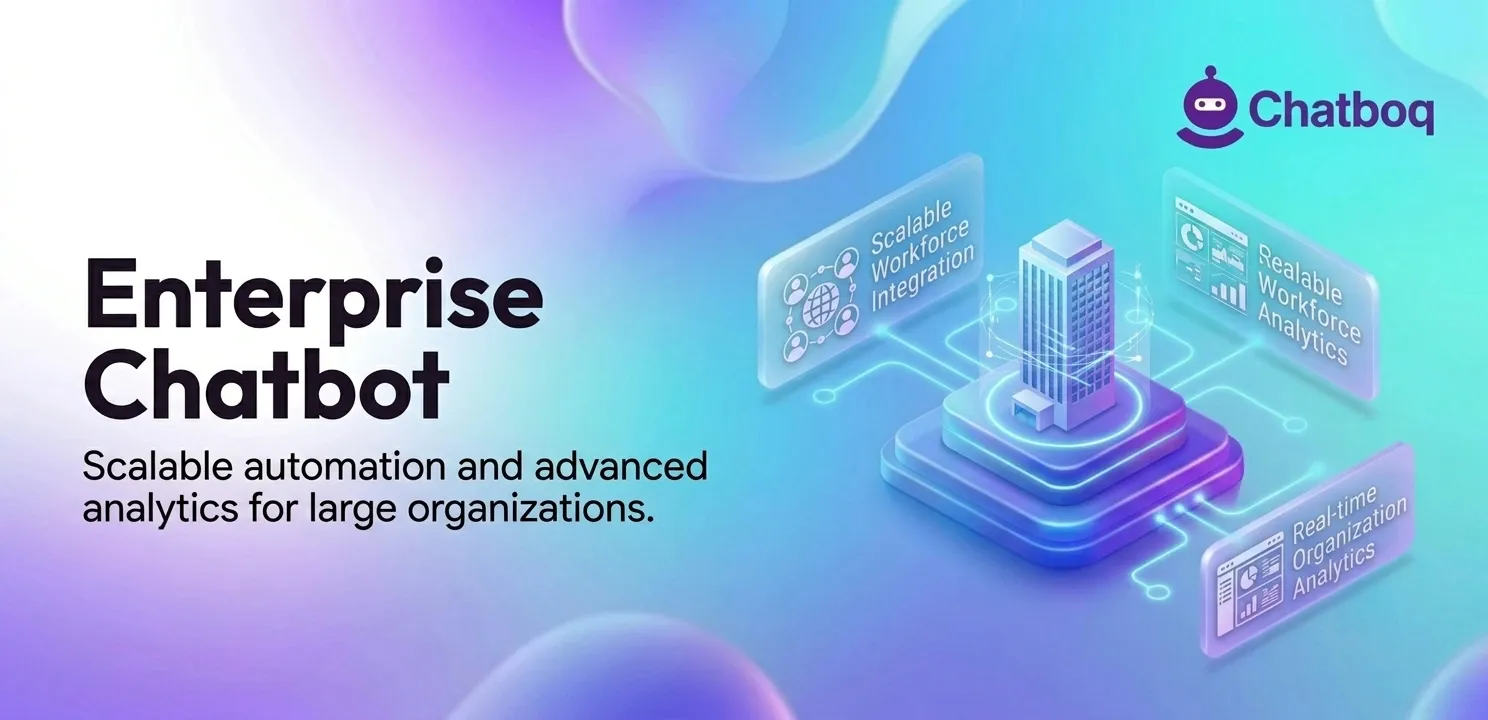
An enterprise chatbot is an AI-powered conversational system designed for large organizations, supporting customers, employees, partners, and internal operations simultaneously. It operates across websites, apps, messaging channels, contact centers, and enterprise systems rather than living inside a single isolated interface.
Enterprise chatbots differ from ordinary chatbots through access to enterprise data, deep workflow automation, strict security requirements, regulatory compliance obligations, multi-system integrations, and large-scale deployment requirements that a simple website widget never has to satisfy. A regular chatbot answers scripted questions on a single channel with little integration, while an enterprise chatbot operates at scale across many channels, connecting deeply to CRM, ERP, ticketing, and knowledge bases under enterprise-grade security.
Enterprise chatbots evolved through 5 distinct generations: FAQ bots, NLP chatbots, conversational AI, generative AI assistants, and agentic AI systems. The biggest shift in this evolution is AI agent capability, where enterprise platforms increasingly complete multi-step workflows rather than only answering FAQs.
What Is an Enterprise Chatbot?
An enterprise chatbot is a conversational AI system built specifically for organizational scale, governance, and integration depth, distinguishing it as a separate enterprise software category rather than simply a larger version of a consumer chatbot.
How Enterprise Chatbots Differ From Consumer Chatbots
Enterprise chatbots connect to internal business systems and enforce strict security and compliance controls that consumer chatbots rarely need. Consumer chatbots typically operate on a single channel with limited backend integration.
This difference shapes everything about how each system is built, since an enterprise deployment must account for governance, auditability, and multi-department use far beyond a single customer-facing widget.
Enterprise Chatbot vs Standard Chatbot
A standard chatbot answers scripted questions on one channel with minimal integration. An enterprise chatbot operates across many channels, connects deeply to CRM, ERP, and ticketing systems, and meets security standards like SOC 2 and GDPR.
This distinction matters for procurement decisions, since buying a standard chatbot tool to handle enterprise-scale, multi-system requirements typically fails well before full deployment.
Enterprise Chatbot vs AI Chatbot
An AI chatbot refers broadly to any chatbot using machine learning or language models, regardless of scale. An enterprise chatbot is specifically an AI chatbot built to meet enterprise governance, security, and integration requirements.
Every enterprise chatbot is therefore a type of AI chatbot, but not every AI chatbot qualifies as enterprise-grade until it meets the organizational requirements this article covers throughout.
Enterprise Chatbot vs Virtual Assistant
A virtual assistant often implies a broader, more personal productivity tool, such as scheduling or task management for an individual. An enterprise chatbot is typically scoped to specific organizational functions like support or HR.
The overlap between these terms is significant in practice, since many enterprise chatbots now function as virtual assistants for employees within a defined departmental scope.
Enterprise Chatbot vs AI Agent
An enterprise chatbot traditionally responds within a conversation, while an AI agent takes autonomous, multi-step actions across systems with less direct human prompting at each step.
The line between these categories is blurring quickly, since the most advanced enterprise chatbot platforms in 2026 increasingly embed agentic capability directly into the conversational layer itself.
 ChatGPT
 Perplexity
 Claude


Leave a Comment
Your email address will not be published. Required fields are marked *
By submitting, you agree to receive helpful messages from Chatboq about your request. We do not sell data.