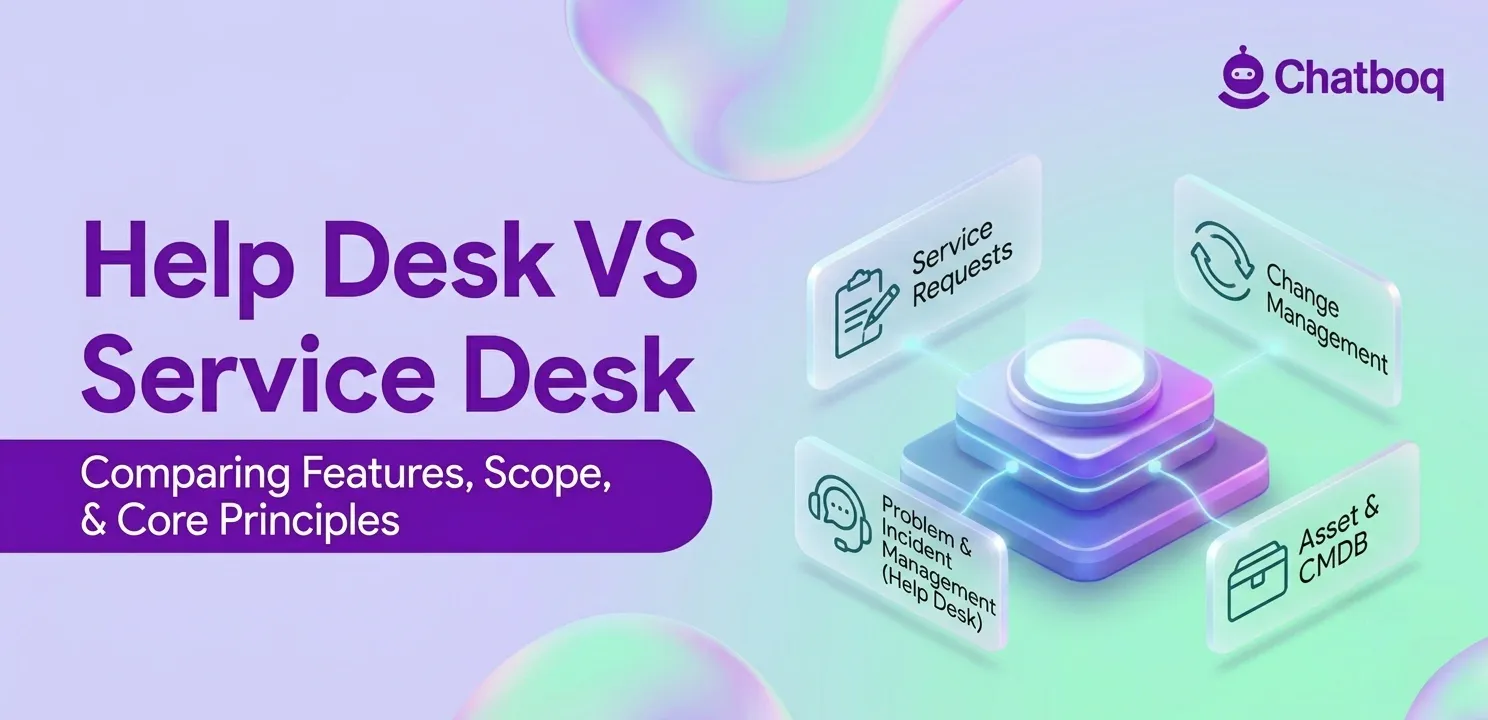
A help desk resolves incidents. A service desk manages IT services. The help desk is a break-fix support system focused on restoring normal user operation as fast as possible. The service desk is a full IT service management system that aligns IT delivery with business requirements across the service lifecycle.
One-line definition
Help desk: a reactive incident resolution system for end-user IT problems. Service desk: a proactive IT service management hub covering incidents, requests, changes, and problems under a governed framework.
Tactical vs strategic model
The help desk maintains operational continuity by fixing what breaks. Success means low average resolution time and high ticket closure rate. The service desk optimizes business alignment by managing how IT services are designed, delivered, and improved. Success means SLA compliance, low incident recurrence, and measurable business impact from IT operations.
Scope difference
A help desk scope ends at ticket closure. Resolution is the outcome. A service desk scope spans the entire service lifecycle: service design, delivery, operation, and continuous improvement. Problem management connects incident data to root cause analysis and permanent fixes.
Architecture difference
A help desk is an incident management system. Its architecture centers on the ticketing workflow. A service desk is an ITSM ecosystem layer. Its architecture includes incident management, the service catalog, change advisory workflows, asset tracking, and knowledge management as integrated components.
Key Functional Differences
Help desks and service desks differ across six functional dimensions. The differences are not cosmetic. They reflect fundamentally different operating models with different tooling, governance, and business alignment requirements.
|
Dimension
|
Help Desk
|
Service Desk
|
|
Primary focus
|
Incident resolution
|
Full IT service lifecycle
|
|
Request handling
|
Incidents only
|
Incidents + service requests + changes
|
|
Operating model
|
Reactive
|
Proactive and reactive
|
|
Tool integration
|
Ticketing system
|
ITSM platform with catalog, CMDB, workflows
|
|
Reporting depth
|
Ticket volume and resolution time
|
SLA compliance, MTTR, change success rate
|
|
SLA handling
|
Informal or basic
|
Formally defined, tracked, and reported
|
Focus and purpose
A help desk exists to resolve user-reported problems quickly. A service desk exists to manage IT service delivery across the organization and align it with business outcomes.
Incident vs service request handling
A help desk handles incidents: unplanned disruptions to normal operation. A service desk handles incidents and service requests, which are planned actions from the service catalog. Installing new software, provisioning access, and onboarding a new employee are service requests, not incidents. Help desks often process these requests without formal categorization, causing tracking and reporting gaps.
Reactive vs proactive model
Help desks respond after failures occur. Service desks prevent failures through problem management and change control. A service desk with mature problem management identifies that 30 percent of incidents trace to a single configuration error and eliminates the error, reducing ticket volume permanently.
Tools and integration depth
Help desk tools are ticketing systems: Freshdesk, Zendesk, Jira Service Management at basic configuration. Service desk tools are full ITSM platforms: ServiceNow, Jira Service Management at enterprise configuration, Ivanti, or Freshservice with ITIL workflows enabled. The service desk platform integrates with the CMDB, asset management systems, change advisory workflows, and the service catalog.
Reporting and analytics maturity
Help desk reporting covers ticket volume, first response time, resolution time, and CSAT. Service desk reporting covers SLA compliance rates, MTTR, change success rate, incident recurrence rate, and service availability metrics that connect IT performance to business impact.
SLA and compliance handling
Help desks apply informal or basic response time targets. Service desks define formal SLAs per service type, track compliance continuously, and escalate SLA breach risks before they occur. In regulated industries, service desk SLA documentation serves as audit evidence for compliance requirements.

 ChatGPT
 Perplexity
 Claude




Leave a Comment
Your email address will not be published. Required fields are marked *
By submitting, you agree to receive helpful messages from Chatboq about your request. We do not sell data.