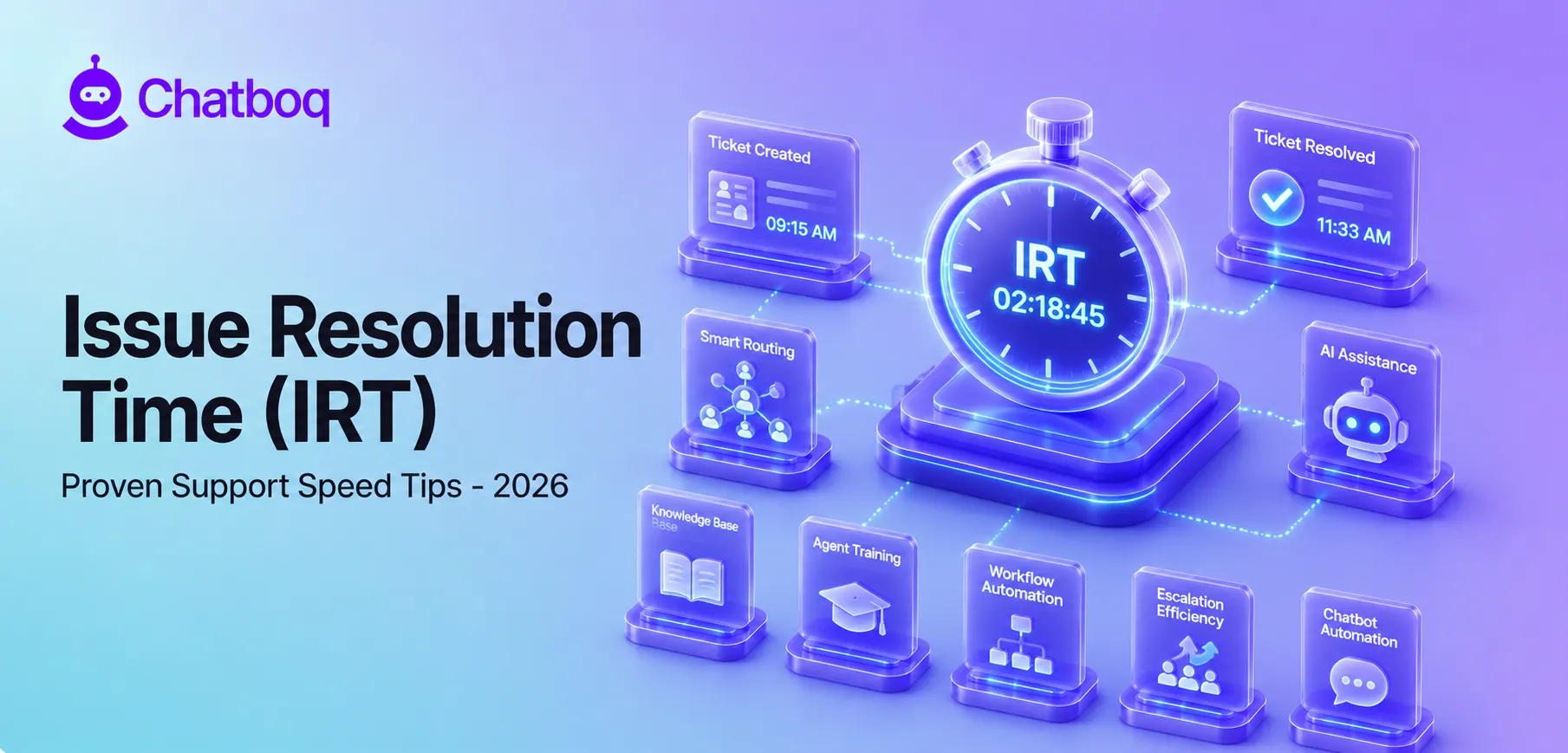
IRT is calculated by subtracting the ticket creation timestamp from the ticket closure timestamp and is commonly used in Service Level Agreement (SLA) tracking to measure compliance. The result is expressed in hours or days depending on the support operation's SLA structure and ticket complexity profile.
IRT Formula: IRT = Ticket Closure Timestamp - Ticket Creation Timestamp
Example of IRT Calculation
If a customer submits a ticket on June 1 at 10:00 AM and the support team closes it on June 3 at 10:00 AM, the Issue Resolution Time is:
-
Closure time: June 3, 10:00 AM
-
Creation time: June 1, 10:00 AM
-
IRT = 48 hours (2 days)
This shows the total elapsed time the ticket remained open until full resolution.
Ticket Time Measurement
IRT begins the moment a ticket enters the system through email-to-ticket conversion, live chat handoff, web form submission, chatbot escalation, or API integration. The clock stops when the ticket status is marked “Closed” in the helpdesk system.
Many platforms pause IRT during the “Pending” state when the issue is waiting on a customer response. This ensures only support-controlled time is measured, not customer delay time. Without proper pause configuration, IRT values can become inflated and misleading in reporting.
Average IRT Calculation
Average IRT (ART) is calculated by summing all individual ticket resolution times and dividing by total tickets in a given period. For example, if 500 tickets collectively take 2,500 hours to resolve, the average IRT equals 5 hours per ticket.
In real-world reporting, median IRT is often used alongside average IRT because extreme outliers, such as highly complex enterprise tickets, can distort the mean and misrepresent typical support performance.
Tracking Across Channels
Modern omnichannel support systems track IRT across email, live chat, phone, SMS, and social messaging within a single unified helpdesk. This ensures consistent measurement rules across all channels and prevents fragmented reporting.
In contrast, separate systems per channel often produce inconsistent IRT values due to differences in pause rules, SLA logic, and closure definitions. Unified tracking provides a more accurate view of true operational performance.
Individual vs Average IRT
Individual IRT measures the resolution time for a single ticket from creation to closure. It is primarily used for SLA compliance checks and identifying whether specific tickets meet required response standards.
Average IRT represents overall team performance across a group of tickets. It is used for trend analysis, benchmarking, and operational optimization. Both metrics are essential because average performance can hide slow or problematic individual tickets.

 ChatGPT
 Perplexity
 Claude





Leave a Comment
Your email address will not be published. Required fields are marked *
By submitting, you agree to receive helpful messages from Chatboq about your request. We do not sell data.