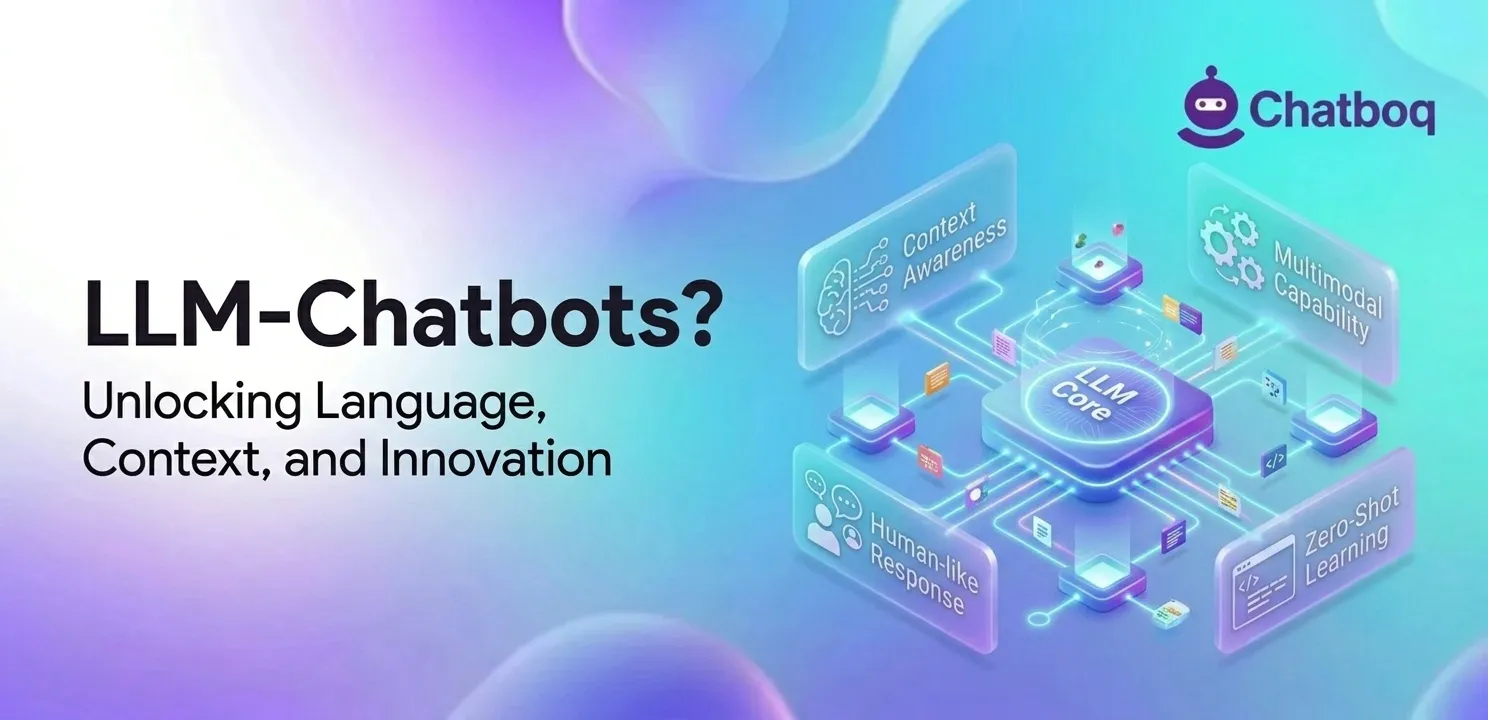
A complete LLM chatbot architecture spans 6 layers: the user interface, orchestration, the LLM itself, the retrieval layer, enterprise systems integration, and analytics, with each layer handling a distinct part of the overall pipeline from user input to enterprise-grounded response.
User Interface Layer
The user interface layer defines all channels through which users interact with an LLM chatbot, including web, mobile, and messaging platforms, while keeping the core conversational behavior consistent across environments. It typically appears as website chat widgets embedded in pages, mobile applications designed for native interaction, and messaging integrations that extend access into everyday communication tools.
These integrations include platforms like Slack and Microsoft Teams for workplace use cases and WhatsApp or similar messaging channels for broader accessibility. Together, they ensure the chatbot is available where users already work and communicate, reducing friction and maintaining a unified experience across different devices and entry points.
Orchestration Layer
The orchestration layer manages how an LLM chatbot processes and organizes user interactions between input and model response generation. It handles prompt routing, conversation state, and session memory to ensure each message is directed correctly and interpreted in the right context.
This includes routing queries to the appropriate model or prompt pipeline, tracking conversation flow across multiple turns, and maintaining session memory so earlier context can be referenced without repetition. Together, these functions ensure coherent, context-aware responses throughout the interaction.
LLM Layer
The LLM layer is the core component that generates responses, using either hosted commercial models, self-hosted open-source models, or a combination of multiple models depending on system design.
Hosted models like GPT-5 or Claude accessed via API enable fast deployment without infrastructure management, while open-source models such as Llama or Mistral provide greater control through self-hosting at the cost of added operational complexity. In more advanced setups, multi-LLM architectures route different queries to different models based on task requirements, balancing performance, cost, and capability.
Retrieval Layer (RAG)
The retrieval layer powers RAG by converting documents into embeddings, storing them in a vector database, and retrieving the most relevant content chunks before the LLM generates a response. It ensures the model is grounded in external knowledge rather than relying only on parametric memory.
Embedding models convert text into dense vector representations that capture semantic meaning, forming the basis for similarity search. These embeddings are stored in vector databases like Pinecone, Weaviate, Milvus, or Chroma, which enable fast retrieval across large document collections. The full process is managed by knowledge retrieval pipelines that handle chunking, embedding, querying, and reranking before passing context to the model.
Enterprise Systems Layer
The enterprise systems layer connects an LLM chatbot to live business systems and data sources, extending its capabilities beyond static knowledge to real-time operational and transactional use cases.
CRM integration enables the chatbot to read and update customer records during conversations, ensuring responses reflect current account data. Help desk integration connects it to ticketing systems for creating, updating, or escalating support requests directly. ERP integration provides access to operational data like inventory or order status for real-time business queries, while internal knowledge base integration grounds responses in verified company documentation through the retrieval pipeline.
Analytics and Evaluation Layer
The analytics and evaluation layer tracks conversation quality, usage patterns, and performance metrics across every interaction, feeding the evaluation and benchmarking practices covered later in this guide.

 ChatGPT
 Perplexity
 Claude



Leave a Comment
Your email address will not be published. Required fields are marked *
By submitting, you agree to receive helpful messages from Chatboq about your request. We do not sell data.