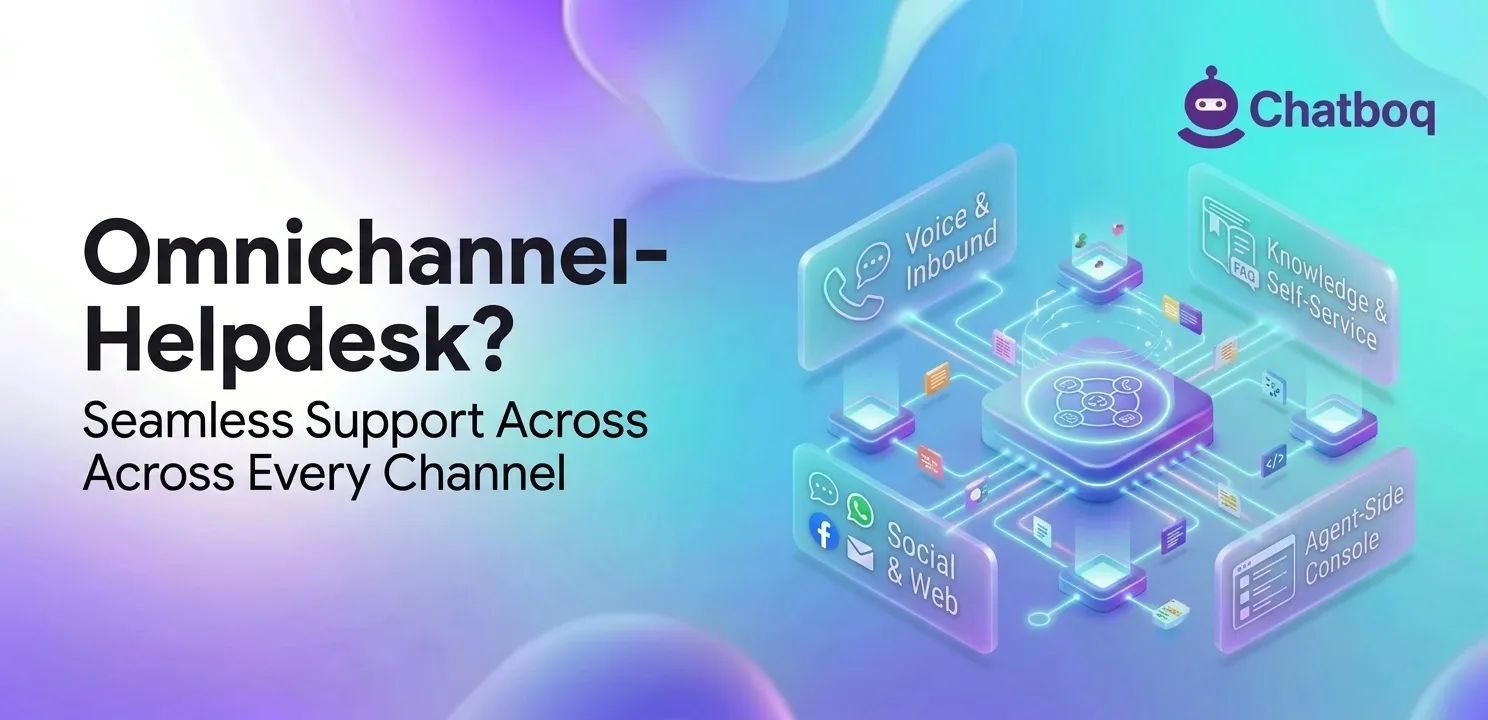
Omnichannel helpdesk software includes AI chatbots, helpdesk systems, and enterprise service platforms that manage customer conversations across channels. These tools handle chat, ticketing, routing, and escalation in a unified system. Examples include Chatboq, Zendesk, Freshdesk, Intercom, and Salesforce Service Cloud.
AI Chatbot Layer
AI Chatbot as the First Contact Point in Omnichannel Helpdesk
An AI chatbot typically sits as the very first contact point in a modern omnichannel architecture, engaging the customer immediately before any conversation reaches a human agent or even a formal ticket.
This positioning matters because it shapes the quality of everything downstream: a well-configured chatbot can resolve or properly triage a conversation before it ever consumes human agent time.
How Chatbots Reduce Ticket Volume Before Human Routing
Chatbots reduce ticket volume by resolving common, repetitive queries directly, with Freddy AI Agent and similar tools able to answer queries and perform actions autonomously without human involvement.
This deflection effect is significant at scale, since every query fully resolved by the chatbot is one that never consumes agent time or counts against response time SLAs at all.
Conversational AI vs Rule-Based Bots in Support Systems
Rule-based bots follow fixed decision trees and fail outside their anticipated paths, while conversational AI interprets natural language flexibly, handling a far wider range of phrasing and intent.
This distinction increasingly favors conversational AI in 2026 deployments, since rule-based systems simply cannot match the flexibility customers now expect from a first point of contact.
Where Chatbot Fits in Omnichannel Architecture
The chatbot functions as an entry layer that filters and structures incoming conversations, not as a replacement for the broader helpdesk system that handles ticketing, routing, and human escalation.
This distinction is important architecturally: a chatbot without a connected helpdesk behind it has no path to escalate complex issues, while a helpdesk without a chatbot in front of it processes unnecessary volume manually.
Core Helpdesk Platforms (Unified Omnichannel Systems)
Chatboq (All-in-One Live Chat and AI Chatbot Platform)
Chatboq combines live chat and AI chatbot capability into a single platform positioned at the entry layer of the omnichannel stack, qualifying and structuring conversations before they reach a core ticketing system.
This positions Chatboq well for teams that want strong AI-driven first contact without committing immediately to a heavier, full enterprise helpdesk suite.
Zendesk (Enterprise Omnichannel Routing + AI Automation)
Zendesk operates as an enterprise-grade customer experience suite with extensive customization and advanced workflows, unifying email, chat, voice, social, and messaging natively in one agent workspace.
Zendesk's entry-level Suite Team plan runs $55 per agent per month, with Suite Professional around $115, and many advanced AI or analytics modules billed as separate add-ons on top of that base.
Freshdesk (SMB + Scalable Omnichannel Inbox)
Freshdesk positions itself as the cost-effective, intuitive helpdesk option, with its Growth plan around $18 to $29 per agent per month and a free tier for teams of up to 2 agents.
Freddy AI Agent uses session-based pricing rather than per-resolution billing, and Freddy AI Copilot can be added for roughly $29 per month per selected agent.
Intercom (AI-First Conversational Support)
Intercom takes a conversational-first approach centered on a messenger interface rather than traditional ticketing, emphasizing real-time messaging and proactive outreach for product-led SaaS companies.
Intercom's Fin AI is included across all its plan tiers, though by the time a team adds the Advanced plan plus Fin AI and additional messaging channels, effective per-agent cost can reach $120 to $175.
HubSpot Service Hub (CRM-Integrated Support Workflows)
HubSpot Service Hub embeds support directly inside the broader HubSpot CRM ecosystem, connecting ticketing and conversation history to the same customer record used by sales and marketing teams.
This deep CRM integration makes it particularly well suited to organizations that want support data to inform broader customer lifecycle decisions without separate integration work.
Zoho Desk (Cost-Efficient Omnichannel Setup)
Zoho Desk is an affordable omnichannel help desk offering ticketing, automation, knowledge base, and multi-channel intake, with particularly strong value for teams already using other Zoho apps.
Zia, Zoho Desk's built-in AI, applies across sentiment detection, response suggestions, and assignment rules, learning from an organization's specific support patterns to improve relevance over time.
Advanced Enterprise Omnichannel Suites
Salesforce Service Cloud (Deep CRM + AI Orchestration)
Salesforce Service Cloud is an enterprise-grade omnichannel service platform tightly integrated with Salesforce CRM, supporting case management, omnichannel routing, and extensive customization through the broader Salesforce platform.
This deep CRM alignment makes it a common fit for large service organizations that need support tightly connected to sales, marketing, and customer data, though implementation typically requires dedicated admin expertise.
ServiceNow CSM (Enterprise Workflow Automation + ITSM Convergence)
ServiceNow CSM brings ITSM discipline directly into customer service, connecting support issues to root causes in backend IT or product systems through connected workflows.
ServiceNow licensing for CSM typically runs $100 to $200 per user per month, often with additional platform licensing fees, making it best suited to enterprises already running ServiceNow for internal IT operations.
HaloCRM / HaloPSA (Service-Centric Omnichannel Orchestration)
HaloCRM and HaloPSA provide service-centric omnichannel orchestration aimed at organizations that want a unified platform spanning both customer-facing support and internal service management.
This positioning suits organizations seeking an alternative to assembling separate ticketing, CRM, and ITSM tools, consolidating that orchestration into a single connected platform instead.
LiveAgent (Multi-Channel Communication Hub)
LiveAgent functions as a multi-channel communication hub combining email, live chat, call center, and social media management within one accessible, mid-market-friendly platform.
This positioning makes it a practical option for growing teams that need broad channel coverage without the implementation complexity associated with larger enterprise suites.
Emerging AI-First Helpdesk Tools (2026 Trend Gap Competitors Miss)
AI-Native Support Agents Replacing Ticket-First Workflows
AI-native support agents are increasingly designed around conversation resolution rather than ticket creation, treating the ticket as a byproduct of the interaction rather than its starting point.
This shift challenges the traditional ticket-first model most legacy helpdesks were built around, favoring instead a conversational record that may never need to become a formally tracked ticket at all.
Autonomous Resolution Systems (Agentic Support Models)
Autonomous resolution systems use agentic AI models capable of taking multi-step action, such as processing a refund or updating an account, rather than simply generating a text response.
This represents a meaningful capability jump beyond earlier chatbot generations, since the system is now executing real changes rather than only answering informational questions.
Multi-LLM Helpdesk Orchestration Platforms
Multi-LLM helpdesk orchestration platforms route different support queries to different underlying language models based on complexity or cost, rather than relying on a single model for every interaction type.
This pattern mirrors the broader multi-LLM trend across AI applications, allowing helpdesk platforms to balance response quality against per-interaction cost more precisely.
Headless Helpdesk APIs for Custom Support Stacks
Headless helpdesk APIs expose core ticketing, routing, and conversation functionality without a fixed front-end interface, allowing organizations to build a fully custom support experience on top.
This approach appeals specifically to organizations with unique workflow requirements that off-the-shelf platforms cannot accommodate without extensive, often fragile customization.

 ChatGPT
 Perplexity
 Claude


Leave a Comment
Your email address will not be published. Required fields are marked *
By submitting, you agree to receive helpful messages from Chatboq about your request. We do not sell data.