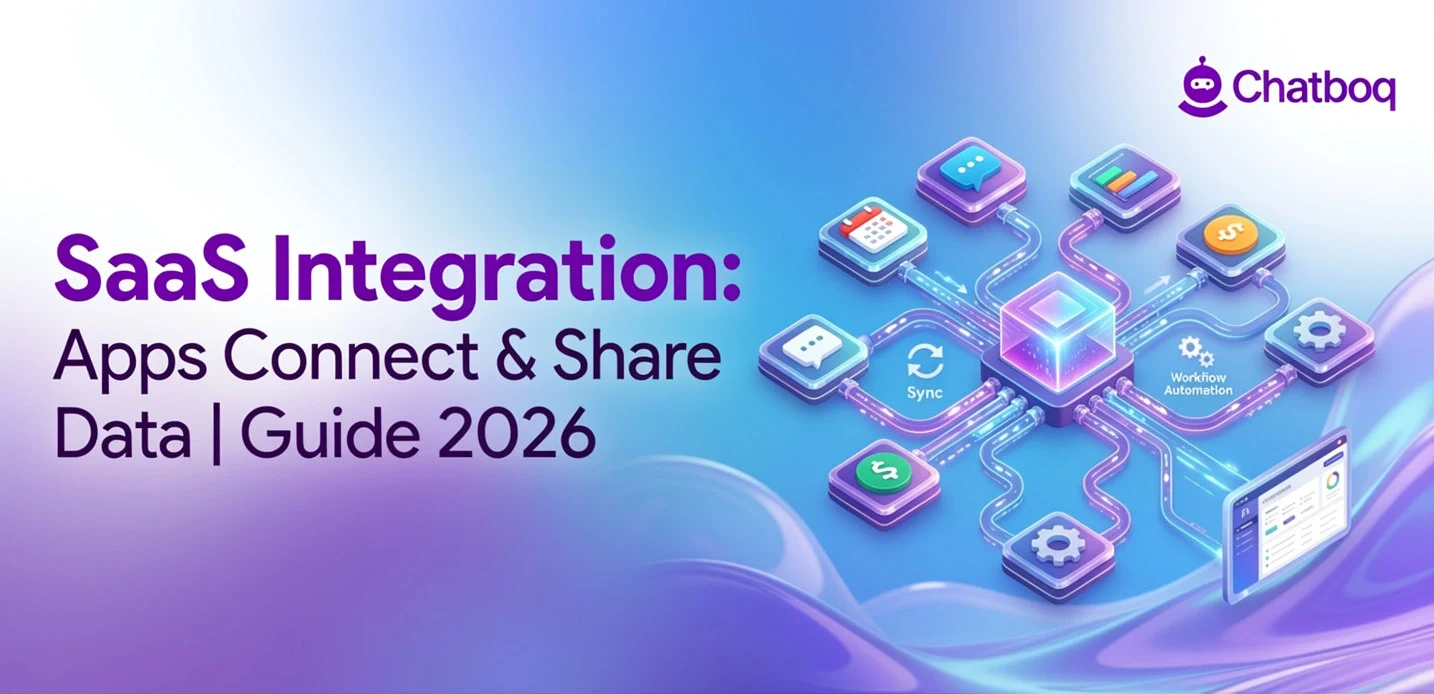
The SaaS integration tool market is divided into 6 layers: AI chatbot integration orchestrators, iPaaS platforms, embedded integration platforms, API management and middleware, data integration tools, and billing and payment integration tools. Each layer solves a distinct technical problem in the integration stack.
AI Chatbot Integration Layer (New Market Layer)
Chatbots as Integration Orchestrators
AI agents are emerging as a new integration layer that can coordinate actions across multiple SaaS applications from a single natural-language request. A support AI can create a Zendesk ticket, update Salesforce, and send
Chatbot-Connected SaaS Ecosystems
Chatbot-connected SaaS ecosystems allow AI agents to act as the coordination layer between tools. The AI agent holds context across a conversation and executes multi-step SaaS workflows in sequence: qualifying a lead, creating a CRM record, assigning a sales rep, and scheduling a calendar invite from a single incoming chat message.
Use Cases: Support Automation, CRM Updates, Internal Ops
Support automation: AI triage agent classifies incoming tickets, routes by urgency, creates Zendesk records, and notifies the relevant team in Slack. CRM updates: AI sales copilot listens to call transcripts and updates Salesforce opportunity fields without manual data entry. Internal ops: AI assistant handles employee onboarding requests by provisioning accounts across Okta, Slack, and Google Workspace.
Tools in the AI Chatbot Integration Layer
|
Tool
|
Primary Use
|
Integration Depth
|
|
Chatboq
|
AI-powered chatbot with SaaS workflow triggers
|
CRM, support, billing integrations
|
|
Intercom AI
|
Support automation with AI triage and routing
|
Zendesk, Salesforce, Slack
|
|
Zendesk AI Agents
|
Automated ticket resolution and routing
|
Internal Zendesk ecosystem + CRM
|
|
Custom GPT-based SaaS Copilots
|
Purpose-built AI assistants for specific SaaS stacks
|
API-based, varies by configuration
|
iPaaS Platforms
Zapier connects 7,000+ apps through trigger-action workflows. The free plan allows 100 tasks per month. Paid plans scale from approximately $20 to $800+ per month based on task volume and team size. Suited for business users building simple automation without developer support.
Workato provides enterprise-grade automation with recipe-based workflow building. Handles complex conditional logic, on-premise connections, and compliance requirements. Workato's pricing typically starts in the high five or six figures annually for enterprise deployments. Suited for IT teams in mid-enterprise organizations.
MuleSoft provides the Anypoint Platform for API management, integration, and developer tooling at enterprise scale. Requires a dedicated integration engineering team. Starting cost exceeds $80,000 per year. Suited for large enterprises integrating proprietary, legacy, and cloud systems.
Make (formerly Integromat) provides visual workflow building with stronger transformation capabilities than Zapier at comparable pricing. The free plan allows 1,000 operations per month. Paid plans start at approximately $9 per month. Suited for technical users who need more than Zapier's linear trigger-action model.
Embedded Integration Platforms (B2B SaaS Focus)
Merge provides a unified API layer for HR, ATS, CRM, accounting, and ticketing categories. SaaS vendors integrate once with Merge and gain access to dozens of underlying systems through a single normalized data model. Data is normalized at the Merge layer before delivery, reducing per-integration engineering work.
Paragon provides an embedded iPaaS for SaaS products, allowing vendors to build native integration experiences inside their product. Paragon manages OAuth flows, webhook delivery, and connector updates on behalf of the SaaS vendor.
Tray.io provides a flexible automation platform for both enterprise workflow automation and embedded product integration. Supports complex conditional routing and custom connector development through a low-code builder.
Cyclr is an embedded iPaaS focused on B2B SaaS vendors that need to deliver white-labeled integration marketplaces to their customers. Pre-built connectors are customizable and deployable within the SaaS product UI.
API Management and Middleware
Apigee (Google Cloud) provides enterprise API gateway services including rate limiting, authentication, analytics, and developer portal management. Used by enterprises that expose internal APIs to external developers or partners.
Kong is an open-source API gateway available as self-hosted or Kong Konnect (cloud-managed). Provides rate limiting, authentication plugins, request transformation, and service mesh capabilities. Lower cost than Apigee for teams with infrastructure engineering capability.
AWS API Gateway provides managed API gateway services within the AWS ecosystem. Integrates natively with Lambda, Cognito, and CloudWatch. Best for teams already operating on AWS infrastructure.
Data Integration Tools
Fivetran automates data pipeline creation from SaaS sources to data warehouses. Pre-built connectors for Salesforce, HubSpot, Stripe, Zendesk, and 300+ additional sources. Schema change handling is automatic. Pricing is consumption-based on rows synced.
Airbyte is an open-source ELT platform with 350+ pre-built connectors available through the Airbyte Cloud or self-hosted versions. Lower cost than Fivetran for high-volume data movement when self-hosted. Connector library is community-maintained.
Stitch (Talend) provides simple SaaS-to-warehouse pipelines with a focus on ease of setup. Fewer connectors than Fivetran but lower pricing for standard use cases. Suitable for teams that need fast warehouse loading without complex transformation logic.
Billing and Payment Integration Tools
Stripe Billing provides a webhook-based integration framework for subscription lifecycle events. Events fire on subscription creation, renewal, payment failure, cancellation, and upgrade. The Stripe API is one of the most developer-friendly in the SaaS ecosystem with clear idempotency support.
Chargebee provides subscription management with native integrations to Salesforce, HubSpot, NetSuite, and QuickBooks. Revenue recognition automation integrates with accounting systems to comply with ASC 606 and IFRS 15 without manual journal entries.
Recurly provides subscription management with built-in dunning management and revenue recovery. Native integrations cover accounting, CRM, and data warehouse destinations. Pricing is percentage-of-revenue based.

 ChatGPT
 Perplexity
 Claude


Leave a Comment
Your email address will not be published. Required fields are marked *
By submitting, you agree to receive helpful messages from Chatboq about your request. We do not sell data.