


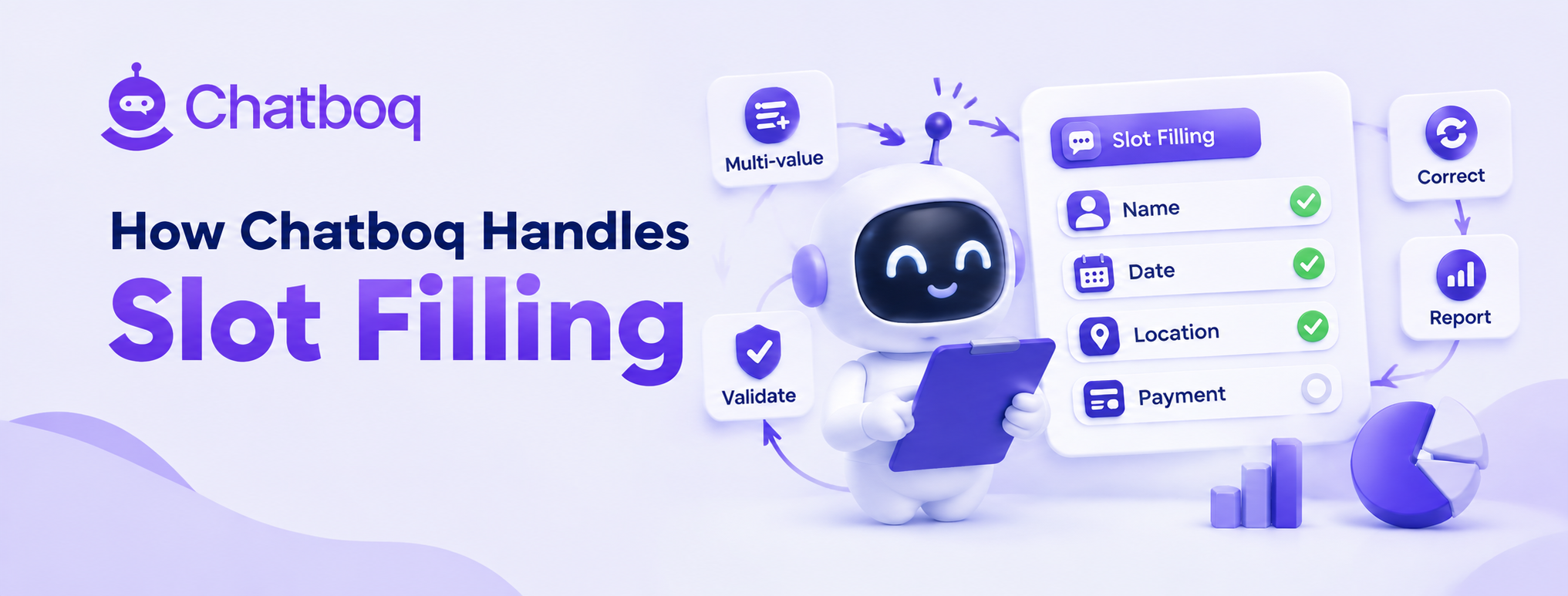
Slots are filled from what the user says, from the customer record, from context earlier in the conversation, or from sensible defaults.
Extracted from the user's message
The most direct source is entity extraction from what the customer wrote, which is why extraction accuracy directly determines how many questions a flow needs to ask.
A single message frequently contains several slot values, and capturing all of them rather than only the one requested is what makes a flow feel responsive.
Retrieved from existing records
Contact details, account references, preferred locations and previous choices are usually already known, and asking for them again signals that the business is not paying attention.
Pre-filling from records and asking the customer only to confirm is faster for them and produces more accurate data than retyping.
Inferred or defaulted
Some slots have sensible defaults, such as assuming the nearest branch or the account holder as the contact, which removes a question entirely.
Defaults must remain visible and correctable, since a silent assumption that proves wrong is worse than the question it replaced.
Carrying values from earlier in the conversation
A value mentioned casually several turns before a flow began should still fill the relevant slot, since the customer will assume the system was listening.
Systems that only extract from the immediate reply create the impression of an assistant that forgets things it was just told.
 ChatGPT
 Perplexity
 Claude







Leave a Comment
Your email address will not be published. Required fields are marked *
By submitting, you agree to receive helpful messages from Chatboq about your request. We do not sell data.