

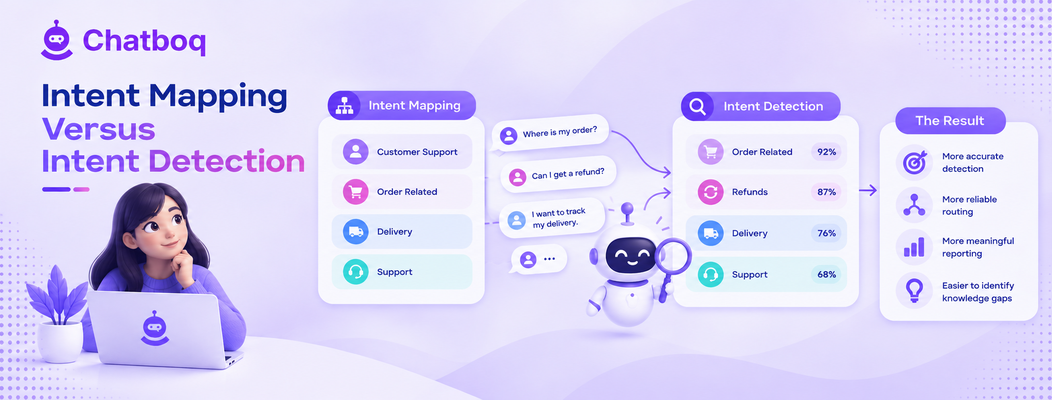
Mapping defines what intents exist and how they are organised, while detection classifies an incoming message against that structure at runtime.
Design time versus runtime
Mapping is a periodic design activity producing a taxonomy, whereas detection happens on every message and depends entirely on the quality of that taxonomy.
Teams frustrated by poor detection accuracy frequently have a mapping problem, since a model cannot distinguish between intents that were never properly distinguished.
Why the distinction gets lost
Both are usually configured in the same interface, which makes them feel like one activity even though they involve very different work and different skills.
Mapping is research and information architecture, while detection tuning is data and threshold work, and doing the second first rarely produces good results.
What good mapping enables
A clean intent set makes detection more accurate, routing more reliable, reporting more meaningful and knowledge gaps considerably easier to identify.
It also gives the business a shared vocabulary for what customers ask about, which is useful well beyond the chatbot project that produced it.
 ChatGPT
 Perplexity
 Claude










Leave a Comment
Your email address will not be published. Required fields are marked *
By submitting, you agree to receive helpful messages from Chatboq about your request. We do not sell data.