

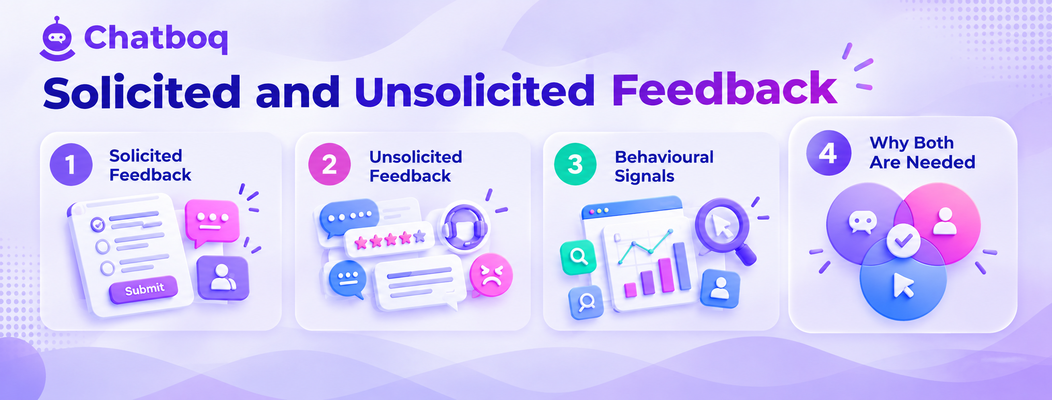
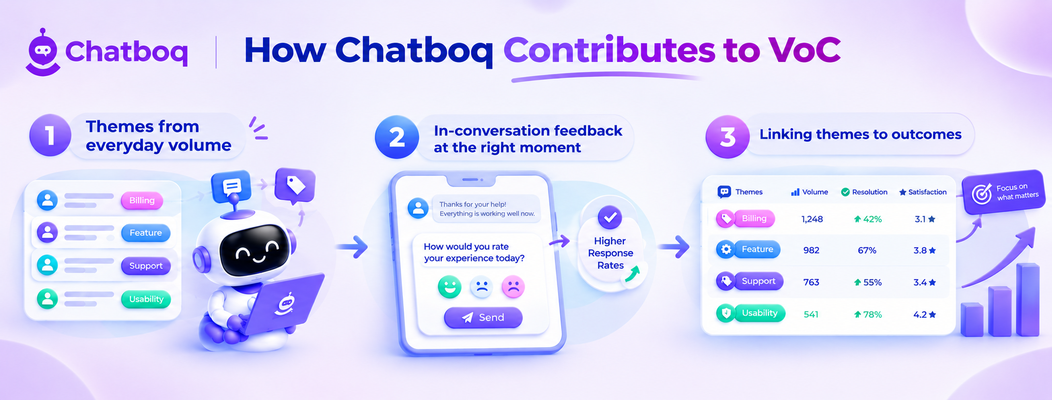
Solicited feedback is what you asked for, unsolicited is what customers volunteered, and a programme relying on only one of them sees a distorted picture.
What solicited feedback gives you
Surveys and interviews let you ask about specific things at specific moments, which is the only way to get comparable data across customers and over time.
The limitation is that you only learn about what you thought to ask, and response rates skew toward customers with strong opinions in either direction.
What unsolicited feedback gives you
Support conversations, reviews and cancellation reasons reveal problems nobody thought to ask about, expressed at the moment of frustration rather than in recollection.
The volume is far larger and the analysis harder, which is why most organisations collect it continuously and analyse it rarely.
Why both are needed
Unsolicited feedback tells you what is going wrong, while solicited feedback tells you how widespread it is and whether a fix worked.
Using only surveys produces a programme that measures known issues, while using only conversations produces one that cannot quantify anything.
Behavioural signals as a third source
What customers do, including where they abandon, what they search for and which features they never use, is feedback expressed through behaviour rather than words.
It is the most honest of the three sources and the least specific, which makes it most useful as a prompt for investigating with the other two.
 ChatGPT
 Perplexity
 Claude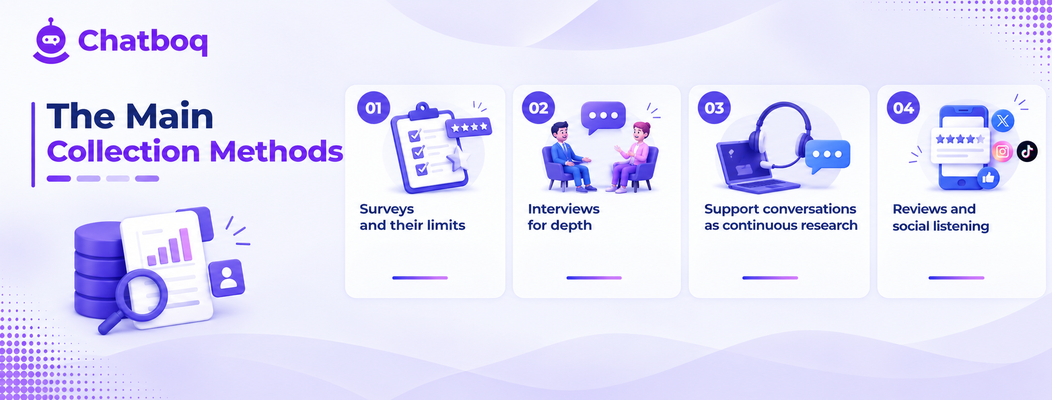





Leave a Comment
Your email address will not be published. Required fields are marked *
By submitting, you agree to receive helpful messages from Chatboq about your request. We do not sell data.