
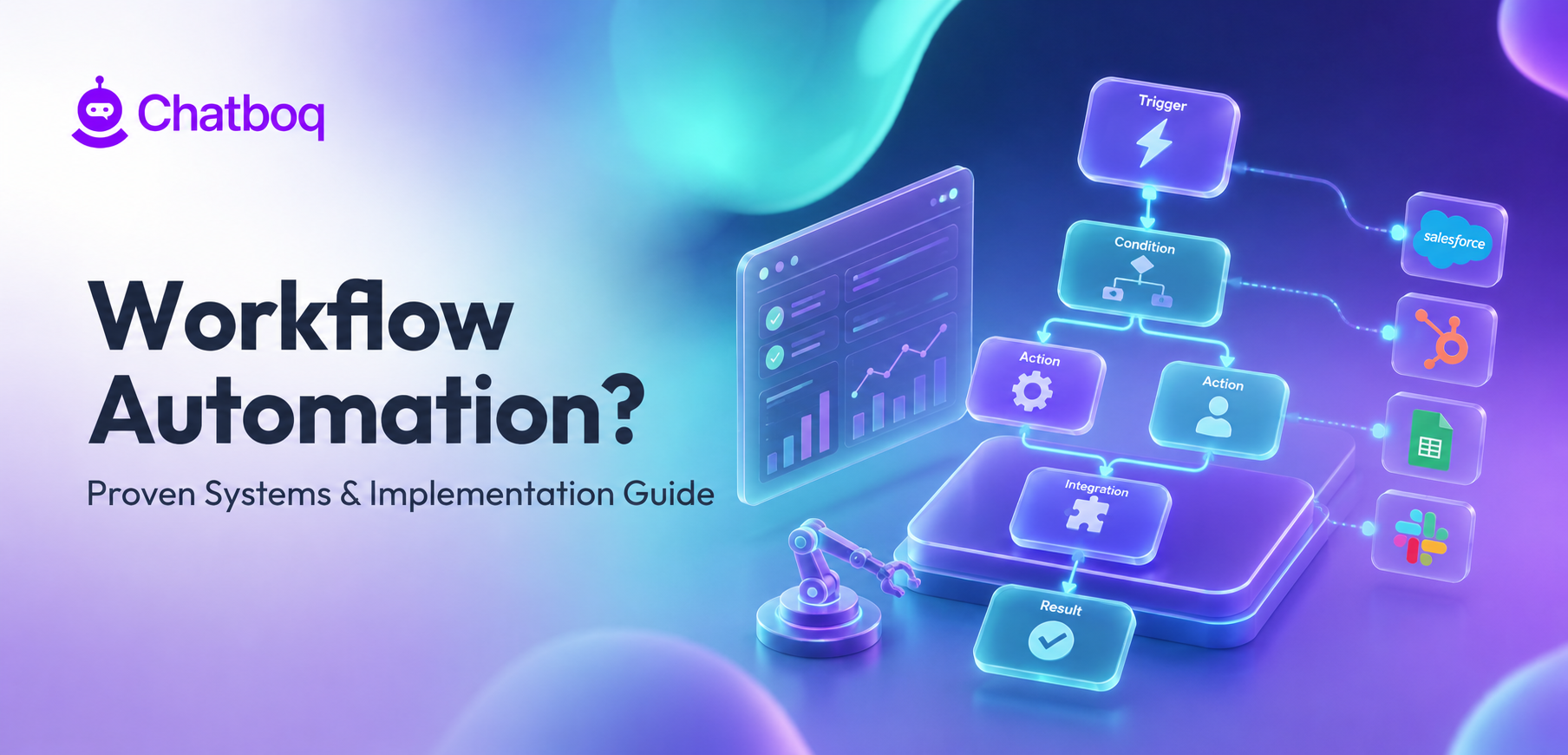
Workflow automation is a system-level execution layer that enables businesses to execute structured processes through triggers, rules, and integrations across connected software environments. It reduces manual coordination by allowing systems to communicate and act on events in real time, forming a core execution layer across departments and tools.
Modern workflow automation is built as a layered system combining rule-based automation for deterministic processes, AI-driven automation for predictive decisions and intelligent routing, and robotic process automation (RPA) for UI-level task execution when APIs are unavailable. These capabilities are delivered through no-code tools like Zapier and Make, enterprise platforms such as Microsoft Power Automate and UiPath, and integration platforms (iPaaS) that connect complex multi-system environments.
Across business functions, workflow automation supports repeatable operational execution: marketing uses it for campaign and lifecycle automation, sales for lead routing and pipeline progression, HR for onboarding and approvals, IT for ticketing and service management, and support teams for structured resolution workflows. In each case, it replaces manual coordination with rule-driven or intelligent execution systems that standardize outcomes and improve operational consistency.
Effective implementation requires identifying repeatable processes, mapping triggers, conditions, and actions, selecting the right automation tools based on complexity, and continuously testing and optimizing workflows in production. When properly implemented, it can increase productivity, reduce operational costs, and improve scalability, while challenges such as data quality issues, integration failures, and weak exception handling must be actively managed.
 ChatGPT
 Perplexity
 Claude


Leave a Comment
Your email address will not be published. Required fields are marked *
By submitting, you agree to receive helpful messages from Chatboq about your request. We do not sell data.