
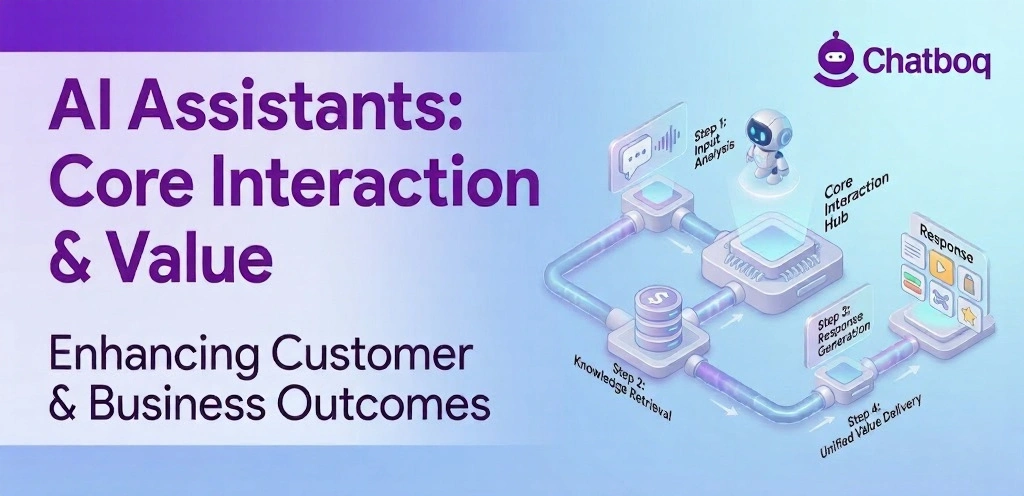
AI assistants are software systems that use natural language processing and machine learning to understand user input and respond with relevant information, completed actions, or guided next steps. They operate across text, voice, and embedded interfaces. The defining characteristic is their ability to interpret intent from unstructured input and respond in a way that moves the user toward a goal.
If you manage business operations, customer support, or internal productivity workflows, AI assistants reduce the manual effort of handling repetitive, predictable tasks. Conversational AI assistants like ChatGPT, Microsoft Copilot, Claude, and Google Assistant handle tasks that previously required a human to read, interpret, and respond. They work across sales, support, marketing, and internal team workflows at a scale no individual could match.
Understanding how AI assistants differ from chatbots and AI agents matters before deploying them. Chatbots follow fixed decision trees. AI assistants interpret natural language using large language models (LLMs) and generate contextual responses. AI agents go further by executing multi-step tasks autonomously. Each fits a different use case, and choosing the wrong one creates process gaps that automation cannot fill.
The capabilities, limitations, and implementation requirements of AI assistants vary significantly by platform and use case. Generative AI, contextual memory, SaaS integrations, and AI workflow automation all shape what an assistant can do in a production environment. The most common implementation failures come from unclear use case definition, poor tool selection, and insufficient integration with existing systems.
 ChatGPT
 Perplexity
 Claude


Leave a Comment
Your email address will not be published. Required fields are marked *
By submitting, you agree to receive helpful messages from Chatboq about your request. We do not sell data.