
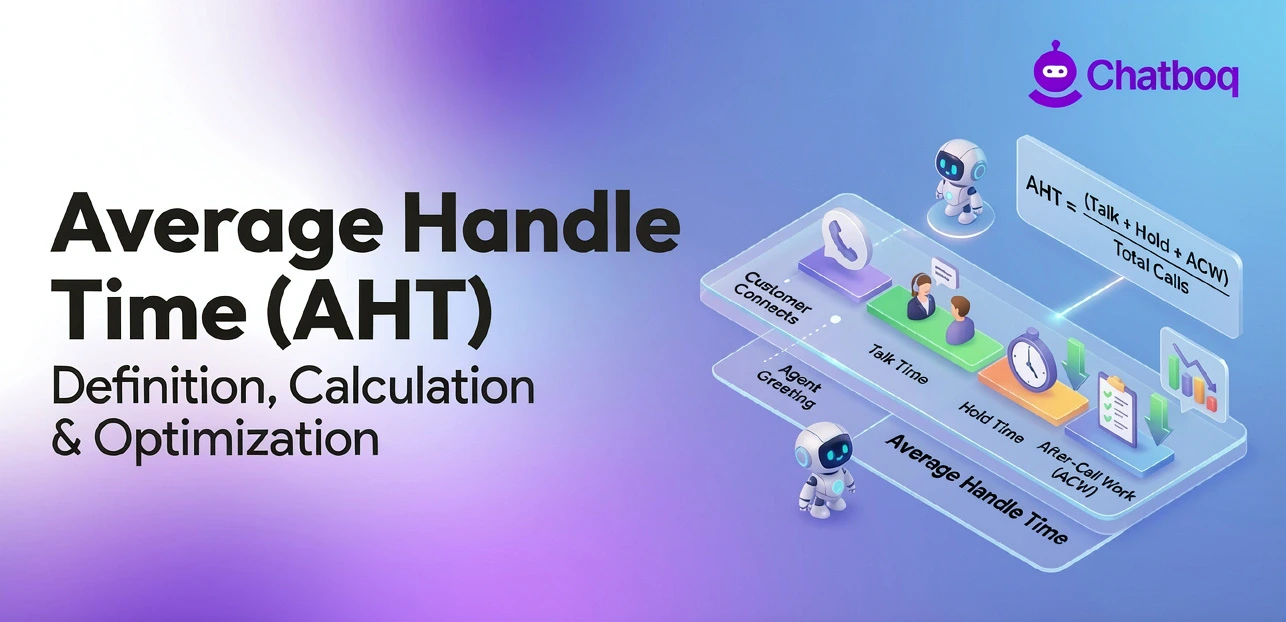
Average Handle Time (AHT) measures how long a support agent spends on a single customer interaction from start to finish, including talk time, hold time, and after-call work. It is one of the most widely tracked contact center metrics because it connects directly to staffing costs, queue capacity, and service quality. When AHT is misconfigured or misread, it pushes teams toward speed at the expense of resolution quality.
If you manage a call center, chat support team, or helpdesk operation, AHT sits at the center of your workforce management decisions. A high AHT means agents are spending too long on each interaction, which increases cost and slows queue throughput. A very low AHT often signals that agents are rushing contacts without fully resolving them, which drives repeat contacts and lowers customer satisfaction (CSAT). Effective AHT targets balance operational efficiency with resolution quality and customer satisfaction outcomes.
The average handle time formula adds total talk time, total hold time, and total after-call work (ACW), then divides by the number of interactions handled. Calculating it correctly requires consistent definitions of what counts as ACW and how partial interactions are handled. Platforms like Zendesk, Freshdesk, Genesys, and NICE surface AHT alongside other support KPIs in their analytics dashboards, but the metric is only useful when it is paired with first call resolution (FCR) and CSAT data.
AHT differs from first response time (FRT) and ticket resolution time in what it actually measures. Benchmarks vary significantly by channel and industry. AI-assisted support, intelligent routing, and knowledge bases all reduce AHT without requiring agents to rush. The most common mistakes in AHT optimization all involve optimizing the number without tracking what happens to resolution quality when it drops.
 ChatGPT
 Perplexity
 Claude





Leave a Comment
Your email address will not be published. Required fields are marked *
By submitting, you agree to receive helpful messages from Chatboq about your request. We do not sell data.