
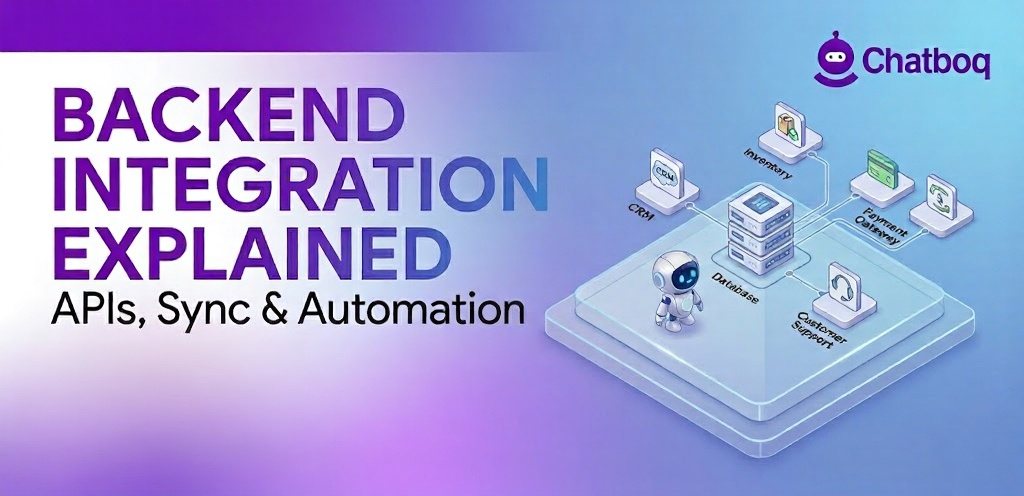
Backend integration enables separate systems, applications, databases, and services to exchange data, coordinate actions, and operate together as a connected infrastructure. It is the infrastructure layer that allows a CRM to update when a payment is processed, a support ticket to generate when an order fails, and a notification to fire when a record changes in a connected system. Without it, each application operates in isolation.
If you build or operate SaaS platforms, ecommerce systems, or enterprise software, backend integration determines how reliably distributed backend systems communicate, synchronize data, and coordinate workflows at scale. APIs are the primary communication mechanism. Middleware, event queues, and data pipelines handle routing, transformation, and delivery. The architecture you choose, whether point-to-point, event-driven, or microservices-based, shapes how maintainable and scalable your integration infrastructure becomes over time.
Backend API integration differs from frontend integration and from standalone API integration in what it coordinates and why. Frontend integration connects user-facing interfaces to data sources. API integration describes a specific communication protocol. Backend integration is the broader system connectivity layer that combines API integration, webhooks, middleware layers, and event-driven architecture to keep backend systems' communication synchronized across distributed services.
Real-world examples span CRM and support platform connections, payment and billing systems, e-commerce inventory synchronization, and messaging tools. The challenges in backend integration involve system complexity, data consistency, security, and latency. Implementation requires clear architecture decisions, scalable design, and ongoing monitoring to keep integrations performing correctly as connected systems evolve.
 ChatGPT
 Perplexity
 Claude




Leave a Comment
Your email address will not be published. Required fields are marked *
By submitting, you agree to receive helpful messages from Chatboq about your request. We do not sell data.