
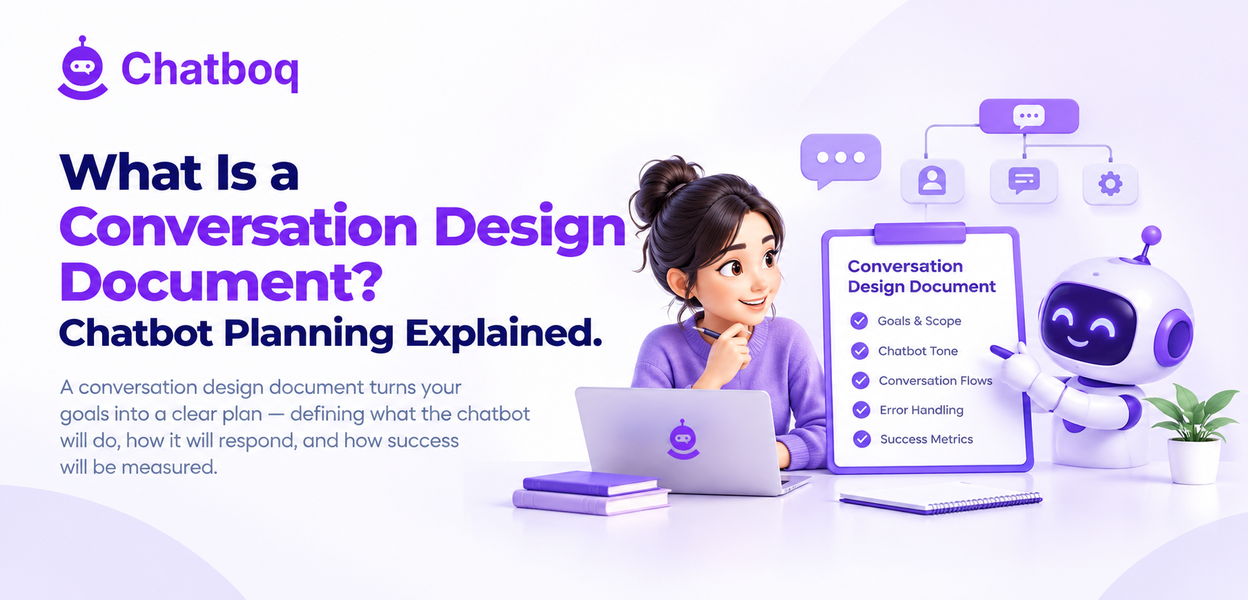
A workable document defines scope, goals, persona, intents, sample dialogues, escalation rules and success measures.
Scope, stated as exclusions
Listing what the assistant will not handle is more useful than listing what it will, because scope disputes almost always concern the boundary rather than the centre.
Explicit exclusions also give the team a defensible answer when someone proposes adding a capability partway through the build.
Goals and success measures
State what the deployment is meant to achieve in measurable terms, whether that is deflecting a proportion of a specific contact type or capturing leads outside hours.
Without this, the project is judged on impressions, and impressions of chatbots are frequently unfavourable regardless of performance.
Persona and tone
Record how the assistant identifies itself, its formality level, vocabulary conventions and response length, with worked examples rather than adjectives.
These decisions shape every response and are far cheaper to agree once in a document than to renegotiate across hundreds of configured messages.
Intents and their boundaries
The intent set, with a short description of what each covers and does not, is the structural core of the document and the part most frequently omitted.
Documenting boundaries prevents the overlapping intents that later appear as unexplained low confidence in production.
Integration and data requirements
Recording which systems the assistant needs to read from or write to, and what data each interaction requires, surfaces dependencies that otherwise appear mid-build.
This section is frequently the one that changes a project timeline, since integration access is usually the slowest dependency to obtain.
 ChatGPT
 Perplexity
 Claude






Leave a Comment
Your email address will not be published. Required fields are marked *
By submitting, you agree to receive helpful messages from Chatboq about your request. We do not sell data.