
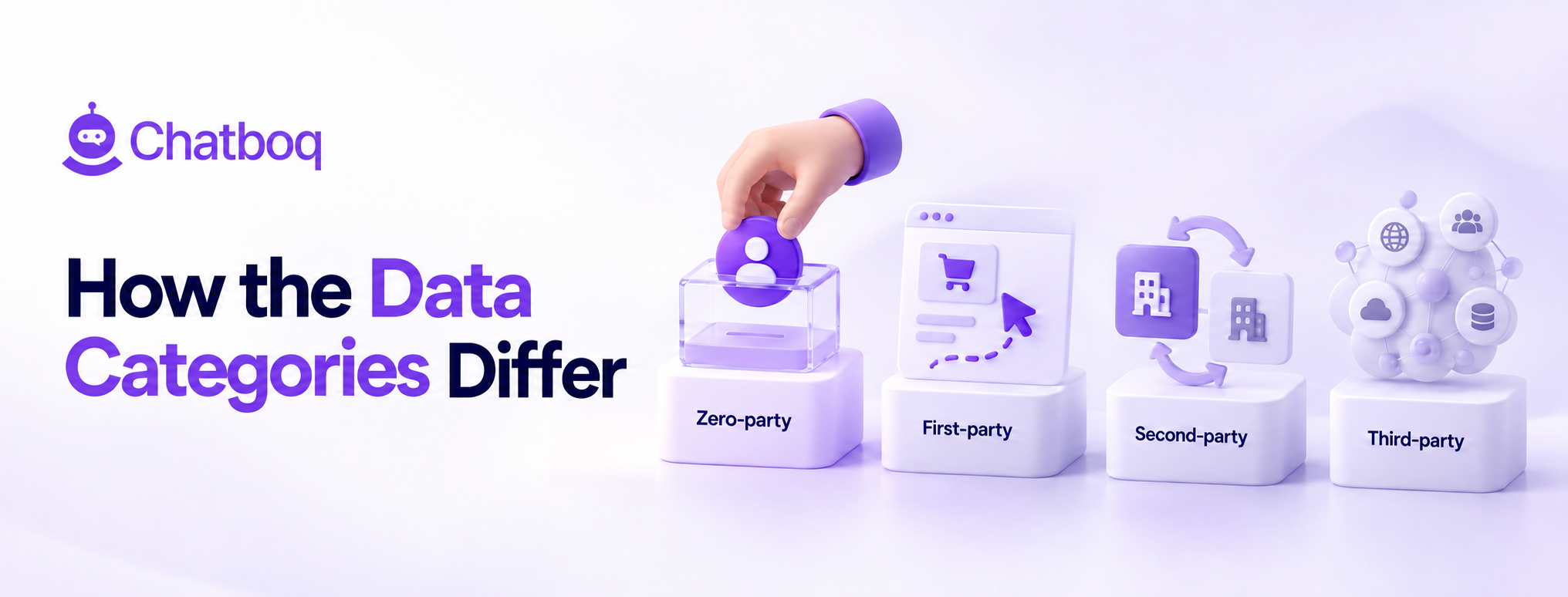
Zero-party data is declared, first-party is observed on your own properties, second-party is another company's first-party data, and third-party is aggregated from elsewhere.
Zero-party versus first-party
First-party data is what you observe, such as which pages a customer visited and what they bought, while zero-party is what they told you deliberately.
The two are complementary, since behaviour reveals what customers do and declared data reveals what they want, and the two frequently differ.
Why the distinction became prominent
Restrictions on cross-site tracking removed a large part of the inferred targeting that many businesses relied on, which made directly declared information considerably more valuable.
The shift is also driven by expectation, since customers increasingly accept giving information deliberately while objecting to it being collected invisibly.
Accuracy differences
Inferred preferences are frequently wrong in ways nobody notices, because there is no feedback mechanism telling you the inference missed.
Declared preferences are wrong less often and, crucially, the customer can correct them, which makes the data self-improving in a way inference is not.
What it is not
Data collected through a form the customer filled in to get something they needed, without understanding it would be used for targeting, is not meaningfully zero-party.
The label describes an intent and a transparency standard rather than merely the mechanism by which information arrived.
 ChatGPT
 Perplexity
 Claude









Leave a Comment
Your email address will not be published. Required fields are marked *
By submitting, you agree to receive helpful messages from Chatboq about your request. We do not sell data.