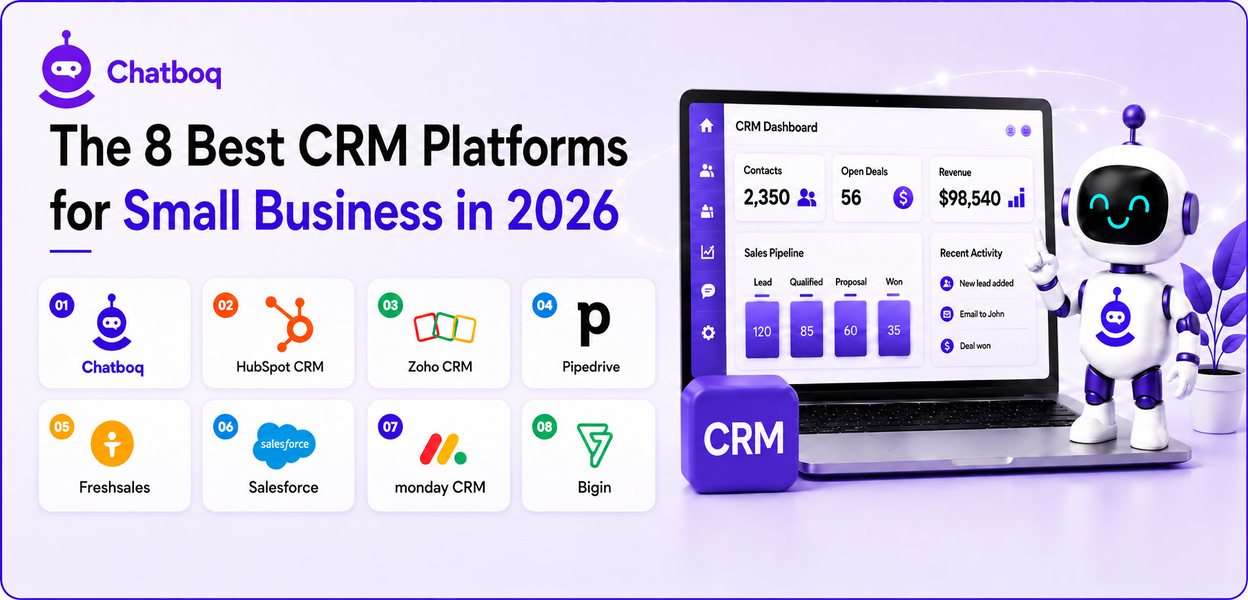
Chatboq, HubSpot CRM, Zoho CRM, Pipedrive, Freshsales, Salesforce Starter Suite, monday CRM, and Bigin by Zoho cover the range of CRM platforms small businesses evaluate in 2026, from chat-native and free-to-start options to sales-focused and enterprise-grade tools priced for small teams.
1. Chatboq
Best for
Small businesses that want customer context built into the same platform where support and sales conversations already happen, rather than a separate sales-pipeline tool.
Key features
A built-in CRM that stores complete customer profiles, custom attributes, smart segmentation and filters, shared customer notes, and a full view of the customer journey, tied directly to Chatboq's live chat and chatbot conversations.
Pricing
Chatboq offers a free plan to get started, with paid tiers that scale as usage grows; Starter at $35/month, and Essentials at $85/month, which unlocks unlimited conversations, and the full AI chatbot suite — AI reply assistant, multilingual AI, and AI writing assistant — plus every major messaging integration.
Limitations
It's built around customer profiles and conversation context rather than a traditional sales pipeline with deal stages, so a B2B sales team running a multi-step deal process may still want a dedicated sales CRM alongside it.
2. HubSpot CRM
Best for
Small businesses that want a genuinely usable free CRM with a clear upgrade path as the team and its marketing needs grow.
Key features
Free contact and deal management, email tracking, a meeting scheduler, and a broader ecosystem of marketing, sales, and service hubs that share the same underlying contact record.
Pricing
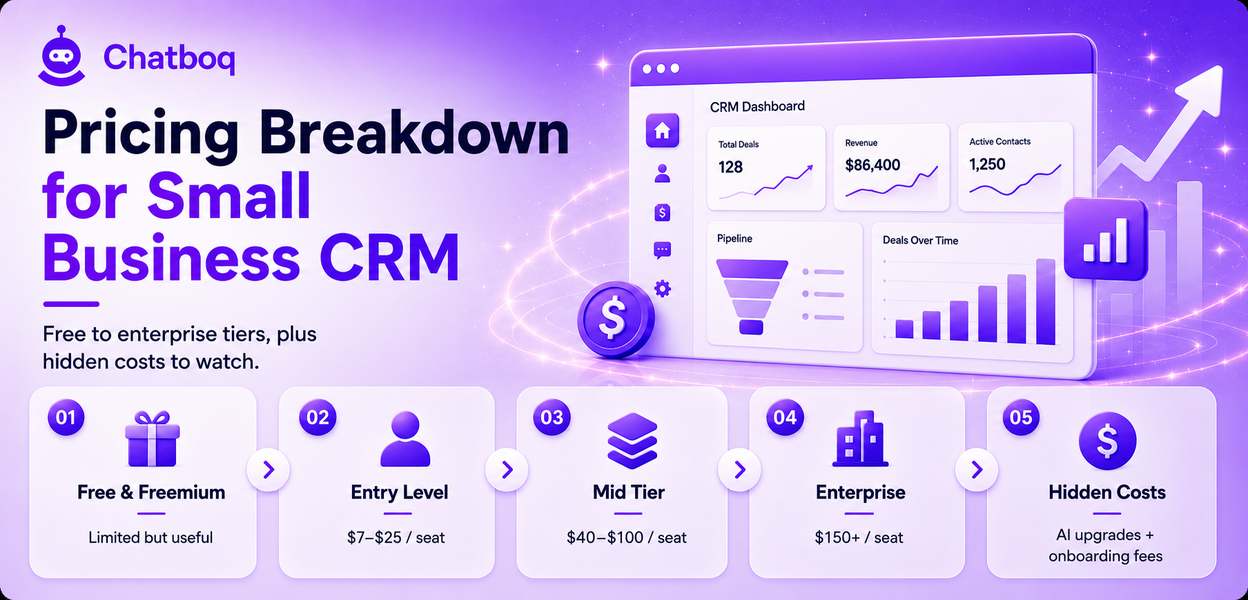
A real free-forever plan covers unlimited users with core CRM features; paid tiers start around $20 per seat monthly (Starter) and rise to roughly $90 to $100 (Professional, with a mandatory onboarding fee) and $150 (Enterprise) on annual billing.
Limitations
Costs escalate quickly once a team needs Professional-tier automation, and mandatory onboarding fees on the higher tiers add a real upfront cost beyond the advertised per-seat price.
3. Zoho CRM
Best for
Budget-conscious small businesses that want strong automation and AI features without paying enterprise prices.
Key features
Multichannel lead and deal tracking, Blueprint process automation, and Zia AI for sales forecasting and next-best-action suggestions, alongside deep integration with the wider Zoho suite.
Pricing
A free plan covers up to three users; paid tiers run roughly $14 per user monthly (Standard), $23 (Professional), $40 (Enterprise), and $52 (Ultimate) on annual billing.
Limitations
The jump from the free plan to a fully automation-capable tier is where most of the real value sits, and teams outside the Zoho ecosystem see less benefit from its deep cross-product integration.
4. Pipedrive
Best for
Sales-focused small teams that want a clean, visual, drag-and-drop pipeline and little else to configure.
Key features
A highly visual deal pipeline, activity-based selling reminders, and an interface built specifically around moving deals forward rather than broader marketing or service functionality.
Pricing
No permanent free plan, only a 14-day trial; paid tiers run roughly $14 per user monthly (Lite), $39 (Growth), $49 (Premium), and $79 (Ultimate) on annual billing.
Limitations
Meaningful functionality such as email sync and workflow automation sits above the entry Lite tier, and several genuinely useful features, like lead capture tools, are sold as separate paid add-ons.
5. Freshsales
Best for
Small teams that want built-in phone, email, and AI lead scoring without stitching together separate communication tools.
Key features
Built-in cloud telephony, AI-powered lead scoring and deal insights through Freddy AI, and multichannel communication tracking inside the same record as the deal.
Pricing
A free plan covers up to three users; paid tiers run roughly $9 per user monthly (Growth), $39 (Pro), and $59 (Enterprise) on annual billing.
Limitations
The jump from Growth to Pro is steep relative to the feature gain, since core capabilities like multiple pipelines and custom reporting sit behind the Pro tier rather than Growth.
6. Salesforce Starter Suite
Best for
Small businesses that want a scaled-down entry point into the Salesforce ecosystem, with a credible upgrade path if the business grows into needing full enterprise CRM depth.
Key features
Simplified onboarding, lead and account management, and basic email marketing and analytics tools, built on the same underlying platform as Salesforce's enterprise products.
Pricing
A limited free suite covers a very small team; Starter Suite is priced around $25 per user monthly, with Pro Suite around $100, Enterprise around $175, and Unlimited around $350, all on required annual billing.
Limitations
The gap between Starter and Pro Suite is a roughly four-times price jump, and Salesforce's broader ecosystem and setup complexity are still more than most very small teams need on day one.
7. monday CRM
Best for
Teams already using monday.com for project management who want their sales pipeline in the same familiar board-based interface.
Key features
A drag-and-drop, board-style pipeline view, two-way email sync, and straightforward automation, built on monday.com's broader work management platform.
Pricing
Paid tiers run roughly $12 to $17 per seat monthly (Basic/Standard) and around $28 (Pro) on annual billing, with a three-seat minimum on every paid plan.
Limitations
The three-seat minimum means even a true solo user pays for three seats, and its CRM-specific depth is lighter than dedicated sales CRMs once a process gets more complex.
8. Bigin by Zoho
Best for
Very small teams and solo operators who want pipeline tracking without the breadth, and learning curve, of the full Zoho CRM.
Key features
A simplified, pipeline-first interface, multiple pipelines for different processes, and lightweight automation aimed specifically at very small teams new to using a CRM at all.
Pricing
Among the least expensive full CRMs available, with paid plans starting around $7 to $9 per user monthly on annual billing.
Limitations
Its intentionally slimmed-down feature set means fast-growing teams often outgrow it and migrate to full Zoho CRM or another platform within a year or two.

 ChatGPT
 Perplexity
 Claude




Leave a Comment
Your email address will not be published. Required fields are marked *
By submitting, you agree to receive helpful messages from Chatboq about your request. We do not sell data.