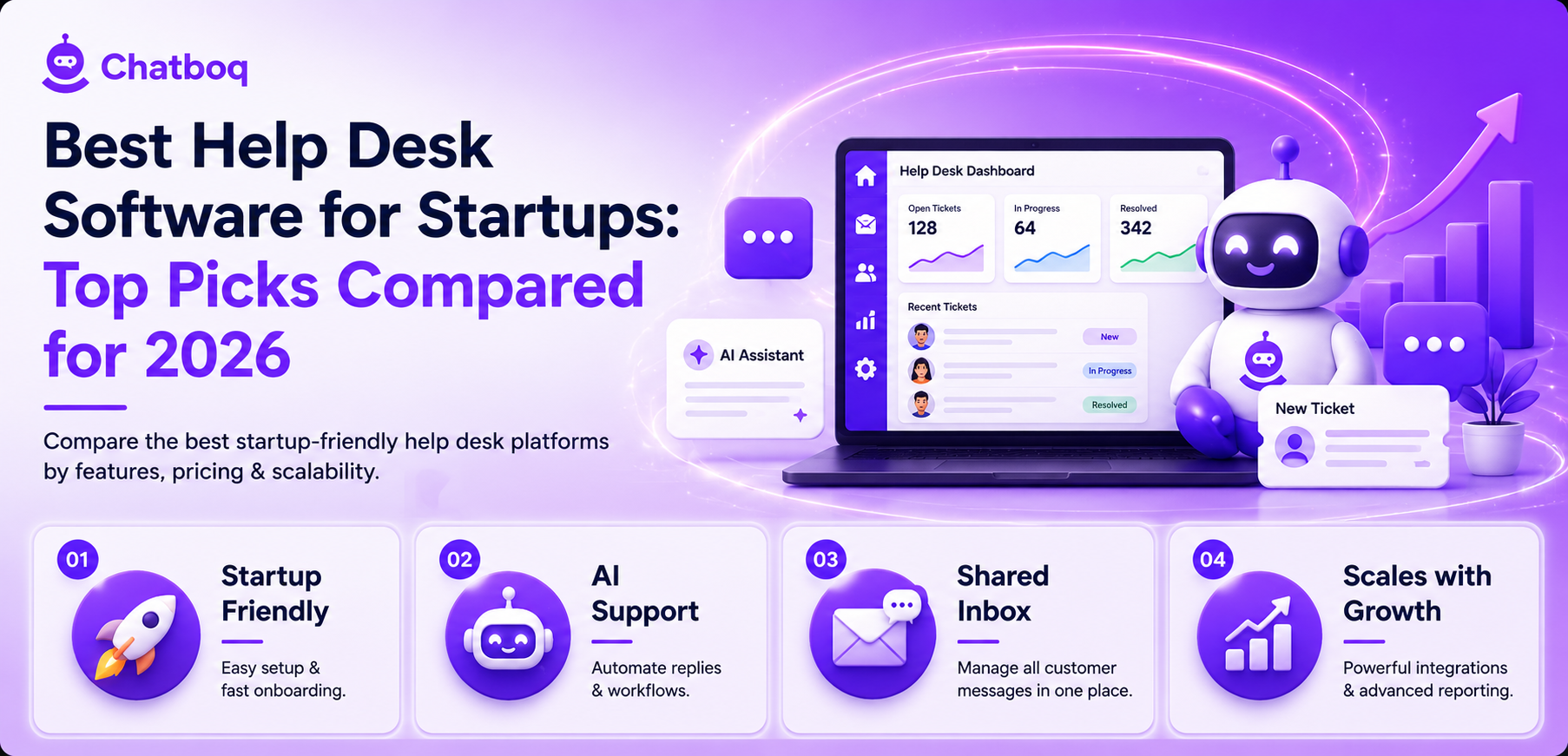
Chatboq, Freshdesk, Zendesk, Help Scout, Zoho Desk, Gorgias, Intercom, and HubSpot Service Hub cover the range of help desk software startups evaluate in 2026, from accessible all-in-one platforms to ecommerce-specific and CRM-adjacent tools.
1. Chatboq
Best for
Startups that want live chat, chatbot automation, and a multichannel inbox running in one workspace before they need a heavyweight ticketing system.
Key features
A live chat widget, AI chatbot automation, a multichannel inbox spanning WhatsApp, Instagram, Messenger, Telegram, Discord, Slack, and Line, a built-in CRM, analytics and reporting, and mobile apps for managing conversations away from a desk.
Pricing
Chatboq offers a free plan to get started, with paid tiers that scale as usage and automation needs grow; current tier includes Starter at $35/month, and Essentials at $85/month, which unlocks unlimited conversations, and the full AI chatbot suite — AI reply assistant, multilingual AI, and AI writing assistant — plus every major messaging integration.
Limitations
Its dedicated ticketing system is rolling out rather than fully mature, so teams that need deep SLA rules or complex multi-department ticket routing today may want to pair it with a dedicated help desk until that module reaches general availability.
2. Freshdesk
Best for
Startups that want a proven, mid-market-ready help desk without jumping straight to enterprise pricing.
Key features
Omnichannel ticketing, automation rules, a built-in knowledge base, CSAT surveys, and Freddy AI for both agent-facing copilot suggestions and customer-facing deflection.
Pricing
A free Support Desk program covers one to two agents for six months, after which paid tiers run roughly $15 to $19 per agent monthly (Growth), $49 to $55 (Pro), and $79 to $89 (Enterprise) on annual billing; Freddy AI Copilot and AI Agent sessions are billed separately from the base plan.
Limitations
The core ticketing product and the fully omnichannel "Freshdesk Omni" line are sold and priced separately, so a startup wanting true omnichannel coverage from day one ends up budgeting for both.
3. Zendesk
Best for
Startups that expect to grow into a large, multi-department support operation and want a platform they won't need to replace later.
Key features
Suite plans bundling ticketing, live chat, voice, and a help center, deep customization through its API and app marketplace, and an AI layer strengthened by Zendesk's 2026 acquisition of the Forethought autonomous-agent platform.
Pricing
A Support-only plan starts around $19 per agent monthly; Suite plans start near $55 (Suite Team) and rise to roughly $115 (Suite Professional) and higher for Enterprise tiers, all on annual billing, with AI Copilot and other add-ons billed on top of the base seat price.
Limitations
The full breadth of Zendesk is more platform than most early-stage startups need on day one, and stacking add-ons plus per-resolution AI charges can push the real bill noticeably above the advertised starting price.
4. Help Scout
Best for
Small, high-touch support teams that want a shared-inbox feel rather than a traditional ticket queue.
Key features
A shared inbox designed to feel like email, a lightweight knowledge base called Docs, a customer-facing chat widget called Beacon, and AI-assisted drafting and thread summarizing for agents.
Pricing
A limited free plan is available, with paid tiers running roughly $20 to $25 per user monthly (Standard), $40 to $45 (Plus), and $65 to $75 (Pro) on annual billing; the AI Answers chatbot add-on bills separately per resolution.
Limitations
Advanced permissions, deeper reporting, and some automation sit behind the higher tiers, and per-resolution AI pricing can become harder to predict as automated conversation volume grows.
5. Zoho Desk
Best for
Budget-conscious startups, especially ones already using other Zoho products such as Zoho CRM.
Key features
Multichannel ticketing, built-in workflow automation through Blueprints, and Zia AI for reply suggestions and sentiment tagging, alongside native integration with the wider Zoho suite.
Pricing
A genuine free-forever plan covers up to three agents; paid tiers run roughly $7 per agent monthly (Express), $14 (Standard), $23 (Professional), and $40 (Enterprise) on annual billing, among the least expensive full help desks in this comparison.
Limitations
Some of the more advanced automation and AI capabilities are reserved for the Enterprise tier, and teams outside the Zoho ecosystem see less of the deep cross-product integration benefit.
6. Gorgias
Best for
Ecommerce startups, particularly Shopify or WooCommerce stores, that want support tied directly to order and customer data.
Key features
Deep Shopify and WooCommerce integrations that surface order details inside every ticket, macros with dynamic variables like customer name and order number, and an AI Agent built around ecommerce workflows such as order status and returns.
Pricing
Priced by ticket volume rather than by agent seat, with unlimited users on every paid plan; list pricing runs from about $10 monthly (Starter, 50 tickets) through roughly $60, $360, and $900 (Advanced, 5,000 tickets), with a custom Enterprise tier above that and a separate per-resolution fee for AI Agent activity.
Limitations
The ticket-based model can cause costs to spike during seasonal traffic surges such as major sales events, and teams outside ecommerce get comparatively little value from its commerce-specific automation.
7. Intercom
Best for
Startups that want a modern, messenger-first support experience and are willing to pay a premium for the polish.
Key features
A refined in-app and web messenger, proactive support campaigns, and its Fin AI agent, which the company has increasingly positioned as the center of the product experience.
Pricing
Seat-based plans start around $29 per agent monthly (Essential), rising to roughly $85 (Advanced) and $132 (Expert) on annual billing, plus a separate per-resolution fee for Fin AI Agent activity on top of seat cost.
Limitations
Total cost climbs quickly once both seat count and AI resolution volume grow, and Intercom's pending acquisition by Salesforce, announced in mid-2026, is worth watching for any startup considering a multi-year commitment.
8. HubSpot Service Hub
Best for
Startups already using HubSpot's CRM or marketing tools that want support data living in the same system as sales and marketing.
Key features
Ticketing, a knowledge base, and customer feedback tools that share a single contact record with HubSpot's CRM, Marketing, and Sales hubs.
Pricing
A free tier covers basic ticketing; paid seats start around $20 monthly (Starter) and rise to roughly $90 to $100 (Professional) and $150 (Enterprise), with Service Hub also sold as part of a bundled Customer Platform alongside HubSpot's other hubs.
Limitations
Its biggest advantages only really show up once a startup is also running on HubSpot's CRM and marketing tools, and cost can climb quickly once a team needs the Professional tier's automation and SLA features.

 ChatGPT
 Perplexity
 Claude



Leave a Comment
Your email address will not be published. Required fields are marked *
By submitting, you agree to receive helpful messages from Chatboq about your request. We do not sell data.