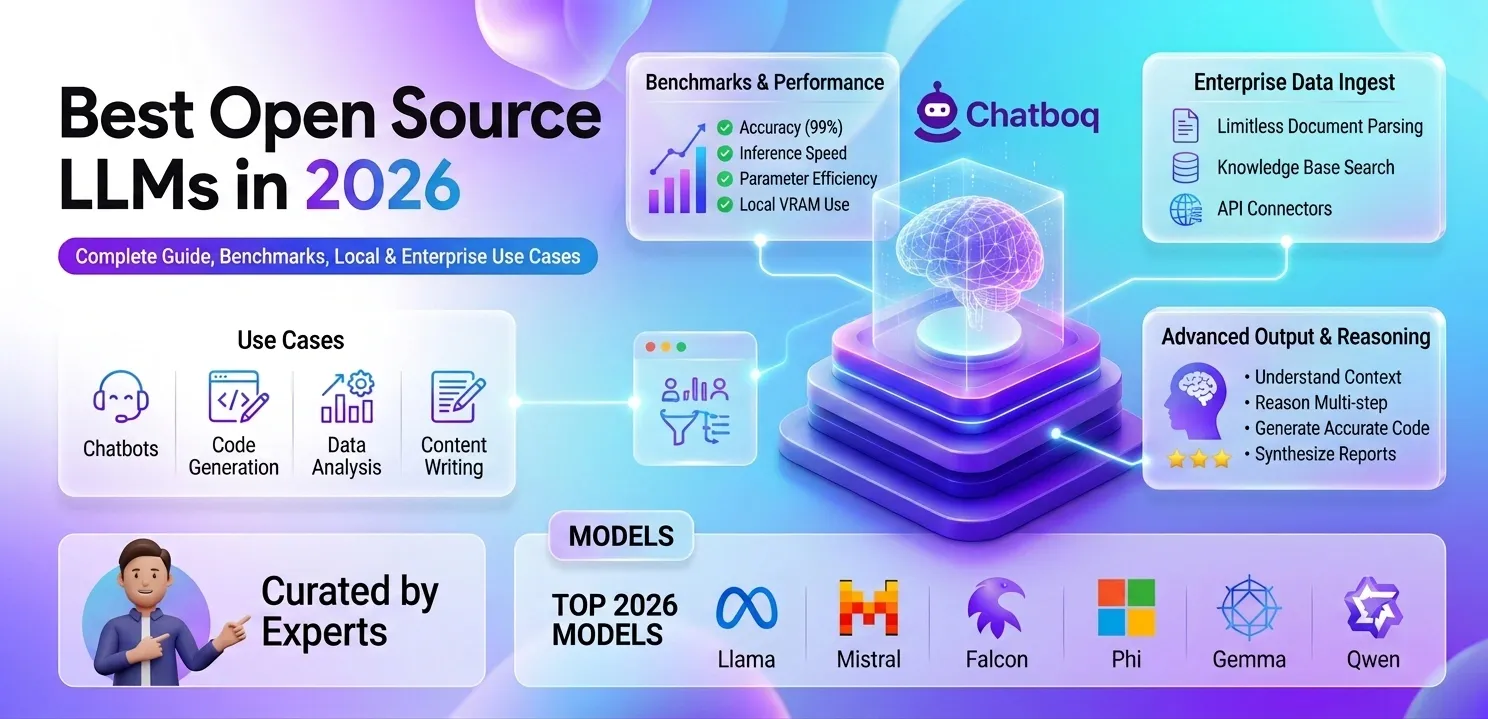
Leading open-source LLMs in 2026 include DeepSeek V3/R1, Qwen 3, Llama 4, Mistral/Mixtral, Gemma, GLM-5, Kimi K2, Falcon, and Phi models. They vary in strength across reasoning, coding, efficiency, multilingual ability, and deployment scale, with no single model dominating all use cases.
1. DeepSeek V3 and R1
DeepSeek V3 is a large open-weight mixture-of-experts model with ~671B total parameters and ~37B active parameters per token, designed for high-efficiency reasoning and coding. DeepSeek R1 is a reasoning-optimized variant trained with reinforcement learning to improve multi-step problem solving and structured reasoning consistency. Together, they sit closest to frontier closed models among open systems, available via API, cloud deployments, and local inference stacks like vLLM, Ollama, and LM Studio.
Strengths
-
Strong reasoning and coding performance approaching frontier closed models in many structured tasks
-
Efficient MoE design reduces compute cost per query while maintaining high capability
-
MIT licensing enables unrestricted commercial and research deployment
-
Strong SWE-bench-level coding ability suitable for real engineering workflows
-
Broad ecosystem support across APIs, local runtimes, and optimized inference engines
Weaknesses
-
Output consistency varies depending on serving stack and quantization level
-
Still behind top closed models in multimodal reasoning and alignment stability
-
Requires substantial infrastructure for high-quality large-scale deployment
-
Performance sensitivity increases in low-precision or poorly configured environments
Best use cases
-
Developer coding assistants and debugging workflows
-
Analytical reasoning tasks requiring structured step-by-step logic
-
Enterprise inference where cost efficiency matters at scale
-
Local or private deployments where data control is required
2. Qwen 3 Series
Qwen 3 is Alibaba’s large-scale open-weight model family ranging from small edge models to ~235B MoE systems. It is designed as a general intelligence and multilingual-first architecture, trained heavily across Asian and global datasets, with strong emphasis on instruction following, code generation, and cross-lingual reasoning. It is distributed under Apache 2.0 (most variants), making it one of the most commercially flexible frontier-scale open models available.
Strengths
-
Strong multilingual capability (Chinese, English, Japanese, Korean, Arabic, and European languages at scale)
-
High coding performance through Qwen Coder variants, competitive with top open coding models
-
Very strong general instruction following and structured response behavior
-
Large parameter spectrum enables deployment from edge to enterprise scale
-
Apache 2.0 licensing supports unrestricted commercial usage and fine-tuning
Weaknesses
-
High-end variants require significant infrastructure (70B+ class needs serious GPU clusters)
-
Slightly weaker alignment stability compared to top closed models in complex multi-step reasoning edge cases
-
Performance varies more noticeably across different quantization and serving stacks
-
Ecosystem still maturing outside Alibaba-native tooling compared to Llama
Best use cases
-
Multilingual AI systems and global-facing applications
-
Code generation, debugging, and developer copilots (via Qwen Coder)
-
Enterprise deployments requiring commercial-friendly licensing
-
General-purpose assistants needing strong balance of reasoning + language coverage
3. Llama 4
Llama 4 is Meta’s latest open-weight model family built on a mixture-of-experts architecture, designed to scale efficiently across different compute tiers while maintaining strong general intelligence. It evolved from Llama 3.x by expanding context handling, improving instruction tuning, and strengthening ecosystem-level adoption across tooling like vLLM, Hugging Face, and Ollama. It is positioned as the most widely integrated open model family in production systems.
Strengths
-
Strong ecosystem support (LangChain, vLLM, Ollama, Transformers, broad community tooling)
-
Highly scalable MoE design improves efficiency at large parameter sizes
-
Excellent fine-tuning ecosystem with abundant LoRA adapters and datasets
-
Strong general-purpose reasoning and instruction following across many domains
-
Flexible deployment options from local inference to enterprise-grade clusters
Weaknesses
-
Licensing restrictions for large-scale commercial use in some scenarios (Meta Llama license constraints)
-
Not always top-ranked in specialized domains like multilingual reasoning or coding vs Qwen/DeepSeek
-
Large variants require significant infrastructure and optimization expertise
-
Performance can vary depending on serving stack and quantization choice
Best use cases
-
Enterprise systems needing stable ecosystem integration and tooling support
-
Fine-tuning-based custom AI products and domain-specific assistants
-
General-purpose chatbots and production assistants
-
Scalable deployments where infrastructure flexibility matters
4. Mistral and Mixtral Models
Mistral and Mixtral are open-weight model families designed around efficiency-first architectures, combining dense small models (like Mistral 7B) with sparse mixture-of-experts systems (like Mixtral 8x7B and 8x22B). The core design goal is to maximize capability per compute unit, making them especially strong for deployment on limited or cost-sensitive infrastructure while still retaining competitive reasoning and instruction-following ability.
Strengths
-
Extremely efficient inference, especially in 7B-24B range models
-
Mixtral MoE models deliver large-model quality at lower active compute cost
-
Strong performance-to-size ratio for local and edge deployment
-
Apache 2.0 licensing enables unrestricted commercial use
-
Fast response latency compared to larger open-weight models
Weaknesses
-
Weaker deep reasoning compared to frontier-tier open models (DeepSeek, top Qwen variants)
-
Smaller context and knowledge breadth in low-parameter variants
-
MoE models require careful serving optimization for best performance
-
Not as strong in multilingual breadth compared to Qwen
Best use cases
-
Local AI assistants on consumer GPUs (8GB-16GB VRAM setups)
-
Low-latency chat systems and lightweight production APIs
-
Cost-sensitive deployments where inference efficiency matters more than peak reasoning
-
Embedded or edge AI applications
5. Gemma (Google)
Gemma is Google’s open-weight model family derived from Gemini research, designed to bring high-quality reasoning and instruction-following capability into lightweight, deployable model sizes. It spans small to mid-scale parameter ranges (roughly 1B-27B), optimized for efficient inference on consumer GPUs and TPU-based cloud environments, with tight integration potential inside Google’s broader AI ecosystem.
Strengths
-
Strong performance in small-to-mid parameter class for reasoning and coding
-
Efficient inference, especially on Google Cloud TPUs and optimized stacks
-
Good instruction following for its model size category
-
Practical balance between capability and deployment cost
-
Easy integration for Google Cloud and Vertex AI users
Weaknesses
-
Smaller ecosystem compared to Llama and Qwen families
-
Limited capability ceiling compared to large MoE models (DeepSeek, Qwen 235B class)
-
Licensing is more restrictive than Apache 2.0 / MIT models in some cases
-
Less dominant in community fine-tuning ecosystem
Best use cases
-
Lightweight AI assistants and embedded applications
-
Cloud-based deployments inside Google ecosystem (Vertex AI workflows)
-
Cost-efficient inference where medium-level reasoning is sufficient
-
Prototype systems and production workloads with constrained compute budgets
6. GLM-5 Series
GLM-5 is Zhipu AI’s latest open-weight model family focused on strong bilingual (Chinese-English) reasoning and competitive performance in coding and knowledge tasks. It builds on GLM-4’s benchmark strength and improves instruction following and domain reasoning consistency, positioning it as a regional frontier competitor especially strong in Chinese-centric workloads and specialized enterprise use cases.
Strengths
-
Strong reasoning in Chinese and bilingual (CN-EN) contexts
-
Competitive MMLU and coding benchmark performance
-
Reliable instruction following in structured prompts
-
Strong performance in region-specific NLP tasks
-
Underrated alternative to Qwen in English guides
Weaknesses
-
Smaller global ecosystem vs Llama and Qwen
-
Limited Western tooling and inference integration support
-
Performance drops outside bilingual or Chinese-heavy tasks
-
Smaller fine-tuning community and adoption base
Best use cases
-
Chinese enterprise and production AI systems
-
Multilingual assistants targeting Asian markets
-
Benchmark comparison against Qwen and DeepSeek
-
Domain-specific NLP applications requiring CN-EN strength
7. Kimi K2
Kimi K2 is a large-scale mixture-of-experts (MoE) model from Moonshot AI designed around agentic capability rather than pure chat performance. It is built with a massive 1T parameter architecture (with ~32B active parameters per forward pass), optimized for long-context reasoning, tool use, and multi-step workflow execution. Unlike many general-purpose open-weight models, Kimi K2 is positioned closer to an “AI agent backbone,” where sustained reasoning over extended interactions is the primary design goal rather than single-turn response quality.
Strengths
-
Strong performance in agentic workflows and tool-use reasoning
-
Excellent long-context handling for extended multi-step tasks
-
Competitive behavior against frontier models in agent benchmarks
-
Efficient MoE design (high capacity with controlled active compute)
-
Permissive MIT licensing for broad deployment flexibility
Weaknesses
-
Less optimized for lightweight local deployment scenarios
-
Ecosystem and tooling support still smaller than Llama/Qwen families
-
Overkill for simple chat, summarization, or small-scale tasks
-
Performance can vary depending on routing and inference configuration
Best use cases
-
AI agents requiring multi-step planning and tool execution
-
Long-context research and document-heavy workflows
-
Autonomous workflow systems and automation pipelines
-
Experimental agentic AI development and benchmarking
8. Falcon (TII)
Falcon is an open-weight model family developed by the Technology Innovation Institute (TII), designed to provide high-performance general-purpose language models with a focus on transparency and research accessibility. Earlier Falcon releases (7B, 40B, 180B) helped establish open-weight models as credible alternatives to closed systems, particularly in academic and enterprise experimentation settings.
Strengths
-
Strong early open-model performance, especially in 40B and 180B variants
-
Solid general-purpose reasoning and text generation quality for its generation tier
-
Open licensing for many variants enabling research and commercial use
-
Good baseline model for evaluation and benchmarking pipelines
-
Reliable dense architecture with predictable behavior patterns
Weaknesses
-
Outperformed by newer generations like DeepSeek, Qwen 3, and Llama 4
-
Weaker coding performance compared to modern specialized coder models
-
Limited ecosystem momentum compared to Llama or Qwen families
-
Less efficient and less optimized inference stack in modern deployments
Best use cases
-
Academic research and benchmarking comparisons
-
Legacy enterprise systems still using early open-weight deployments
-
Baseline experimentation for model behavior analysis
-
Simple general-purpose generation tasks where cutting-edge performance is not required
9. Phi Models (Microsoft)
Phi is Microsoft’s family of small language models designed around “small but capable” reasoning, optimized training data, and high efficiency. Unlike large open-weight models, Phi focuses on strong performance at low parameter counts (typically 2B-14B range depending on version), making it suitable for edge devices, local inference, and cost-sensitive production workloads. It is trained with a heavy emphasis on high-quality curated datasets rather than sheer scale.
Strengths
-
Very strong performance relative to size (high capability per parameter)
-
Efficient enough to run on low-end GPUs and even CPU-only setups
-
Good reasoning quality for small-model class, especially structured tasks
-
Fast inference with low latency in real-world deployments
-
Practical for embedding AI into lightweight applications
Weaknesses
-
Limited knowledge depth compared to large-scale models (70B+)
-
Weaker long-form reasoning and complex multi-step problem solving
-
Not suitable for advanced coding or agentic workflows at scale
-
Smaller context and reduced robustness on ambiguous prompts
Best use cases
-
On-device AI applications and offline assistants
-
Lightweight chatbots and embedded systems
-
Cost-sensitive production pipelines with strict latency limits
-
Pre-processing tasks like classification, summarization, and extraction

 ChatGPT
 Perplexity
 Claude



Leave a Comment
Your email address will not be published. Required fields are marked *
By submitting, you agree to receive helpful messages from Chatboq about your request. We do not sell data.