
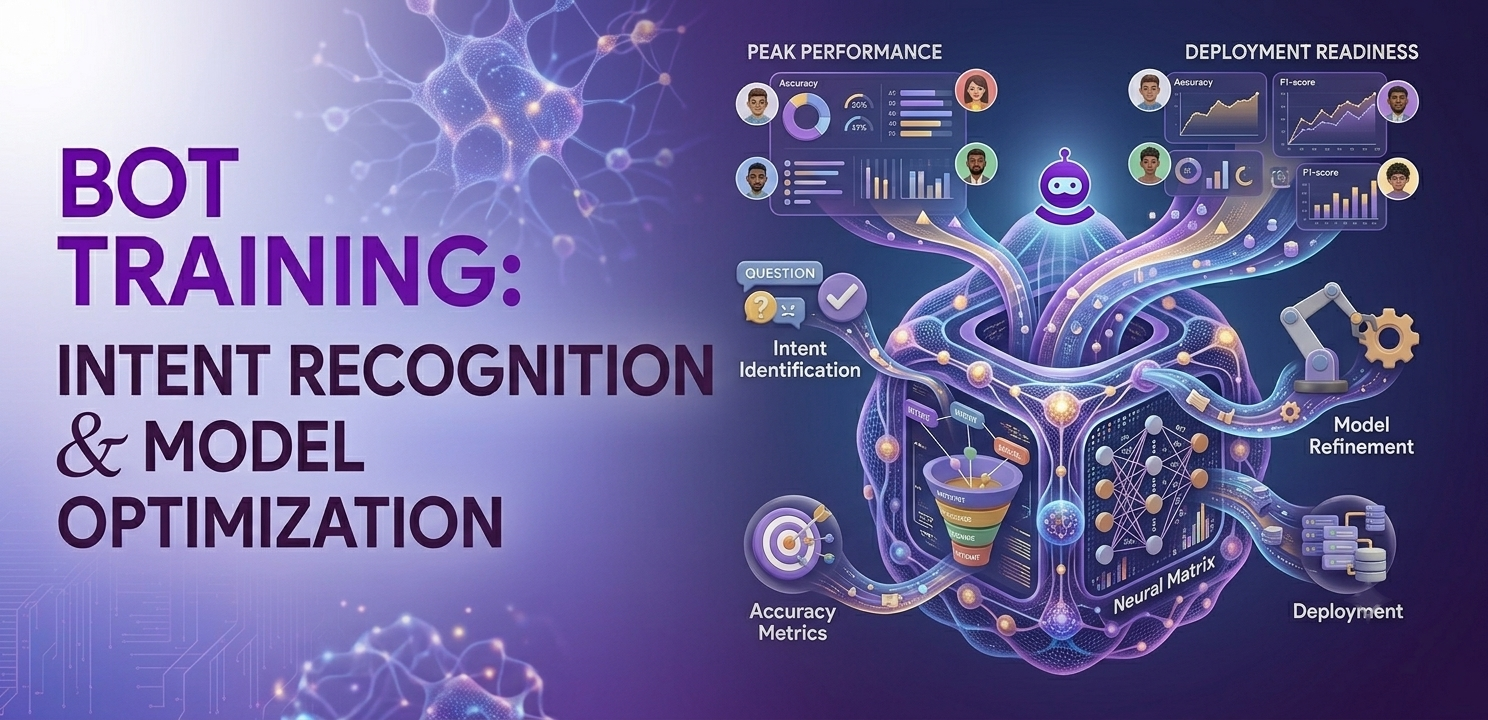
Bot training gives chatbots the information and conversational patterns they need to handle real user interactions effectively. Without training, bots struggle to understand requests, follow conversation context, or deliver useful responses consistently across support, sales, and automation workflows.
Strong bot training combines intent recognition, entity extraction, dialogue management, chatbot optimization, and AI model training to improve language understanding and reduce conversational errors. Businesses use chatbot learning systems to train support bots, ecommerce assistants, onboarding systems, and automation workflows using training datasets, conversation logs, FAQs, and chatbot knowledge base content.
Modern conversational AI training combines NLP systems, machine learning models, semantic matching, and fine-tuning techniques to improve chatbot learning and response accuracy. Conversational AI platforms also use fallback responses, response confidence scoring, human handoff workflows, and chatbot analytics to improve conversational flows and chatbot response accuracy over time.
Bot training affects chatbot accuracy, automation reliability, and overall user experience across support and onboarding workflows. AI training pipelines use training phrases, utterances, reinforcement learning, and vector embeddings to improve response generation and support scalable AI chatbot training.
 ChatGPT
 Perplexity
 Claude


Leave a Comment
Your email address will not be published. Required fields are marked *
By submitting, you agree to receive helpful messages from Chatboq about your request. We do not sell data.