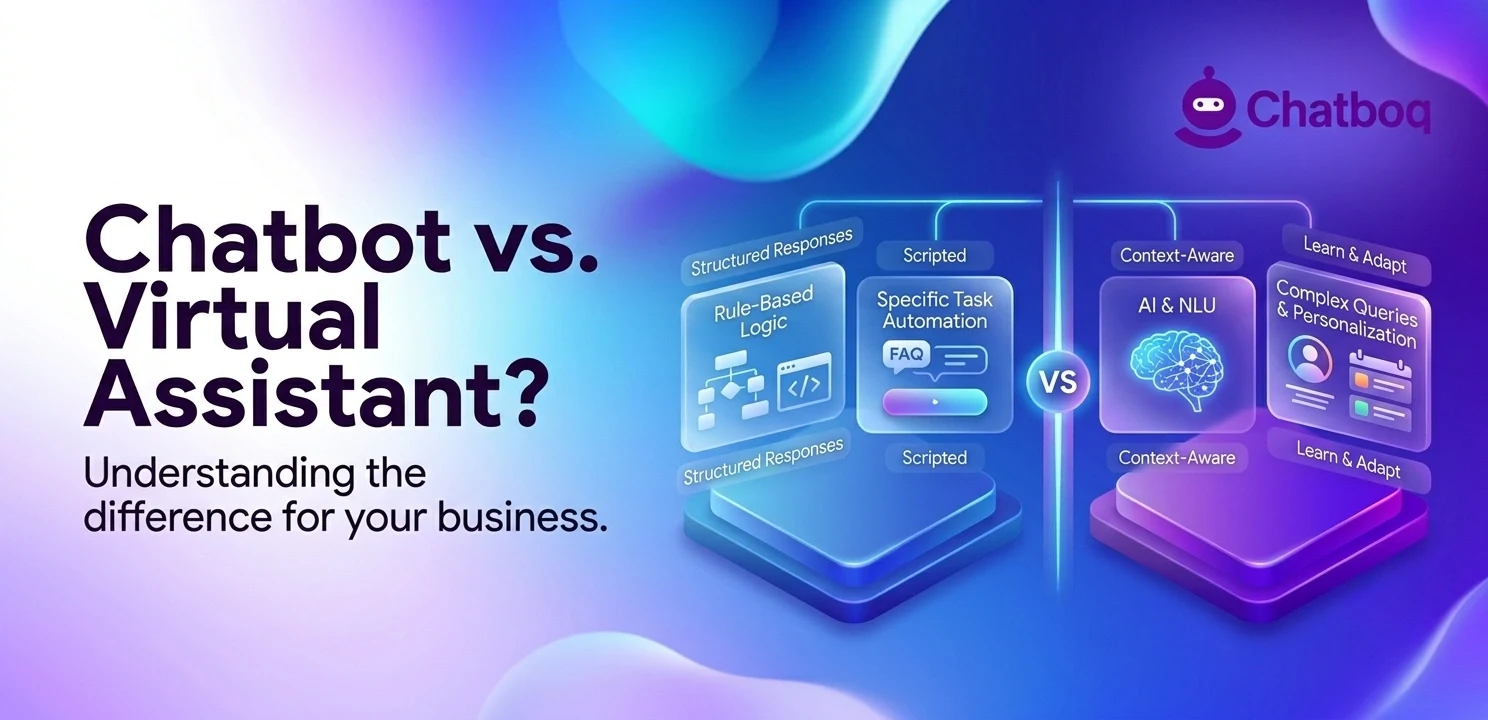
Across industries, chatbots primarily provide information and customer guidance, while virtual assistants execute industry-specific actions such as managing orders in ecommerce, scheduling appointments in healthcare, processing transactions in banking, and automating workflows in SaaS platforms.
Ecommerce
Ecommerce chatbots handle product discovery, recommendations, and pre-purchase questions. When the interaction requires order management system access (order status, return initiation, shipping updates), the architecture shifts to virtual assistant execution. Most ecommerce customer service platforms deploy hybrid systems: chatbot for product and policy questions, virtual assistant for transaction and account actions. Chatboq, Gorgias, Zendesk, and Tidio all represent hybrid architectures in the ecommerce support context.
Healthcare
Healthcare chatbots handle symptom checking, appointment information, medication reminders via notifications, and general health queries where output is text-based guidance. Healthcare virtual assistants execute actions in EHR systems: scheduling appointments, updating patient records, processing prescription refills, and routing clinical questions. Healthcare deployments require HIPAA-compliant architecture for EHR access. Chatbots can describe dosage guidelines, while only virtual assistants can update prescription records in systems.
Banking and Finance
Banking chatbots handle account queries, transaction history, product info, and FAQs with informational output. Banking virtual assistants execute transactions, transfers, recurring payments, and account updates via secure APIs with strong authentication. Security requirements include PCI DSS, multi-factor authentication, and fraud detection integration. Virtual assistants often fail at security boundaries, where authentication friction leads users to prefer human agents for high-value transactions.
SaaS Businesses
SaaS chatbots handle onboarding, documentation, troubleshooting, and support deflection using knowledge base content. SaaS virtual assistants execute product actions like configuring settings, adding members, managing integrations, generating reports, and triggering automations. Companies like Notion, Airtable, and Linear are adopting assistant-style interfaces that convert natural language into product actions, reducing the need for manual UI navigation.
Small Businesses
Small businesses predominantly deploy chatbots because virtual assistant infrastructure requires API integration investment beyond typical budget and technical capacity. Website chatbots handle customer inquiries, appointment pre-qualification, and FAQs effectively. Virtual assistants for accounting, inventory, and CRM integration require ERP and system APIs most small businesses cannot self-implement. Platforms like HubSpot and Zoho reduce this gap through pre-integrated ecosystems.

 ChatGPT
 Perplexity
 Claude


Leave a Comment
Your email address will not be published. Required fields are marked *
By submitting, you agree to receive helpful messages from Chatboq about your request. We do not sell data.