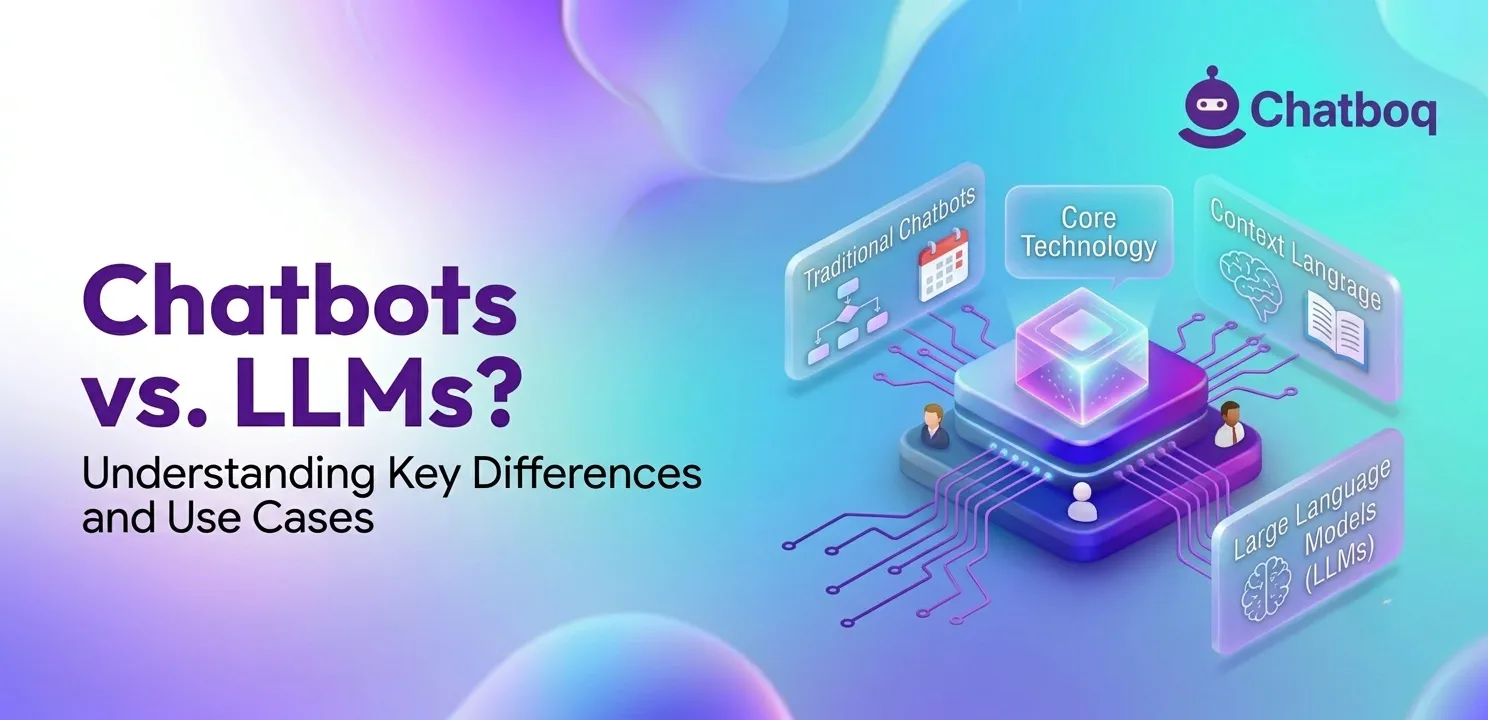
A chatbot is an application layer that manages conversation between a user and a system. It is not an AI model. A chatbot handles routing, flow control, user input processing, and response delivery. The intelligence behind the response can come from rules, NLP systems, or an LLM depending on the architecture.
Confusing a chatbot with an AI model is the most common error in this topic. ChatGPT is an LLM-powered chatbot. The LLM is GPT-4o. The chatbot is the interface, memory layer, and orchestration wrapper around it.
What does a chatbot mean in AI systems?
A chatbot is a software application designed to simulate conversation through text or voice. In AI systems, the chatbot handles the user-facing layer: input collection, session management, and response formatting. The AI model, if present, sits behind the chatbot and generates or classifies the response.
The chatbot vs AI model confusion arises because modern products like Claude and Gemini combine both layers into one product interface. The layers are architecturally separate even when they appear unified.
How chatbots work (rule-based vs AI-based systems)
Rule-based chatbots use decision trees and scripted flows. Each user input triggers a branch in a predefined logic tree. The system matches keywords or patterns and returns a scripted response. No learning occurs. The system executes deterministic logic, not probabilistic reasoning.
AI-based chatbots replace or extend scripted flows with intent classification systems and entity extraction pipelines. The system identifies what the user wants (intent) and extracts relevant data points (entities) to route the conversation. Modern bots connect to APIs that return dynamic responses based on extracted data.
Types of chatbots in real systems
Rule-based chatbots execute fixed decision trees. They handle predictable, structured queries where every possible input can be anticipated in advance. Pre-LLM NLP chatbots use intent classification and entity extraction to handle broader input variation but still rely on predefined response templates.
LLM-powered chatbots use a large language model as the response generation engine. The chatbot layer handles conversation memory, routing, and business logic. The LLM generates the actual text output. This architecture shift replaced most NLP-based systems in commercial deployments between 2023 and 2025.
Where chatbots are used (deployment layer)
Chatbots deploy across customer support, banking IVR systems, lead generation flows, FAQ automation, and internal IT helpdesk systems. Each deployment type uses a different chatbot architecture.
Customer support bots route tickets and resolve common queries. Banking bots handle balance checks, transaction history, and fraud alerts through API-triggered responses. Lead generation bots collect contact data and qualify prospects through scripted or AI-driven conversation flows.
Limitations of traditional chatbots
Rule-based chatbots fail when user input falls outside the predefined decision tree. They cannot generalize beyond scripted scenarios. Every new use case requires manual flow updates. Context continuity across conversation turns is absent in most rule-based systems.
Reasoning ability is near zero in rule-based systems. A user asking a question that combines two intents the bot was not trained to handle simultaneously produces a fallback or error response. This limitation drove the shift to LLM-powered systems for high-complexity support and automation use cases.

 ChatGPT
 Perplexity
 Claude


Leave a Comment
Your email address will not be published. Required fields are marked *
By submitting, you agree to receive helpful messages from Chatboq about your request. We do not sell data.