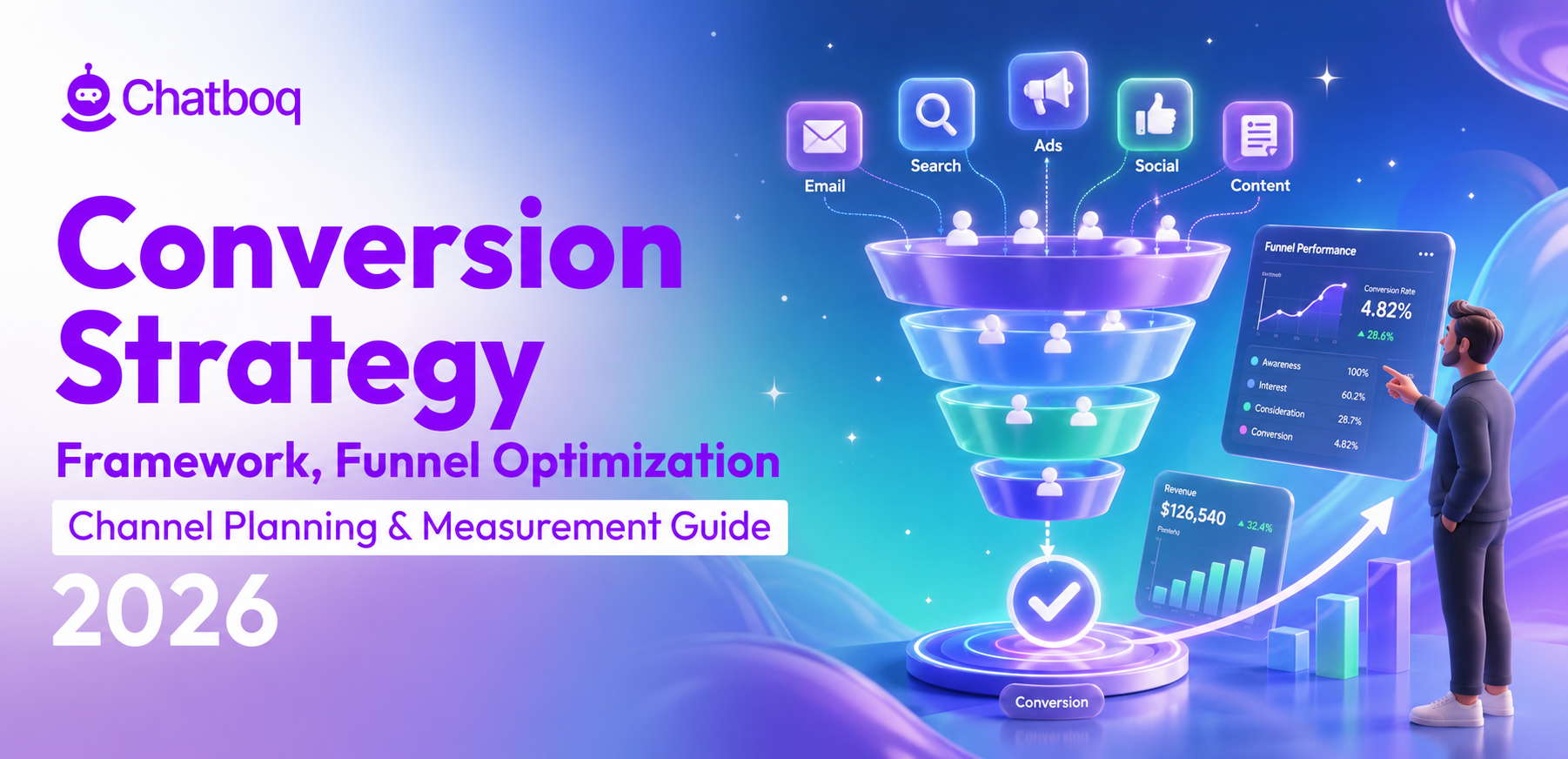
A conversion strategy framework guides prospects from goal setting to retention by defining objectives, understanding intent, removing friction, increasing motivation, building trust, guiding decisions, and optimizing post-conversion outcomes.
Stage 1: Define Business Objectives
Objectives anchor every downstream decision in the framework, and skipping this stage leads to optimization work that improves a metric without actually advancing the business.
Revenue Goals
Revenue goals define the actual dollar outcome the strategy must produce, directly shaping which conversion actions and customer segments deserve the most optimization attention and resources.
Lead Goals
Lead goals define target volume and quality thresholds for sales-qualified prospects, particularly central to B2B and high-consideration purchase businesses with longer sales cycles.
Customer Acquisition Goals
Customer acquisition goals define target new customer counts and acceptable acquisition cost, balancing growth ambition against the unit economics the business can actually sustain.
Retention Goals
Retention goals define how much value the business needs to capture from existing customers, shaping how much of the conversion strategy should focus beyond the first transaction.
Stage 2: Understand Conversion Intent
Visitor intent varies enormously, and applying the same message to every visitor regardless of their actual awareness stage wastes the most persuasive content on people not yet ready to receive it.
Problem-Aware Visitors
Problem-aware visitors recognize they have an issue but have not yet identified solution categories, requiring educational content rather than product-specific pitches at this early stage.
Solution-Aware Visitors
Solution-aware visitors understand the category of solution needed but have not selected a specific vendor, requiring content that differentiates your approach from alternative solution types.
Product-Aware Visitors
Product-aware visitors know your specific product exists and are evaluating it directly, requiring detailed feature, pricing, and comparison content to support their active evaluation process.
Ready-to-Buy Visitors
Ready-to-buy visitors have decided to purchase and need only a frictionless final path, making any unnecessary obstacle at this stage disproportionately costly to overall conversion rate.
Stage 3: Remove Conversion Friction
Friction is anything that makes converting harder than it needs to be, and removing it is consistently the highest-leverage work in any conversion strategy.
UX Friction
UX friction includes confusing navigation, unclear next steps, and poor mobile experience, all of which increase the cognitive effort required to complete a conversion.
Information Friction
Information friction occurs when visitors cannot find answers to questions blocking their decision, like shipping costs or contract terms, forcing them to search elsewhere or abandon entirely.
Trust Friction
Trust friction arises from unfamiliarity or skepticism about the business itself, addressed through credibility signals rather than UX or pricing changes alone.
Technical Friction
Technical friction includes slow page loads, broken forms, and payment errors, directly and measurably reducing completion rates regardless of how compelling the offer itself is.
Pricing Friction
Pricing friction occurs when cost feels unclear, unjustified, or poorly framed relative to perceived value, requiring transparent presentation rather than necessarily lower prices.
Decision Friction
Decision friction comes from excessive choice or ambiguous differentiation between options, often resolved through simplification rather than additional persuasive content.
Stage 4: Increase Conversion Motivation
Beyond removing obstacles, an effective strategy actively builds the desire to convert through clear, benefit-focused communication and appropriately calibrated psychological triggers.
Clear Value Proposition
A clear value proposition states specifically what the visitor gets and why it matters, immediately, rather than requiring them to infer benefit from feature lists alone.
Benefit-Focused Messaging
Benefit-focused messaging translates product features into outcomes the visitor actually cares about, since most visitors care about results, not technical specifications, in isolation.
Emotional Triggers
Emotional triggers, like aspiration, relief, or belonging, often drive initial interest even in B2B contexts where rational justification follows the emotional response rather than preceding it.
Urgency and Scarcity
Urgency and scarcity, when genuine, accelerate decision timing for visitors who are otherwise convinced but inclined to delay, though fabricated urgency damages trust when detected.
Risk Reduction
Risk reduction through guarantees, free trials, or flexible cancellation lowers the perceived cost of a wrong decision, directly increasing willingness to convert.
Stage 5: Build Trust
Trust-building elements address the skepticism that even a well-targeted, well-motivated visitor still carries before committing to an unfamiliar business.
Reviews
Reviews provide third-party validation that other real customers had a positive experience, often the single most influential trust signal for consumer purchases specifically.
Testimonials
Testimonials offer more detailed, narrative validation than star ratings alone, particularly persuasive when they address the specific objection a prospect is silently weighing.
Case Studies
Case studies demonstrate concrete, often quantified outcomes for B2B and high-consideration purchases, where prospects need evidence beyond simple satisfaction claims.
Security Signals
Security signals, like payment badges and privacy certifications, matter intensely at the point of transaction, where visitors are about to share sensitive financial or personal information.
Guarantees
Guarantees explicitly transfer risk from the buyer back to the seller, directly addressing the fear of a wrong decision that otherwise prevents conversion.
Authority
Authority signals, like press mentions, awards, or industry certifications, establish credibility quickly for visitors unfamiliar with the brand before deeper trust signals are even reviewed.
Stage 6: Guide the Decision
Once a visitor is motivated and trusting, the strategy must make the actual decision and action path as clear and simple as possible.
CTA Hierarchy
CTA hierarchy ensures the primary desired action is visually and contextually obvious, while secondary actions remain available without competing for the same attention.
Progressive Commitment
Progressive commitment breaks a large decision into smaller sequential steps, each easier to say yes to than the full commitment requested upfront would be.
Choice Simplification
Choice simplification reduces the number of options presented at the decision point, since excessive choice frequently increases abandonment rather than improving satisfaction with the eventual choice.
Personalization
Personalization tailors the presented options and messaging to what is already known about the specific visitor, reducing the irrelevant information they must filter through.
Stage 7: Optimize After Conversion
The strategy does not end at the completed transaction, since what happens immediately afterward determines whether that conversion becomes a one-time event or the start of an ongoing relationship.
Onboarding
Onboarding ensures a new customer experiences value quickly, directly affecting whether they remain engaged long enough to become a retained, recurring customer.
Activation
Activation marks the point a customer experiences the product's core value for the first time, a critical milestone particularly central to SaaS retention modeling.
Upsell
Upsell strategies offer additional value once initial trust and satisfaction are established, expanding revenue from existing customers rather than relying solely on new acquisition.
Retention
Retention efforts maintain ongoing engagement and renewed conversions over time, since acquiring a new customer is consistently more expensive than retaining an existing one.
Referral
Referral mechanisms turn satisfied customers into an acquisition channel themselves, converting trust built during the relationship into new prospect introductions.

 ChatGPT
 Perplexity
 Claude



Leave a Comment
Your email address will not be published. Required fields are marked *
By submitting, you agree to receive helpful messages from Chatboq about your request. We do not sell data.