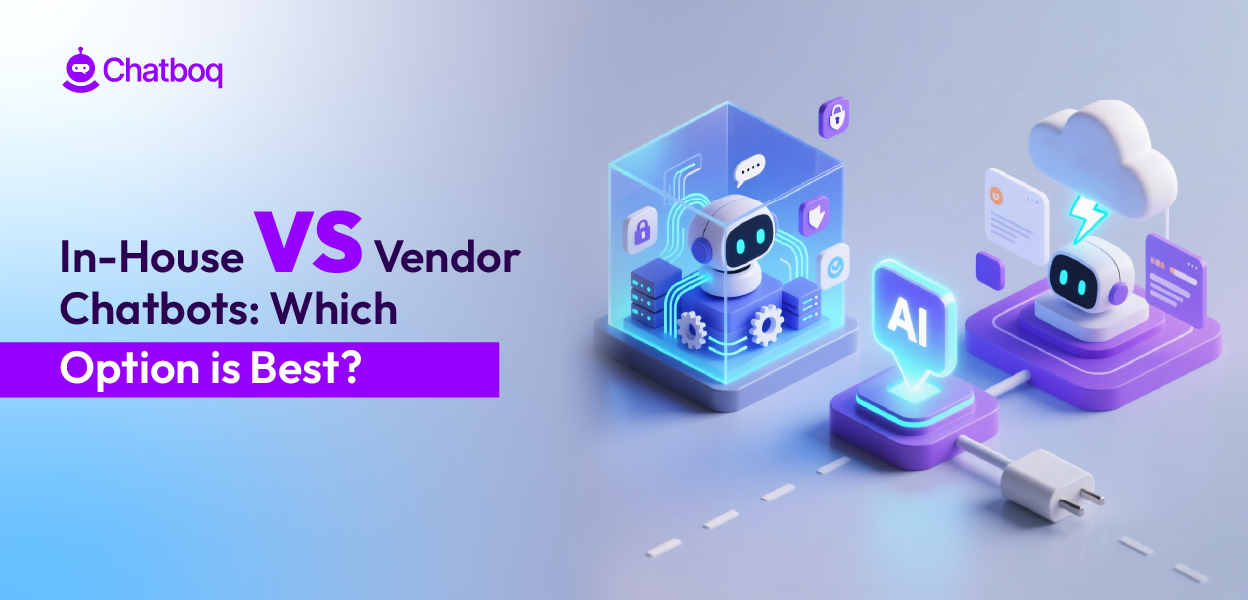
The main differences between in-house and vendor chatbots include cost, deployment speed, customization, scalability, and maintenance.
In-house chatbots offer full customization, advanced AI features, and deep CRM integration but require higher upfront chatbot development cost and technical expertise.
Comparing these factors helps choose the best enterprise chatbot solution.
Cost and ROI Comparison
When evaluating in-house versus vendor chatbots, cost and ROI are critical factors.
-
Cost Analysis: In-house chatbots require higher upfront costs for AI development and building a chatbot, whereas vendor chatbots offer predictable subscription fees. Using AI software in-house may increase efficiency but requires technical talent.
-
Cost-Benefit Analysis: While in-house solutions allow full customization and advanced generative AI capabilities, vendor chatbots provide faster deployment and lower internal resource requirements.
-
Impact on ROI: Building in-house is beneficial for businesses with high volume or complex workflows, whereas vendor chatbots allow implementing AI solutions with lower initial investment.
Automation and Lead Nurturing Capabilities
AI chatbots enhance automation, lead engagement, and customer support, using AI-driven messaging to qualify leads, respond to users, and streamline sales workflows for better ROI.
-
Role of AI-driven Messaging: In-house chatbots can leverage natural language processing and large language models to respond to user queries intelligently.
-
Customer Support Automation: Vendor chatbots provide immediate efficiency, while in-house solutions can implement highly tailored AI features.
-
Lead Engagement: Both enhance lead nurturing, but developing a chatbot in-house allows complex scoring and personalized workflows.
Integration and Maintenance Requirements
In-house chatbots offer full API and CRM integration but need ongoing maintenance and technical expertise, while vendor chatbots provide pre-built integrations with managed updates and support.
-
In-house solutions support extensive API integrations, SDKs/developer tools, and customization and integration.
-
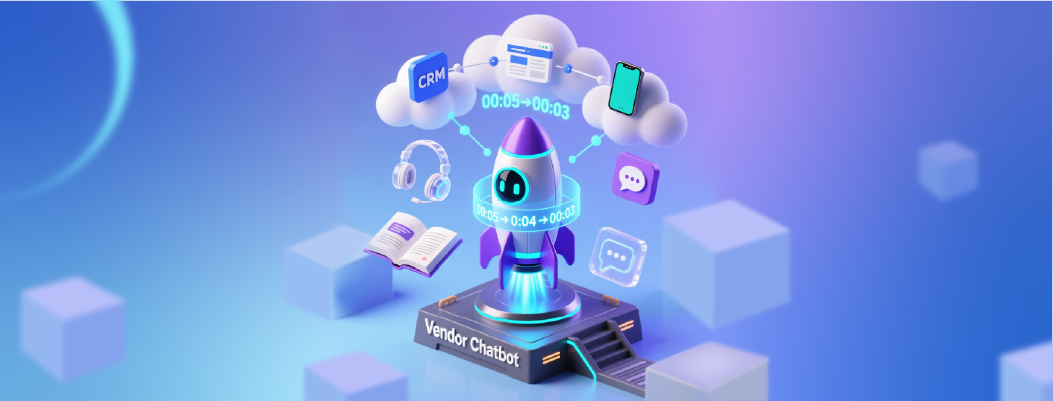
Vendor solutions are managed by the vendor, with support for launching a chatbot, updates, and AI system monitoring.
Deployment Speed & Technical Burden
Speed is rarely just about launch timelines. It determines how quickly teams can test, iterate, and generate measurable ROI. The real question is not “how fast can we go live?” but “how much internal complexity are we willing to manage?”
Vendor Chatbots
Vendor platforms typically deploy within days or weeks because infrastructure, hosting, and scaling are already provisioned. Teams configure workflows rather than architect systems. Updates, uptime monitoring, and performance scaling remain the vendor’s responsibility.
This model reduces internal dependency on engineering resources. It also shortens experimentation cycles, allowing support and sales teams to refine flows without waiting on backend development.
In-House Chatbots
In-house deployments require architectural planning, infrastructure provisioning, AI model integration, and QA validation. Conversation logic must be tested against real user scenarios before release. Ongoing scaling requires internal DevOps oversight.
While this increases complexity, it also ensures architectural independence. Teams can align chatbot systems directly with internal data structures and security frameworks.
Decision Lens:
If launch urgency and reduced engineering burden matter most, vendor solutions create momentum. If infrastructure control and system-level ownership outweigh speed, internal development becomes justifiable.
Customization Depth
Customization is not about changing button colors. It is about controlling how intelligence behaves inside workflows. The deeper the AI requirement, the more architectural flexibility matters.
In-House AI Advantages
Internal development allows teams to define model routing logic, scoring systems, and conversational constraints. AI behavior can be tuned using proprietary data. Complex workflows, such as multi-layer qualification or industry-specific compliance validation, can be embedded directly into the logic layer.
This level of control supports differentiated user experiences and long-term innovation strategies.
Vendor AI Advantages
Vendor platforms provide pre-trained NLP models, configurable automation builders, and regular AI updates. Teams can deploy intelligent routing, auto-responses, and lead qualification flows without building model pipelines from scratch.
While deep model control may be limited, the trade-off is faster implementation and lower experimentation risk.
Strategic Question:
Is chatbot intelligence a competitive differentiator, or an operational efficiency layer?
If it drives strategic advantage, deeper ownership matters. If it supports standardized automation, vendor platforms are often sufficient.
Data Ownership, Compliance & Vendor Lock-In
Data governance decisions often determine long-term flexibility. Once workflows, analytics, and user histories accumulate, migration becomes complex.
In-House Model
Internal hosting provides full control over data residency, retention policies, and audit logging. Compliance frameworks can align precisely with internal governance standards. Exit risk remains low because systems are self-managed.
This structure suits industries with strict regulatory oversight or proprietary data sensitivity.
Vendor Model
Established vendors provide certifications such as SOC 2, GDPR alignment, and encryption standards. Governance is platform-based, and compliance documentation is often readily available.
However, architectural dependency introduces migration considerations. Data portability and workflow exportability should be reviewed early.
Lock-In Risk Checklist
Before selecting a vendor, evaluate:
-
Can conversation data be exported in structured format?
-
Are workflows portable outside the platform?
-
Are APIs open and fully documented?
-
What termination clauses exist in the contract?
Reducing exit friction protects long-term flexibility.

 ChatGPT
 Perplexity
 Claude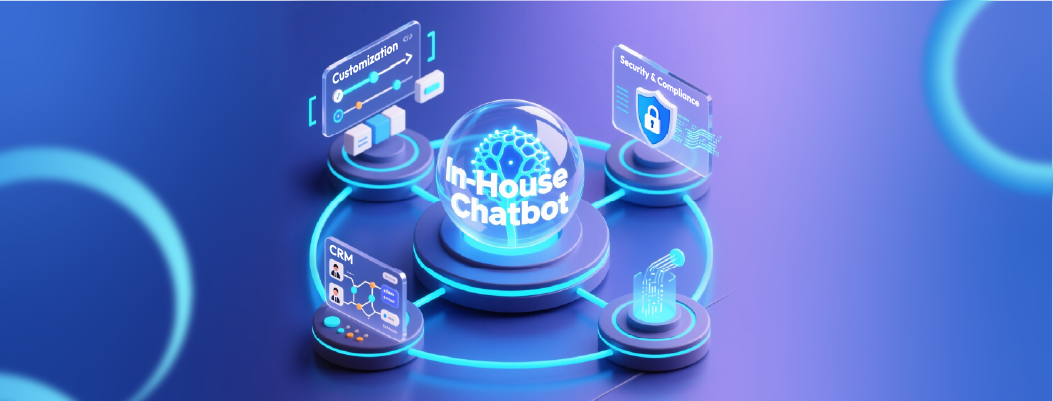



Leave a Comment
Your email address will not be published. Required fields are marked *
By submitting, you agree to receive helpful messages from Chatboq about your request. We do not sell data.