
Four definitional choices produce figures that differ by a factor of several from the same underlying conversations.
What is being timed
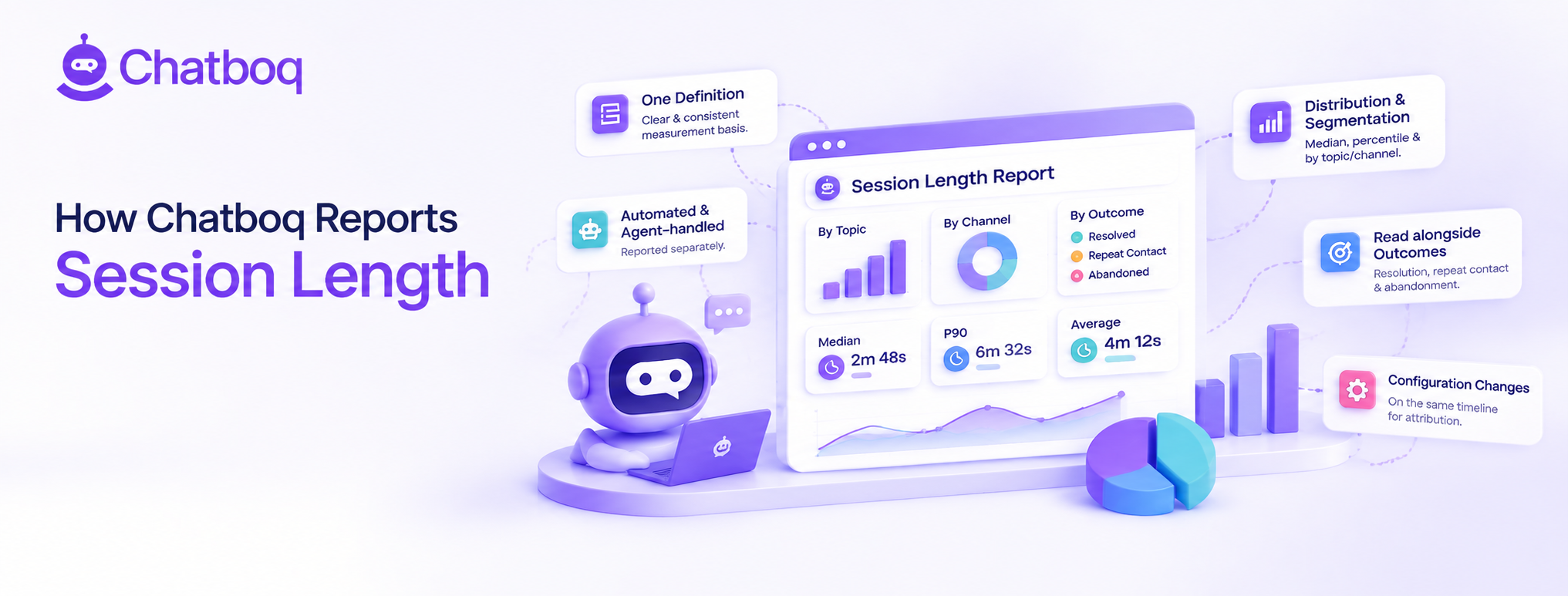
Some sources measure from first customer message to last message, others from widget open to close, and others only the agent's active handling time.
The same conversation can be several minutes by one definition and considerably longer by another, which alone explains much of the variation.
Whether idle time counts
Chat conversations contain long gaps while customers read, type or step away, and whether these count changes the figure substantially.
Wall clock duration and active handling time are different metrics that are frequently reported under the same label.
What is included
Automated conversations, abandoned sessions and widget opens with no message all pull an average in different directions depending on inclusion.
A dataset dominated by short automated resolutions produces a very different figure from one covering only agent conversations.
Whose data it is
Vendor-published benchmarks reflect that vendor's customer base, which is not a random sample of businesses and frequently skews toward a particular size or sector.
This does not make the figures wrong, but it does make them specific to a population you may not belong to.
When the figures were gathered
Benchmarks published in a given year frequently draw on data gathered considerably earlier, and chat behaviour has shifted with mobile use and automation.
Checking the collection period matters as much as the definition when reading any published figure.
 ChatGPT
 Perplexity
 Claude





Leave a Comment
Your email address will not be published. Required fields are marked *
By submitting, you agree to receive helpful messages from Chatboq about your request. We do not sell data.