
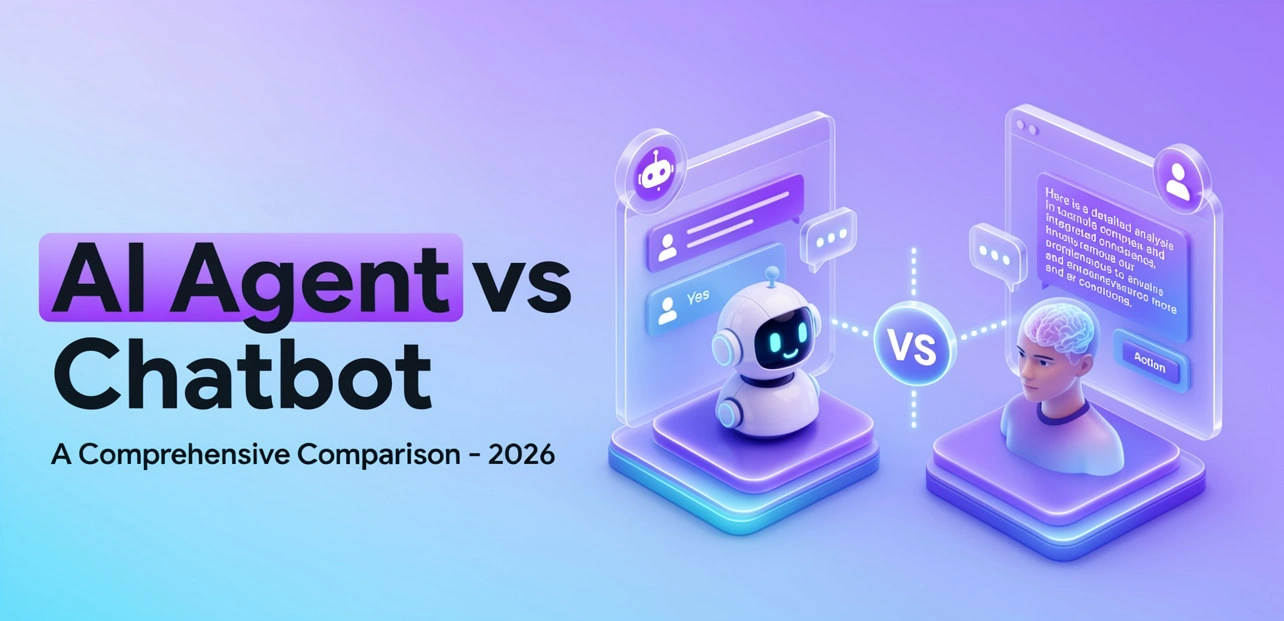
AI agents and chatbots are both conversational AI systems within enterprise automation and conversational AI ecosystems but differ in autonomy, reasoning depth, memory, tool usage, and workflow execution. Chatbots respond only to user input using rule-based logic or LLMs, making them suitable for high-volume predictable tasks like FAQs, order tracking, and basic customer support. AI agents are autonomous systems that use reasoning loops to plan and execute multi-step workflows across external tools and APIs to achieve defined goals in supported environments.
The difference goes beyond response generation into system capability. Chatbots typically rely on session-based memory and limited context handling, while AI agents extend this with persistent memory systems and vector database retrieval to maintain context across sessions. Chatbots respond to user input only, whereas AI agents can initiate actions, call APIs, and execute workflows across CRMs, databases, and enterprise systems.
AI agents also support feedback-driven adaptation through workflow outcomes, while chatbots remain static and require manual updates. This leads to clear differences in cost, scalability, security, and governance, chatbots are simpler and cheaper to deploy, while AI agents require AI orchestration frameworks, tool execution systems, and stricter permission control because they operate with autonomous execution capability. In enterprise automation and workflow automation systems, both are commonly deployed together in hybrid architectures where chatbots handle tier-1 volume and AI agents handle complex multi-step automation.
 ChatGPT
 Perplexity
 Claude


Leave a Comment
Your email address will not be published. Required fields are marked *
By submitting, you agree to receive helpful messages from Chatboq about your request. We do not sell data.