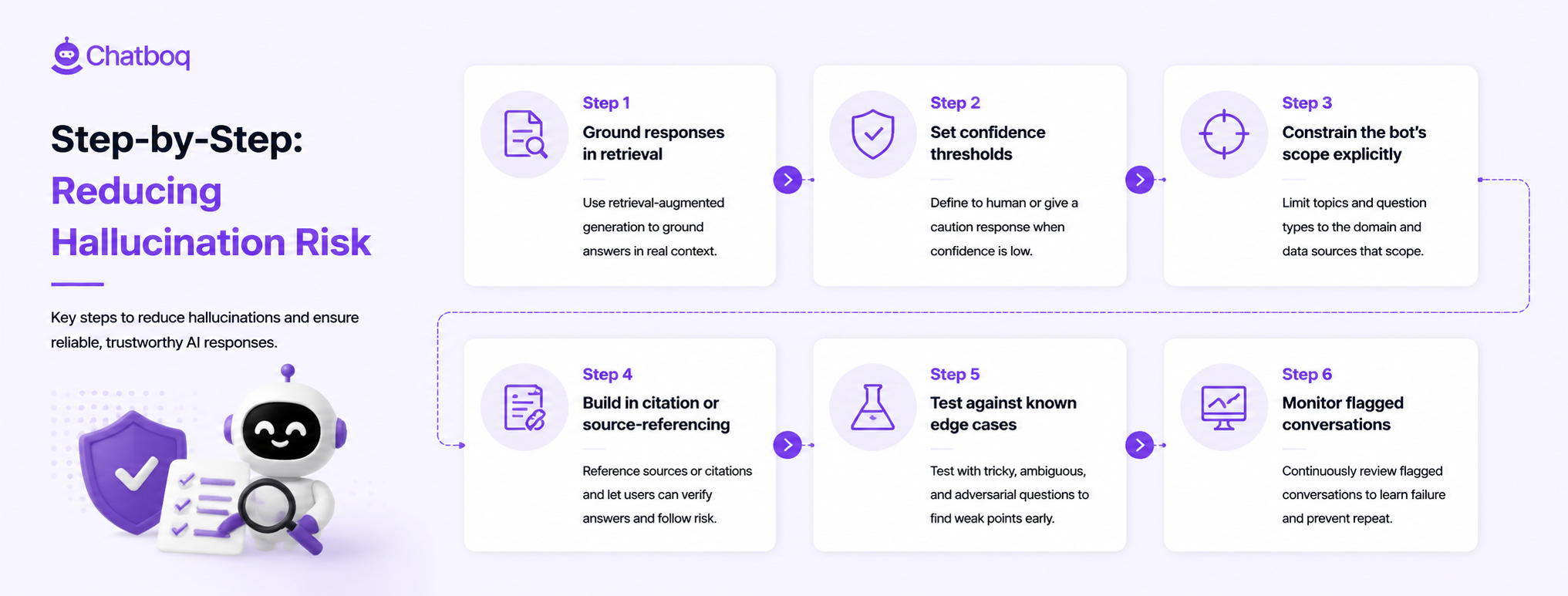
Reducing hallucination risk well involves grounding responses in genuine retrieval rather than pure open-ended generation, setting appropriate confidence thresholds that trigger a fallback when the system isn't genuinely certain, explicitly constraining the bot's scope, building in source-referencing where feasible, testing against known edge cases and adversarial prompts, and ongoing monitoring of flagged conversations for emerging hallucination patterns.
Step 1: Ground responses in retrieval, not pure generation
Building the system around retrieval-augmented generation, where responses are grounded in genuinely retrieved, real content rather than pure open-ended generation, meaningfully reduces the underlying opportunity for hallucination in the first place.
Step 2: Set confidence thresholds for fallback
Configuring the system to defer to a human or offer a cautious, hedged response whenever its own confidence in an answer falls below a defined threshold prevents it from confidently presenting a genuinely uncertain answer as fact.
Step 3: Constrain the bot's scope explicitly
Explicitly limiting what topics and question types the bot is designed to handle, and having it defer clearly outside that scope, reduces the surface area where hallucination risk is genuinely highest.
Step 4: Build in citation or source-referencing
Where feasible, having the system reference the specific source it drew an answer from gives both the customer and any reviewing human a way to verify the response, and it can also discourage the system from generating ungrounded content.
Step 5: Test against known edge cases and adversarial prompts
Deliberately testing the system against tricky, ambiguous, or adversarially crafted questions before launch surfaces hallucination-prone weak points that normal, everyday testing would likely miss.
Step 6: Monitor flagged conversations for hallucination patterns
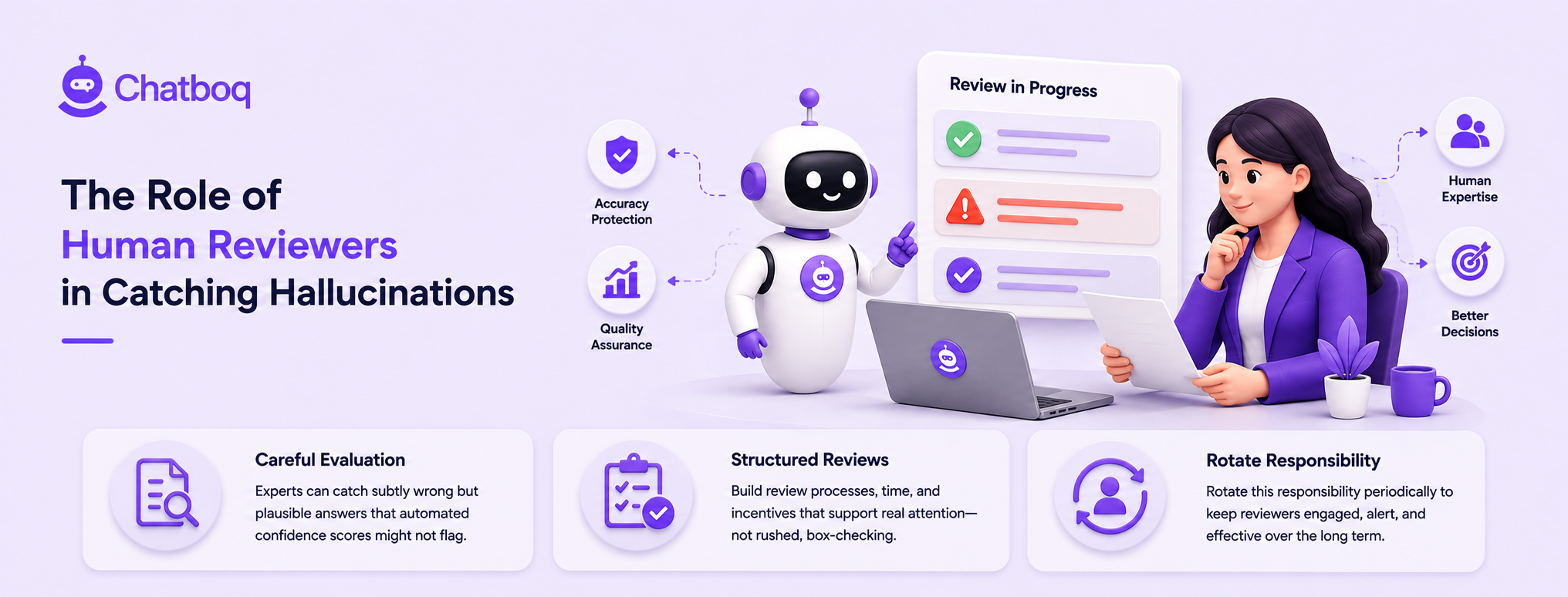
Building an ongoing process for reviewing flagged or escalated conversations specifically for hallucination patterns catches emerging issues before they accumulate into a significant, widespread problem.

 ChatGPT
 Perplexity
 Claude





Leave a Comment
Your email address will not be published. Required fields are marked *
By submitting, you agree to receive helpful messages from Chatboq about your request. We do not sell data.