
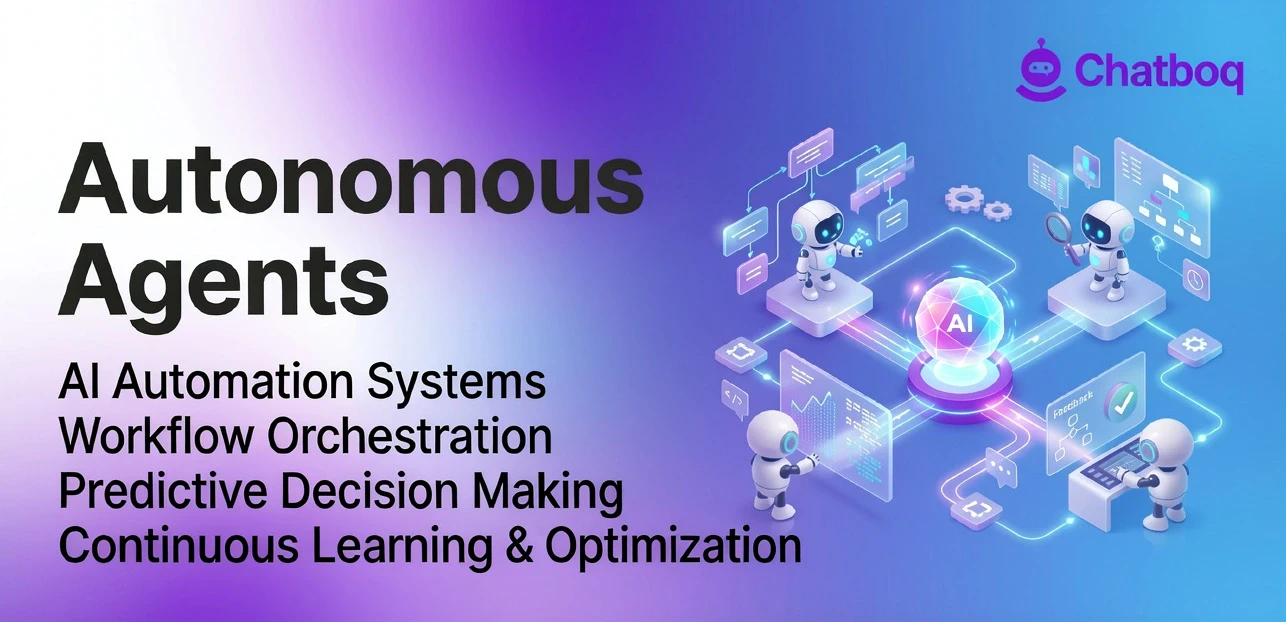
Autonomous agents are AI systems that perceive their environment, make decisions, and execute tasks without requiring step-by-step human instruction. They operate on defined goals, use reasoning models to plan a path toward those goals, and take action through tool calling, API integration, or direct system interaction. The core difference from standard automation is self-direction: the agent decides how to proceed, not just what to execute when triggered.
If you are working with AI agents, agentic AI systems, or autonomous workflows, you need to understand the AI agent architecture that makes them work. Autonomous AI agents rely on memory systems to retain context, planning algorithms to break goals into steps, and feedback loops to evaluate and correct their outputs. Frameworks like LangChain, CrewAI, and AutoGPT provide the workflow orchestration layer that connects these components into functional autonomous systems.
Autonomous agents differ from basic AI agents and other self-directed AI systems in meaningful ways. Reactive agents respond to inputs without planning. Deliberative agents plan before acting. Learning agents adapt based on outcomes. Multi-agent systems distribute tasks across multiple agents working in coordination. Knowing which type fits a given process is a prerequisite for effective deployment.
Businesses use autonomous agents to reduce manual decision-making in support operations, financial workflows, and process automation. The risks are real too: error propagation, lack of control, and security compliance gaps require careful monitoring and workflow design. Implementation requires choosing the right tools, defining workflows with clear boundaries, and building in continuous performance tracking from the start.
 ChatGPT
 Perplexity
 Claude



Leave a Comment
Your email address will not be published. Required fields are marked *
By submitting, you agree to receive helpful messages from Chatboq about your request. We do not sell data.