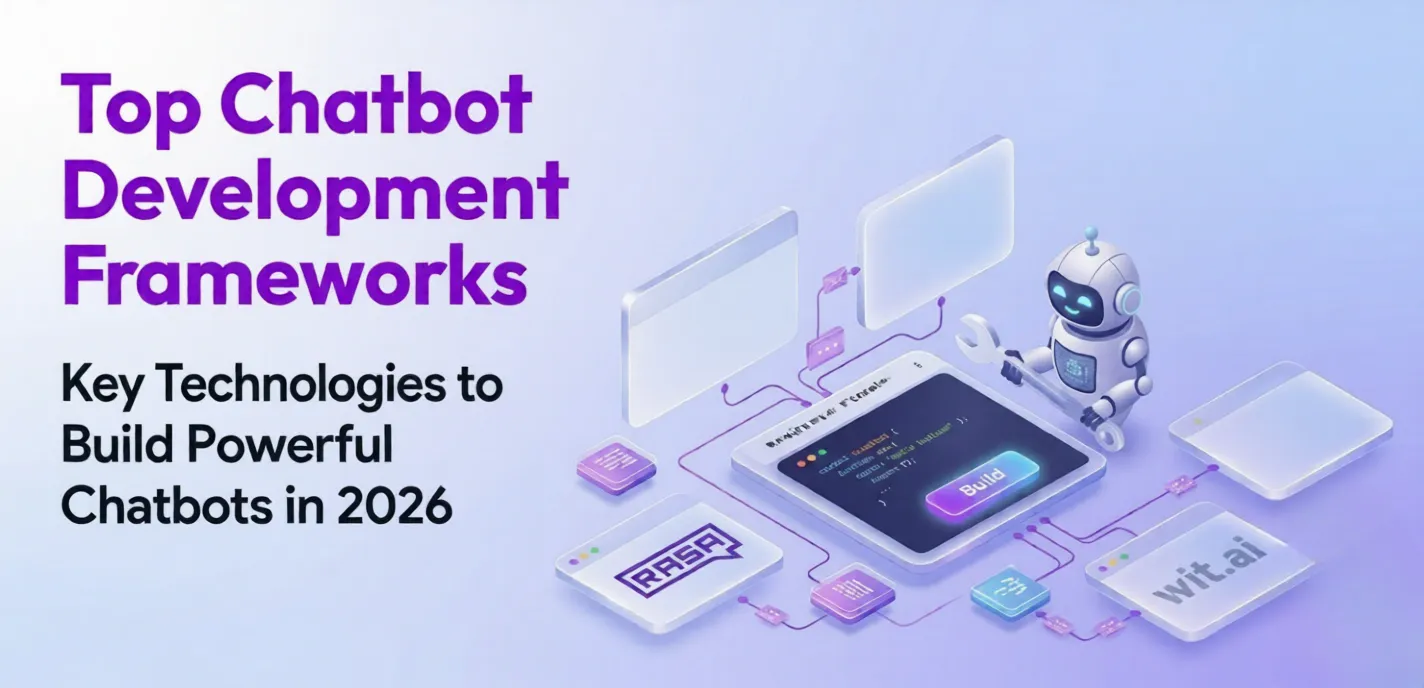
The best chatbot frameworks in 2026 include open-source (Rasa, OpenDialog), enterprise platforms (Dialogflow, Microsoft Bot Framework, Amazon Lex, IBM Watson), and low-code tools (Botpress, Voiceflow), with selection depending on whether you need full control, cloud simplicity, or fast visual development.
Rasa
Rasa is a leading open-source chatbot development framework designed for teams that need full control over their conversational AI stack, including NLU, dialogue management, and deployment infrastructure. It is widely used in enterprise and regulated environments where data privacy and customization are critical.
Key features
-
DIET classifier for intent and entity extraction
-
Full dialogue management control
-
Self-hosted or private cloud deployment
-
Enterprise extensions via Rasa Pro
Advantages
-
Maximum flexibility and customization
-
Full ownership of data and models
-
Strong compliance and privacy support
-
Highly extensible architecture
Limitations
-
Requires Python and ML expertise
-
High DevOps and infrastructure overhead
-
Longer initial setup time
Best use cases
-
Enterprise customer support automation
-
Regulated industries (finance, healthcare)
-
On-premise chatbot deployments
Ideal users
Google Dialogflow
Google Dialogflow is a managed conversational AI platform that provides strong natural language understanding with visual conversation design tools. It is widely adopted for scalable customer support systems and integrates tightly with Google Cloud services.
Key features
-
Cloud-hosted NLU engine
-
CX/ES visual flow builders
-
Prebuilt agents and templates
-
Google Cloud integration ecosystem
Advantages
-
Strong intent recognition accuracy
-
Fully managed infrastructure
-
Easy scalability in cloud environments
-
Fast deployment with low setup effort
Limitations
Best use cases
Ideal users
Microsoft Bot Framework
Microsoft Bot Framework is a developer-focused conversational AI framework that enables building multi-channel chatbots integrated with Azure and Microsoft 365 ecosystems. It is commonly used for enterprise-grade internal and customer-facing assistants.
Key features
-
Multi-channel SDK (C#, JavaScript, Python)
-
Azure Bot Service deployment
-
Azure OpenAI integration
-
Teams and enterprise identity support
Advantages
-
Deep Microsoft ecosystem integration
-
Strong enterprise security and identity management
-
Highly scalable architecture
Limitations
-
High development complexity
-
Requires strong coding expertise
-
Longer development cycles
Best use cases
Ideal users
Amazon Lex
Amazon Lex is an AWS-native conversational AI service that provides speech and text-based interaction capabilities with deep integration into AWS services like Lambda and DynamoDB.
Key features
Advantages
-
Seamless AWS ecosystem integration
-
Strong scalability and reliability
-
Voice and chatbot support
Limitations
Best use cases
Ideal users
IBM Watson Assistant
IBM Watson Assistant is an enterprise-grade conversational AI platform built for regulated industries that require strong compliance, explainability, and structured dialogue management.
Key features
-
Advanced NLU with disambiguation
-
Industry-specific models
-
On-premise and hybrid deployment
-
Enterprise governance tools
Advantages
Limitations
Best use cases
-
Healthcare systems
-
Financial services
-
Government applications
Ideal users
Botpress
Botpress is a hybrid chatbot framework combining a visual conversation builder with open-source flexibility and modern LLM capabilities, making it suitable for both technical and semi-technical teams.
Key features
Advantages
-
Fast development with low-code tools
-
Supports modern LLM workflows
-
Flexible deployment options
Limitations
-
Less mature than enterprise platforms
-
Requires configuration for scaling
-
Limited deep enterprise governance features
Best use cases
-
SaaS support bots
-
SMB automation
-
Multi-channel chatbots
Ideal users
Voiceflow
Voiceflow is a visual conversation design platform focused on enabling designers and product teams to build conversational experiences across voice and chat channels without heavy coding.
Key features
-
Drag-and-drop flow builder
-
Voice and chat support
-
Prototype-to-production workflow
-
Collaboration tools for teams
Advantages
-
Extremely easy to use
-
Fast prototyping cycles
-
Strong UX design focus
Limitations
Best use cases
Ideal users
-
Product managers
-
UX designers
-
Non-technical teams
OpenDialog
OpenDialog is an open-source conversational AI framework designed around advanced context management and semantic conversation modeling, making it suitable for complex enterprise workflows.
Key features
-
Semantic conversation architecture
-
Multi-turn dialogue management
-
Context-aware processing
-
Enterprise deployment flexibility
Advantages
-
Strong contextual reasoning
-
Flexible conversation modeling
-
Suitable for complex workflows
Limitations
Best use cases
Ideal users
Wit.ai
Wit.ai is a lightweight cloud-based NLU service by Meta that provides intent classification and entity extraction for developers building custom conversational applications.
Key features
Advantages
Limitations
-
Not a full chatbot framework
-
No dialogue management layer
-
Limited scalability for complex bots
Best use cases
Ideal users
Xatkit
Xatkit is a model-driven chatbot framework that generates conversational systems from high-level specifications, focusing on structured and reproducible chatbot development.
Key features
-
Model-driven chatbot generation
-
Specification-based development
-
Automated code generation
-
Structured workflow design
Advantages
-
Reproducible chatbot architecture
-
Good for structured systems
-
Reduces manual coding effort
Limitations
Best use cases
-
Academic research
-
Model-driven AI systems
Ideal users
Chatbot Development Frameworks Comparison
|
Framework
|
NLP/AI Type
|
Hosting
|
LLM Integration
|
Open Source
|
|
Rasa
|
ML/NLP + LLM
|
Self-hosted
|
Yes (via CALM)
|
Yes
|
|
Dialogflow CX
|
ML/NLP
|
Google Cloud
|
Yes (Vertex AI)
|
No
|
|
Microsoft Bot Framework
|
ML/NLP + LLM
|
Azure
|
Yes (Azure OpenAI)
|
Yes (SDK)
|
|
Amazon Lex
|
ML/NLP
|
AWS
|
Yes (Bedrock)
|
No
|
|
IBM Watson Assistant
|
ML/NLP
|
IBM Cloud / On-prem
|
Limited
|
No
|
|
Botpress
|
ML/NLP + LLM
|
Self / Cloud
|
Yes
|
Yes
|
|
Voiceflow
|
Visual / NLP
|
Cloud
|
Yes
|
No
|
|
LangChain
|
LLM-native
|
Self-hosted
|
Core
|
Yes
|
|
OpenDialog
|
ML/NLP + Context-based
|
Self-hosted
|
Limited / Custom
|
Yes
|
|
Wit.ai
|
ML/NLP (NLU API)
|
Cloud
|
No (API-level only)
|
Yes (API)
|
|
Xatkit
|
Model-driven NLP
|
Self-hosted
|
Limited
|
Yes
|
Ease of development: Voiceflow and Botpress (visual builder) require the lowest technical skill. Rasa and Microsoft Bot Framework require the highest.
Scalability: Enterprise cloud platforms (Dialogflow, Amazon Lex, Watson) manage scaling automatically. Self-hosted frameworks (Rasa, Botpress) require infrastructure management at scale.
Security: IBM Watson and Rasa provide the strongest on-premise options for compliance-sensitive data. Cloud platforms require reviewing the vendor's data processing agreements against regulatory requirements.

 ChatGPT
 Perplexity
 Claude


Leave a Comment
Your email address will not be published. Required fields are marked *
By submitting, you agree to receive helpful messages from Chatboq about your request. We do not sell data.