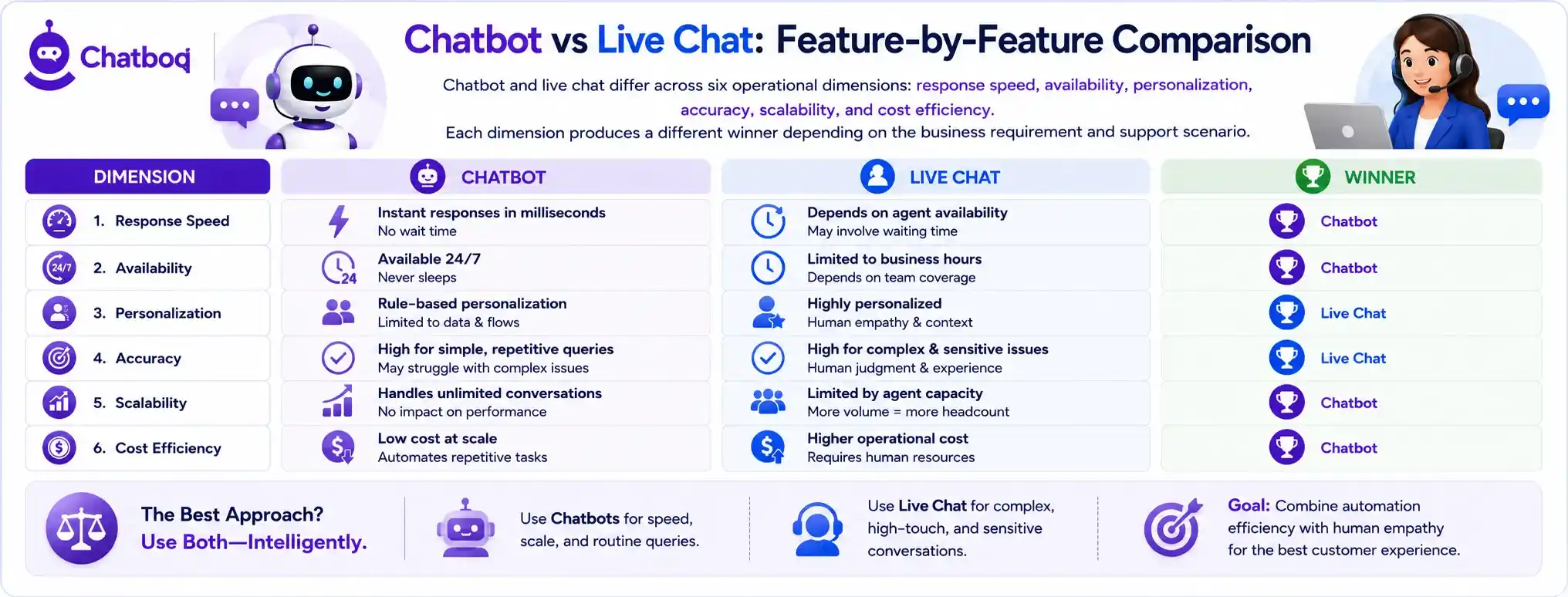
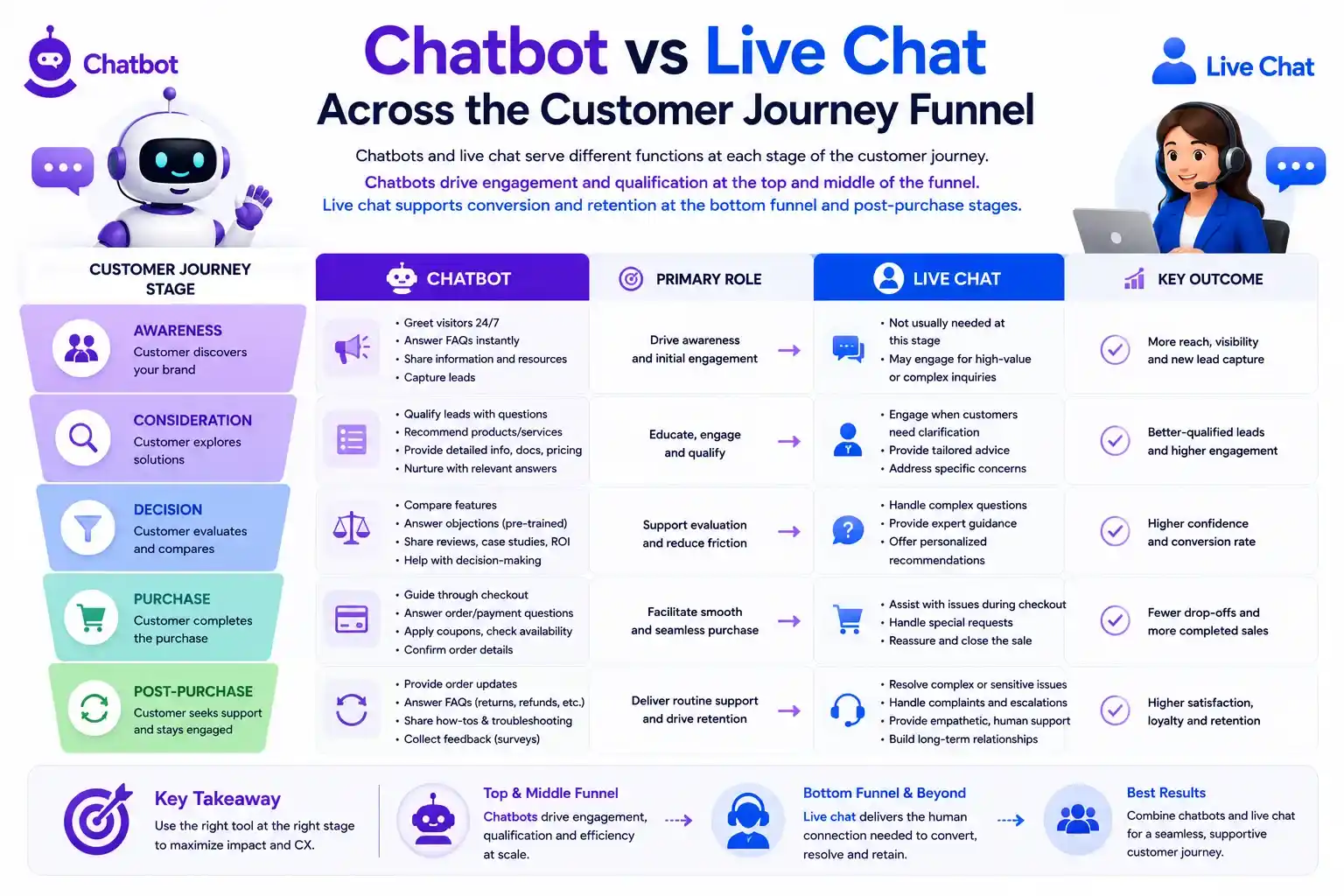
Chatbot and live chat differ across six operational dimensions: response speed, availability, personalization, accuracy, scalability, and cost efficiency. Each dimension produces a different winner depending on the business requirement and support scenario.
Response Speed
Chatbots deliver instant replies in under 1 second regardless of query volume. Live chat agents average a first response time of 45 seconds to 3 minutes depending on queue depth, agent availability, and conversation complexity.
For customers expecting immediate acknowledgment, chatbots eliminate the wait entirely. Live chat response speed degrades during peak volume because agents handle one conversation at a time. A chatbot serving 500 simultaneous conversations delivers the same response speed as a chatbot serving 1.
Winner: Chatbot. Instant automated responses outperform human response time in every volume scenario. Chatbots remove queue delays entirely for predictable queries.
Availability
Chatbots operate 24 hours a day, 7 days a week, with no staffing dependency. Live chat availability is constrained by working hours, agent schedules, time zones, and staffing capacity.
Businesses that cannot fund round-the-clock live chat staffing leave customers without support during evenings, weekends, and holidays. A chatbot deployed as an after-hours agent captures and resolves queries that would otherwise create next-day ticket backlogs.
Winner: Chatbot. 24/7 automated availability cannot be replicated by live chat without significant staffing cost. Chatbots provide consistent coverage where human agents are unavailable.
Personalization
Live chat agents personalize responses by reading emotional tone, applying contextual judgment, and adapting communication style to the individual customer. AI chatbots personalize at the data level: they use CRM attributes, past interaction history, and behavioral signals to tailor responses, but they cannot replicate human emotional intelligence.
A live agent handling a frustrated customer adjusts tone, acknowledges the frustration directly, and offers a resolution that fits the customer's specific situation. A chatbot identifies the intent category and returns a scripted or generated response that may not address the emotional dimension of the interaction.
Winner: Live Chat. Human agents produce a quality of personalization, empathy, and contextual adaptation that AI-driven chatbots cannot match in emotionally complex or high-stakes conversations.
Accuracy
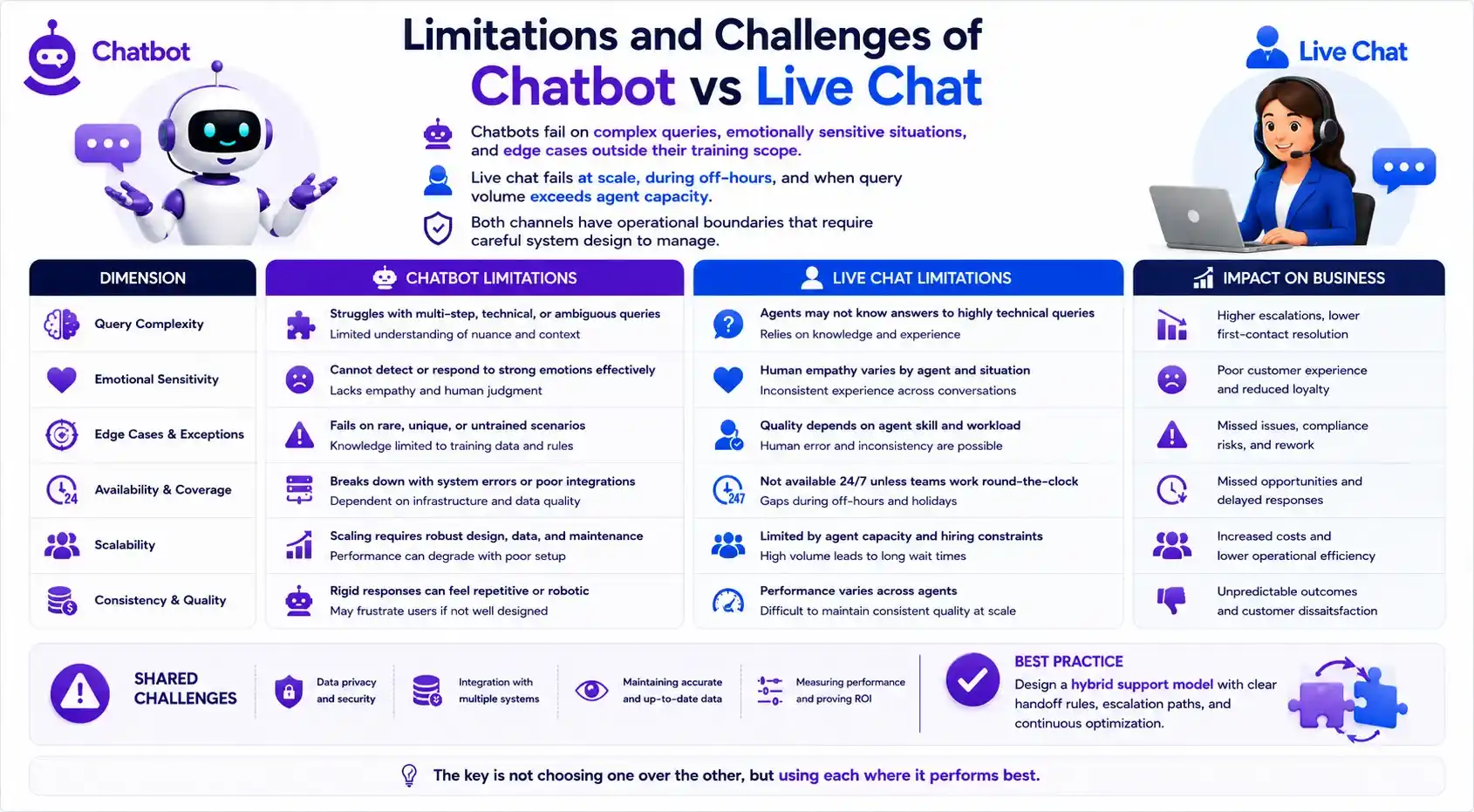
Live chat agents apply human judgment, access real-time information, and recognize when a situation falls outside standard procedure. AI chatbots produce responses based on training data and intent classification, which introduces accuracy risks for complex, multi-part, or unusual queries.
Chatbot accuracy is high for queries that fall within trained intent categories with clear, unambiguous phrasing. It degrades for edge cases, policy exceptions, or queries that require multi-step reasoning. Live chat agents make errors too, but they can recognize ambiguity, ask clarifying questions, and escalate to specialists.
Winner: Live Chat. Human judgment outperforms AI classification accuracy for complex queries, exceptions, and scenarios outside the chatbot's training distribution.
Scalability
Chatbots scale horizontally without additional cost. Adding 10,000 more conversations to a chatbot system requires no additional staffing. Live chat scales linearly with headcount: each additional agent handles an additional 3 to 5 simultaneous conversations.
A live chat operation serving 10,000 conversations per day requires 400 to 600 agent hours. A chatbot operation serving 10,000 conversations per day requires the same infrastructure as 1,000 conversations. Scalability is the strongest structural advantage of chatbot automation in high-volume support environments.
Winner: Chatbot. Automation scales without labor cost. Live chat staffing costs grow proportionally with conversation volume, making chatbots the only viable channel for high-volume, repetitive query handling.
Cost Efficiency
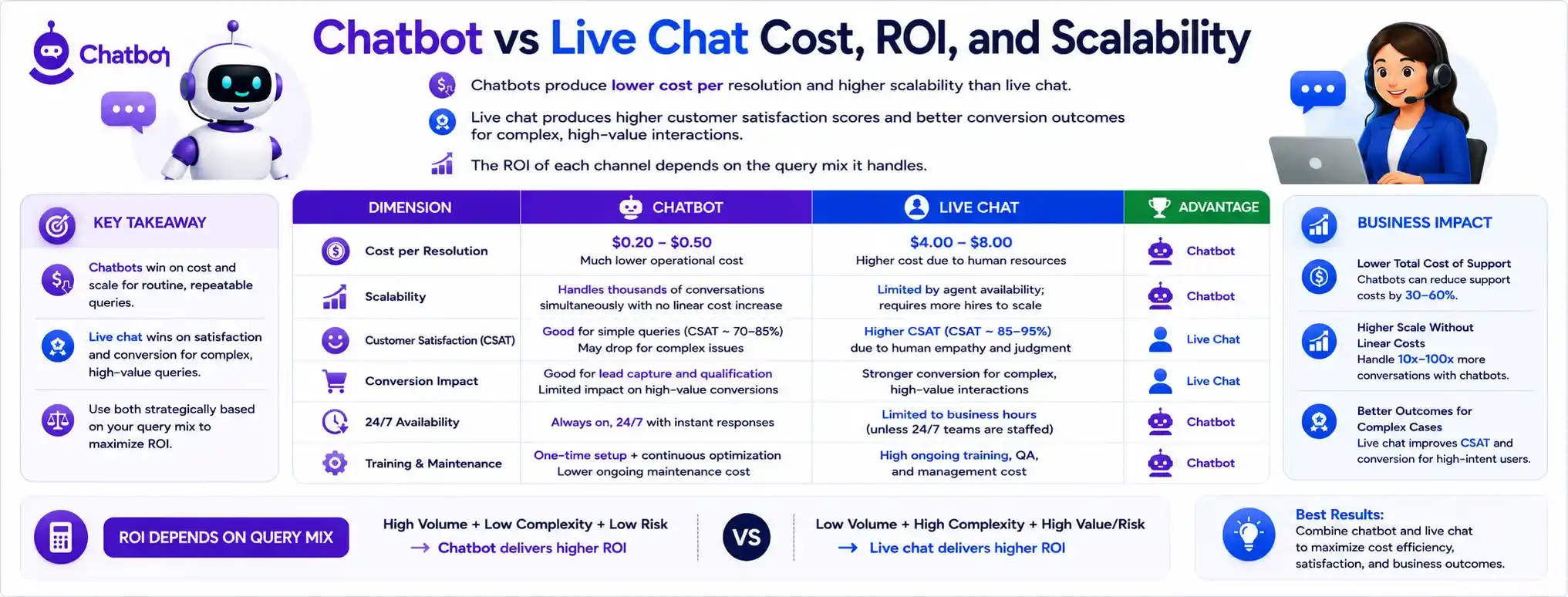
Chatbot platforms operate on SaaS subscription or usage-based pricing models, with monthly costs ranging from $50 to $500 for SMB deployments and $1,000 to $10,000 for enterprise configurations. Live chat staffing costs $3,000 to $5,000 per agent per month when fully loaded with salary, benefits, training, and management overhead.
A chatbot handling 60% of inbound query volume reduces the live chat headcount required by a proportional amount. The cost per resolution for a chatbot-handled query averages $0.10 to $0.50. The cost per resolution for a live chat interaction averages $5 to $12 depending on handle time and agent cost.
Winner: Chatbot. Cost per resolution for automated handling is 10x to 40x lower than human-handled interactions. Chatbots produce the strongest ROI for predictable, high-volume query categories.
Quick Summary Table
|
Feature
|
Chatbot
|
Live Chat
|
Winner
|
|
Response Speed
|
Instant automated replies
|
Queue-dependent responses
|
Chatbot
|
|
Availability
|
24/7 coverage
|
Business-hours dependent
|
Chatbot
|
|
Personalization
|
Behavioral personalization
|
Human empathy and judgment
|
Live Chat
|
|
Accuracy for Complex Queries
|
Limited by training scope
|
Handles exceptions and nuance
|
Live Chat
|
|
Scalability
|
Unlimited simultaneous chats
|
Requires additional agents
|
Chatbot
|
|
Cost Per Resolution
|
Very low
|
High labor cost
|
Chatbot
|
|
Best Use Case
|
FAQs and Tier 1 support
|
Complex and high-value conversations
|
Depends on scenario
|

 ChatGPT
 Perplexity
 Claude


Leave a Comment
Your email address will not be published. Required fields are marked *
By submitting, you agree to receive helpful messages from Chatboq about your request. We do not sell data.